


Tibia shaft fractures: costly burden of nonunions
- PMID: 23351958
- PMCID: PMC3573940
- DOI: 10.1186/1471-2474-14-42
Tibia shaft fractures: costly burden of nonunions
Abstract
Background: Tibia shaft fractures (TSF) are common for men and women and cause substantial morbidity, healthcare use, and costs. The impact of nonunions on healthcare use and costs is poorly described. Our goal was to investigate patient characteristics and healthcare use and costs associated with TSF in patients with and without nonunion.
Methods: We retrospectively analyzed medical claims in large U.S. managed care claims databases (Thomson Reuters MarketScan®, 16 million lives). We studied patients ≥ 18 years old with a TSF diagnosis (ICD-9 codes: 823.20, 823.22, 823.30, 823.32) in 2006 with continuous pharmaceutical and medical benefit enrollment 1 year prior and 2 years post-fracture. Nonunion was defined by ICD-9 code 733.82 (after the TSF date).
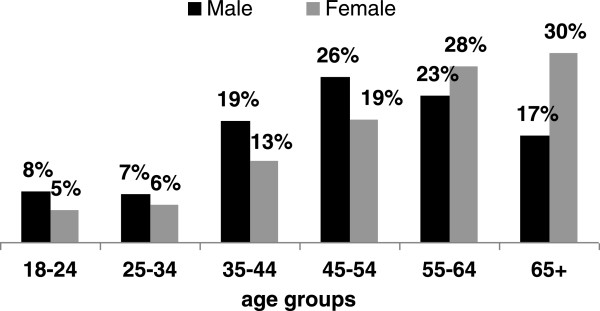
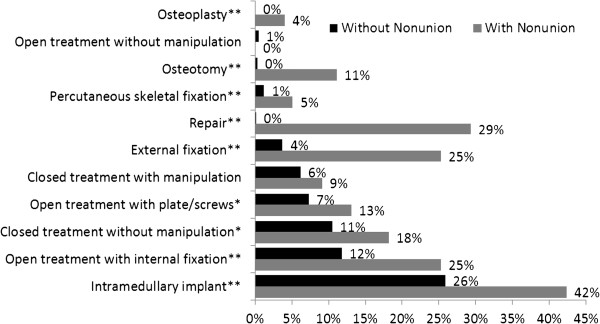
Results: Among the 853 patients with TSF, 99 (12%) had nonunion. Patients with nonunion had more comorbidities (30 vs. 21, pre-fracture) and were more likely to have their TSF open (87% vs. 70%) than those without nonunion. Patients with nonunion were more likely to have additional fractures during the 2-year follow-up (of lower limb [88.9% vs. 69.5%, P < 0.001], spine or trunk [16.2% vs. 7.2%, P = 0.002], and skull [5.1% vs. 1.3%, P = 0.008]) than those without nonunion. Nonunion patients were more likely to use various types of surgical care, inpatient care (tibia and non-tibia related: 65% vs. 40%, P < 0.001) and outpatient physical therapy (tibia-related: 60% vs. 42%, P < 0.001) than those without nonunion. All categories of care (except emergency room costs) were more expensive in nonunion patients than in those without nonunion: median total care cost $25,556 vs. $11,686, P < 0.001. Nonunion patients were much more likely to be prescribed pain medications (99% vs. 92%, P = 0.009), especially strong opioids (90% vs. 76.4%, P = 0.002) and had longer length of opioid therapy (5.4 months vs. 2.8 months, P < 0.001) than patients without nonunion. Tibia fracture patterns in men differed from those in women.
Conclusions: Nonunions in TSF's are associated with substantial healthcare resource use, common use of strong opioids, and high per-patient costs. Open fractures are associated with higher likelihood of nonunion than closed ones. Effective screening of nonunion risk may decrease this morbidity and subsequent healthcare resource use and costs.
Figures
References
-
- Praemer A, Furner S, Rice DP. Musculoskeletal conditions in the United States. Park Ridge, IL: American Academy of Orthopedic Surgeons; 1992.
-
- AHRQ (Agency for Health Care Research and Quality) Introduction to the HCUP state inpatient databases (SID). Online Manual. URL: http://hcup-us.ahrq.gov/db/state/siddist/Introduction_to_SID.pdf, Accessed 4 August 2011.
-
- Becker DJ, Yun H, Kilgore ML. et al. Health services utilization after fractures: evidence from Medicare. J Gerontol A Biol Sci Med Sci. 2010;65(9):1012–1020. - PubMed
Publication types
MeSH terms
LinkOut - more resources
Full Text Sources
Other Literature Sources
Medical
