. 2012 Sep 25;20(1):40.
doi: 10.1186/2008-2231-20-40.

Positive effect of septimeb™ on mortality rate in severe sepsis: a novel non antibiotic strategy

Affiliations

Positive effect of septimeb™ on mortality rate in severe sepsis: a novel non antibiotic strategy

Kaveh Eslami et al. Daru. .

Abstract

Background: Septimeb is a new herbal-derived remedy, recently approved for its potential immunomodulatory effects. Regarding the key role of immune system in the pathogenesis of severe sepsis and lack of any standard treatment for improving survival of these patients; we evaluated the effect of Septimeb -as an adjutant to standard treatment-on inflammatory biomarkers and mortality rates in patients with severe sepsis.

Methods: In this multicenter, randomized, single-blind trial, we assigned patients with severe sepsis and Acute Physiology and Chronic Health Evaluation (APACHE II) score of more than 20 to receive standard treatment of severe sepsis (control group) or standard treatment plus Septimeb. This group was treated with Septimeb for 14 days then followed up for another14 days. APACHE score, Sequential Organ Failure Assessment (SOFA) and Simplified Acute Physiology Score (SAPS) were calculated daily. Blood samples were analyzed for interleukin 2 tumor necrosis factor-α, total antioxidant power, platelet growth factor and matrix metalloproteinase 2.

Results: A total of 29 patients underwent randomization (13 in control group and 16 in Septimeb group). There was significant difference between the Septimeb and control group in the 14 days mortality rate (18.8% vs. 53.85 respectively, P=0.048). Compared to control group, Septimeb was significantly effective in improving SAPS (P= 0.029), SOFA (P=0.003) and APACHE II (P=0.008) scores. Inflammatory biomarkers didn't change significantly between the two groups (P>0.05).

Conclusion: Septimeb reduces mortality rates among patients with severe sepsis and it could be added as a safe adjutant to standard treatment of sepsis.


Figures
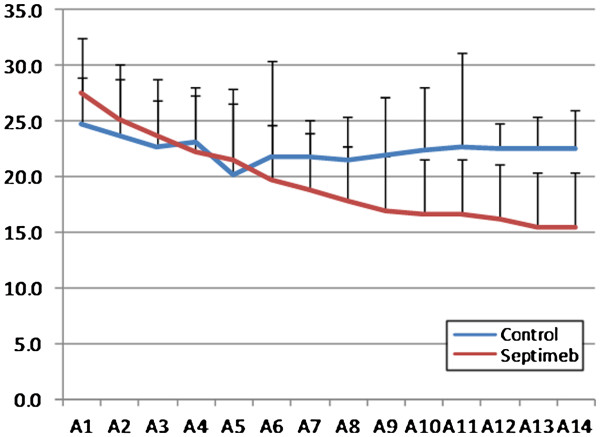
Figure 1
Figure 1
Changes of patients APACHE II score in different days of study. Difference between two groups is not significant (P= 0.266). A: APACHE (Acute Physiologic And Chronic Health Evaluation) 1–14: day 1–14.
Figure 2
Figure 2
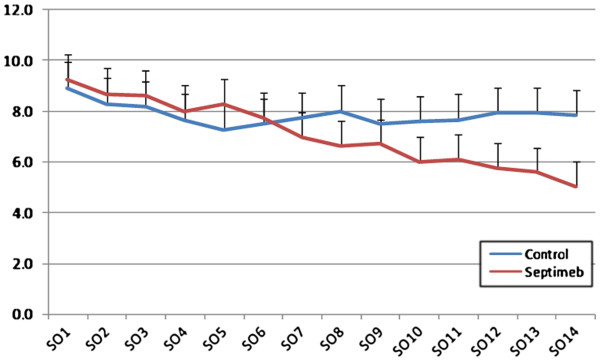
Changes of patients SOFA score in different days of study. Difference between two groups is not significant (P= 0.335). SO: SOFA (Sequential Organ Failure Assessment) 1–14: day 1–14.
Figure 3
Figure 3
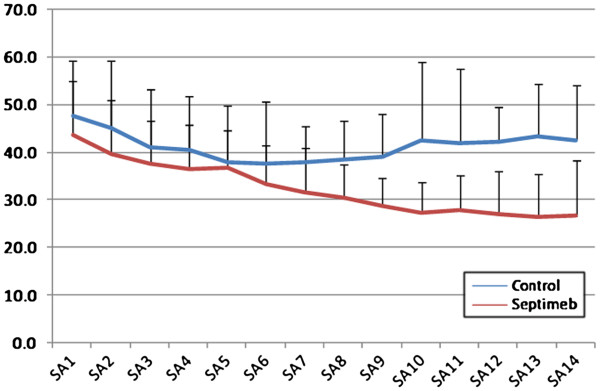
Changes of patients SAPS score in different days of study. Difference between two groups is not significant (P= 0.059). SA: SAPS (Simplified Acute Physiologic Score) 1–14: day 1–14.
Figure 4
Figure 4
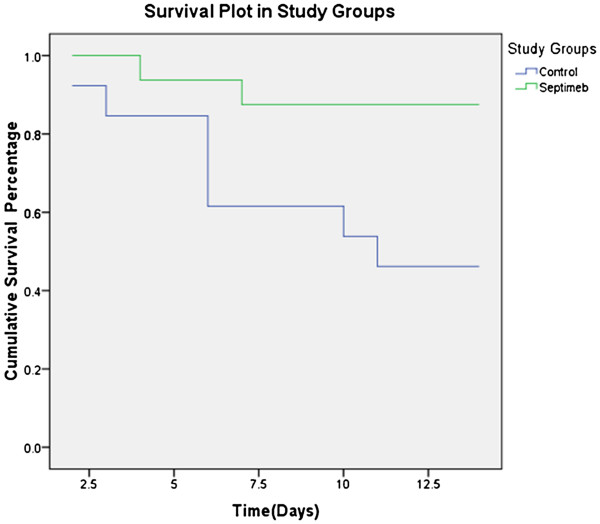
Changes of patient’s survival during study period. The differences in survival time was significant (P=0.019).
Figure 5
Figure 5
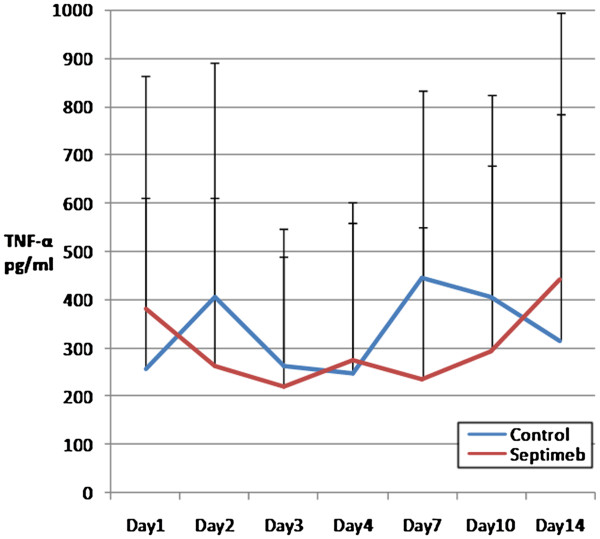
Changes in blood TNF-α level in different days of study. Data are mean ± SE. **Difference between two groups is not significant at P>0.05.
Figure 6
Figure 6
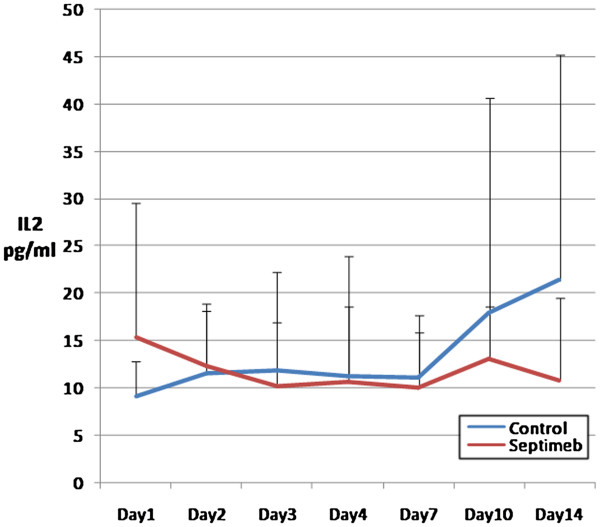
Changes in blood IL-2 level in different days of study. Data are mean ± SE. **Difference between two groups is not significant at P>0.05.
Figure 7
Figure 7
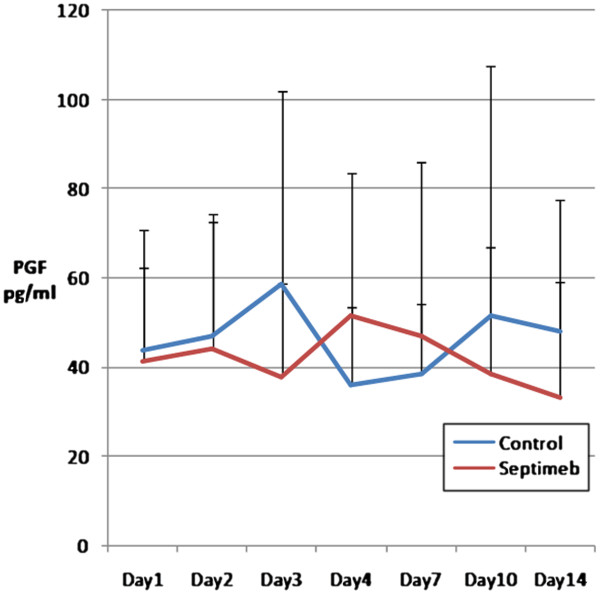
Changes in blood PGF levels in different days of study. Data are mean ± SE. **Difference between two groups is not significant at P>0.05.
Figure 8
Figure 8
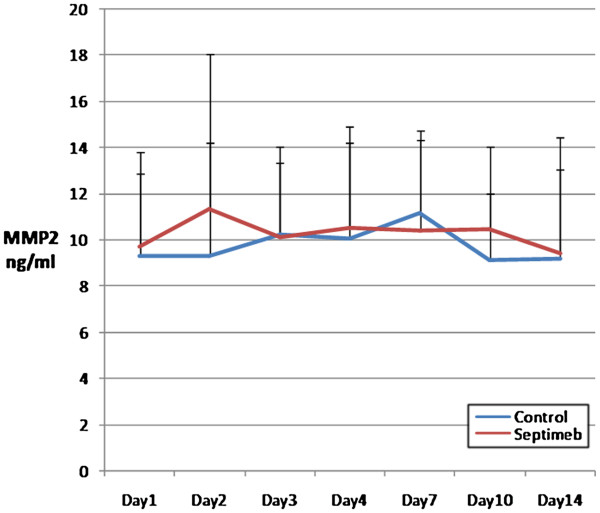
Changes in blood MMP-2 level in different days of study. Data are mean ± SE. **Difference between two groups is not significant at P>0.05.
Figure 9
Figure 9
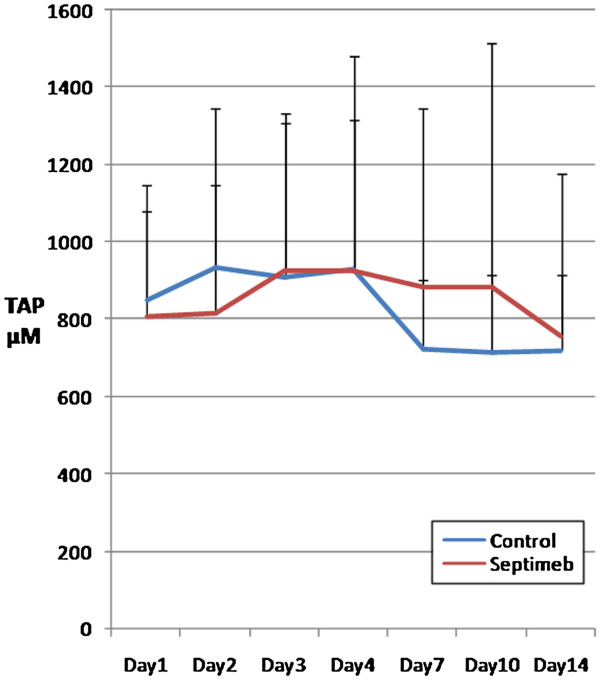
Changes in blood TAP level in different days of study. Data are mean ± SE. **Difference between two groups is not significant at P>0.05.

References

    1. Moreno RP, Metnitz B, Adler L, Hoechtl A, Bauer P, Metnitz PGH. Sepsis mortality prediction based on predisposition, infection and response. Intensive Care Med. 2008;34:496–504. doi: 10.1007/s00134-007-0943-1. - DOI - PubMed
    1. Vesteinsdottir E, Karason S, Sigurdsson SE, Gottfredsson M, Sigurdsson GH. Severe sepsis and septic shock: a prospective population-based study in Icelandic intensive care units. Acta Anaesthesiol Scand. 2011;55:722–731. doi: 10.1111/j.1399-6576.2011.02437.x. - DOI - PubMed
    1. Caille V, Bossi P, Grimaldi D, Vieillard-Baro A. [Physiopathology of severe sepsis] Presse Med. 2004;33:256–261. doi: 10.1016/S0755-4982(04)98551-X. discussion 269. - DOI - PubMed
    1. Bozza FA, Salluh JI, Japiassu AM, Soares M, Assis EF, Gomes RN, Bozza MT, Castro-Faria-Neto HC, Bozza PT. Cytokine profiles as markers of disease severity in sepsis: a multiplex analysis. Critical Care. 2007;11:R49. doi: 10.1186/cc5783. - DOI - PMC - PubMed
    1. Mousavi S, Mojtahedzadeh M, Abdollahi M. Place of iron chelators like desferrioxamine and deferasirox in management of hyperoxia-induced lung injury: A systematic review. Int J Pharmacol. 2010;6:326–337.

LinkOut - more resources