Review
. 2013 Jan 23;77(2):219-34.
doi: 10.1016/j.neuron.2013.01.002.

Vulnerable neural systems and the borderland of brain aging and neurodegeneration

Affiliations
Review

Vulnerable neural systems and the borderland of brain aging and neurodegeneration

William Jagust. Neuron. .

Abstract

Brain aging is characterized by considerable heterogeneity, including varying degrees of dysfunction in specific brain systems, notably a medial temporal lobe memory system and a frontostriatal executive system. These same systems are also affected by neurodegenerative diseases. Recent work using techniques for presymptomatic detection of disease in cognitively normal older people has shown that some of the late life alterations in cognition, neural structure, and function attributed to aging probably reflect early neurodegeneration. However, it has become clear that these same brain systems are also vulnerable to aging in the absence of even subtle disease. Thus, fundamental systemic limitations appear to confer vulnerability of these neural systems to a variety of insults, including those recognized as typical disease and those that are attributed to age. By focusing on the fundamental causes of neural system vulnerability, the prevention or treatment of a wide range of late-life neural dysfunction might be possible.


Figures

Figure 1
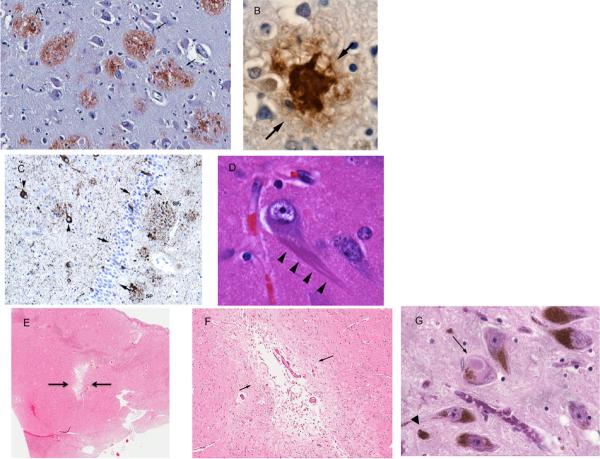
Figure 1. Neuropathology of common age-related diseases
(A) Aβ-immunostained senile plaques (arrows) (B) Magnified view of an Aβ-immunoreactive cortical senile plaque (C) Tau-immunostained section of the hippocampus showing phospho-tau immunoractive, NFT-bearing neurons (arrowheads) and the granule cell layer of the hippocampus (arrows) with some tau-immunoreactive neurons (D) Magnified view of neuron with NFTs (arrow) (E) Low magnification view of a small-vessel infarct in the basal ganglia (F) Magnified basal ganglia infarct (G) Brainstem Lewy body (arrow) and neuromelanin, some of which is extraneuronal (arrowhead).
Figure 2
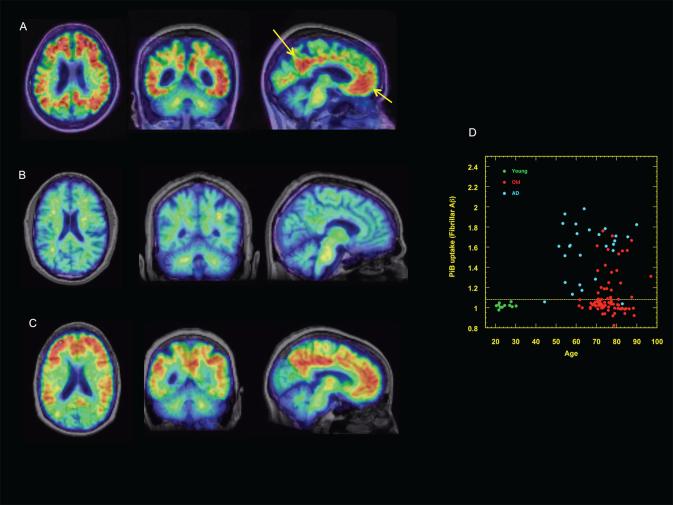
Figure 2. PET evidence of fibrillar brain Aβ deposition in normal aging
[11C]PiB-PET scans (A) A patient with AD. Hotter colors indicate tracer retention, or binding to Aβ, throughout cortex. Aβ deposition is seen throughout cortex but particularly in medial parietal and frontal regions (arrows), areas associated with the default mode network. (B) A normal older person with no evidence of brain Aβ. Cool colors indicate non-specific uptake primarily in white matter (C) A normal older person with extensive Aβ deposition in a pattern identical to that seen in AD. (D) Quantitative tracer retention by age in a group of young subjects (green), AD patients (blue), and 95 cognitively normal older people (red) from the Berkeley Aging Cohort. Y-axis is the distribution volume ratio (DVR), a quantitative index of total brain tracer retention indicating the brain fibrillar Aβ load. Dotted yellow line indicates 2 SD above the mean of young normal subjects DVR, a threshold surpassed by 28% of the older normal subjects.
Figure 3
Figure 3. Brain activation and deactivation during memory encoding
(A) Map of the topographic distribution of PiB retention in a group of older subjects. (B) Deactivation in young subjects during the succesful encoding of memories. (C) Deactivation in older individuals without PiB retention is reduced in comparison to young (D) Deactivation in older individuals with PiB retention is further reduced. The patterns of PiB retention and deactivation reflect the default-mode network (DMN). A–D from Sperling et al, 2009, with permission. (E) Pattern of activation (yellow/orange) and deactivation (blue) across all young and old subjects during encoding of scenes (F) Differences between young and old subjects in hippocampal brain activation (arrow) during succesful memory encoding, indicating reduced activation with aging (G) Same data as in (F), but shown as a function of PiB retention in the elderly, demonstrating higher activation in PiB+ elderly than young. E–G from Mormino et al, 2012, with permission.
Figure 4
Figure 4. Pathological and imaging evidence of white matter disease
Normal white matter seen on gross inspection (A) and microscopically (B). Severe white matter pallor (C) indicating rarefaction and demyelination microscopically (D). These findings are consistent with white matter hyperintensities (E) which characteristically surround the ventricles throughout subcortical white matter (arrow). These WMHs also disrupt fiber tracts, seen in (F) using diffusion tensor imaging tractography.
Figure 5
Figure 5. In vivo dopamine imaging and relationships to brain function
(A) Uptake of the dopamne synthesis tracer [18F]-fluorometatyrosine (FMT) in a normal individual. Hotter colors indicate tracer uptake in presynaptic neurons in striatum (yellow arrows) and brainstem (red arrow). (B) Correlation between performance on the listening span test, a test of working memory, and dopamine synthesis measured with FMT. Hot-colored voxels (indicated with red arrow) are regions in which greater dopamine function is associated with better working memoryAC performance in a group of older individuals. (C) Correlation of caudate dopamine synthesis with brain activation in the left middle frontal gyrus. Higher dopamine synthesis was associated with greater activation during the delay phase of a working memory task. (B and C from Landau et al, 2009, with permission). (D) Regions in which binding potential at the D1 receptor was reduced in young people performing the multi-source interference task. Reduced binding potential reflects release of endogenous dopamine. (E) Changes in binding potential by age in the same experiment as D. Younger individuals show evidence of dopamine release, while older individuals do not. D and E from Karlsson et al, 2009, with permission.
Figure 6
Figure 6. Human hippocampus in cross section and MR images
(A) Coronal cross-section of human temporal lobe. DG = dentate gryrus, S=subiculum, PrS=presubiculum, EC=entorhinal cortex, cs=collateral sulcus, FG=fusiform gyrus, its=inferior temporal sulcus, ITG=inferior temporal gyrus, mts=middle temporal sulcus, MTG=middle temporal gyrus, sts=superior temporal sulcus, STG=superior temporal gyrus. (B) Coronal MRI view indicating location of hippocampus (arrow). (C, D) High field MRI images showing hippocampus and medial temporal lobe segmented into CA3/DG (brown), CA1–2 transition (yellow), CA1 (blue), Subiculum (green) and entorhinal cortex (red).

References

    1. Aarsland D, Tandberg E, Larsen JP, Cummings JL. Frequency of dementia in Parkinson disease. Arch Neurol. 1996;53:538–542. - PubMed
    1. Aizenstein HJ, Nebes RD, Saxton JA, Price JC, Mathis CA, Tsopelas ND, Ziolko SK, James JA, Snitz BE, Houck PR, et al. Frequent amyloid deposition without significant cognitive impairment among the elderly. Arch Neurol. 2008;65:1509–1517. - PMC - PubMed
    1. Alexander GE, DeLongh RM, Strick PL. Parallel organization of functionally segregated circuits linking basal ganglia and cortex. Ann Rev Neurosci. 1986;9:357–381. - PubMed
    1. Amaral DG. Morphological analyses of the brains of behaviorally characterized aged nonhuman primates. Neurobiol Aging. 1993;14:671–672. - PubMed
    1. Amieva H, Le Goff M, Millet X, Orgogozo JM, Peres K, Barberger-Gateau P, Jacqmin-Gadda H, Dartigues JF. Prodromal Alzheimer's disease: successive emergence of the clinical symptoms. Ann Neurol. 2008;64:492–498. - PubMed

Publication types