Review
. 2012 Dec;24(6):429-35.
doi: 10.1016/j.smim.2012.12.005. Epub 2013 Jan 24.

mTOR, linking metabolism and immunity

Affiliations
Review

mTOR, linking metabolism and immunity

Xiaojin Xu et al. Semin Immunol. 2012 Dec.

Abstract

mTOR is an evolutionarily conserved serine/threonine kinase that plays a critical role in cell growth and metabolism by sensing different environmental cues. There is a growing appreciation of mTOR in immunology for its role in integrating diverse signals from the immune microenvironment and coordinating the functions of immune cells and their metabolism. In CD8 T cells, mTOR has shown to influence cellular commitment to effector versus memory programming; in CD4 T cells, mTOR integrates environmental cues that instruct effector cell differentiation. In this review, we summarize and discuss recent advances in the field, with a focus on the mechanisms through which mTOR regulates cellular and humoral immunity. Further understanding will enable the manipulation of mTOR signaling to direct the biological functions of immune cells, which holds great potential for improving immune therapies and vaccination against infections and cancer.


Figures

Figure 1
Figure 1. mTOR signaling cascade
The mTOR kinase forms two functionally distinct complexes: mTORC1 and mTORC2. mTOR senses environmental cues, including growth factors, nutrients and immune signals, through mTORC1 and mTORC2. mTORC1 controls cellular activities, such as autophagy, protein translation as well as cell growth and metabolism, while mTORC2 regulates cytoskeleton organization, cell survival as well as metabolism. Rapamycin forms complex with FKBP12 and inhibits the kinase activity of mTORC1. Inhibition of mTORC2 requires high doses or prolonged exposure. Arrows indicate activation signal whereas bars correlates to inhibition.
Figure 2
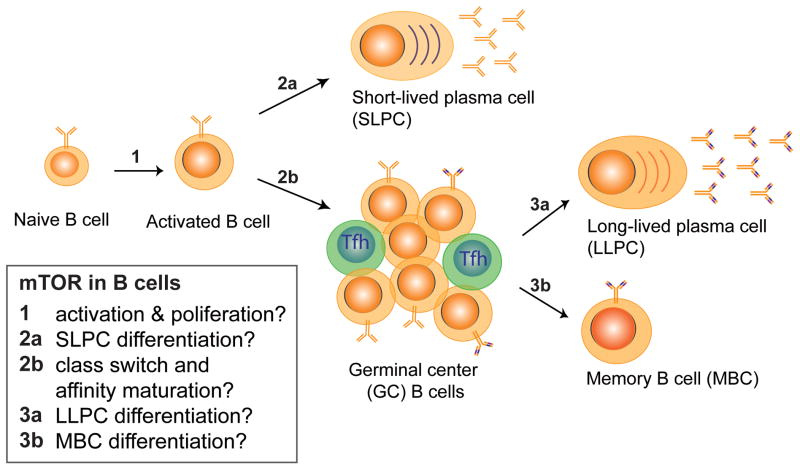
Figure 2. mTOR and B cell responses
In a T-dependent B cell response, naive B cells become activated and differentiate into either short-lived plasma cells (SLPCs) or germinal center (GC) B cells. With help from antigen-specific cognate Tfh cells, GC B cells undergo rapid proliferation and extensive somatic hypermuation, leading to the eventual differentiation of long-lived plasma cells (LLPCs) and memory B cells (MBCs). mTOR may have potential roles in integrating various immune and environmental signals in dictating different outcomes at various stages of B cell differentiation as highlighted in the boxed area.
Figure 3
Figure 3. Metabolic changes of antigen-specific CD8 T cells at various stages of response to an acute infection
Along with co-stimulatory signals, TCR signaling in engaging a cognate antigen presented by MHC-I can activate naive CD8 T cells. Naïve and memory T cells are quiescent, using mainly fatty acid oxidation and autophagy for basal levels of energy and biosynthesis. Activated T cells and effector T cells have distinct metabolic signatures. In order to meet the bioenergetic demand of subsequent clonal expansion, naïve T cells undergo metabolic reprogramming, switching from mitochondrial oxidation to glycolysis, glutominolysis and pentose phosphate pathway. During contraction phase, where effector T cells transition to become long-lived memory T cells, the metabolic program reverts from effector-like (anabolic) to memory-like (catabolic). This metabolic switch is less well characterized. It is yet to be determined if this process is immediate or gradual, and whether processes such as autophagy contribute to this transition. Green represents catabolic metabolism whilst red represents anabolic metabolism. The gray pyramid represents the level of antigen.

References

    1. Laplante M, Sabatini DM. mTOR signaling in growth control and disease. Cell. 2012;149:274–293. - PMC - PubMed
    1. Dazert E, Hall MN. mTOR signaling in disease. Curr Opin Cell Biol. 2011;23:744–755. - PubMed
    1. Thomson AW, Turnquist HR, Raimondi G. Immunoregulatory functions of mTOR inhibition. Nat Rev Immunol. 2009;9:324–337. - PMC - PubMed
    1. Laplante M, Sabatini DM. mTOR signaling at a glance. J Cell Sci. 2009;122:3589–3594. - PMC - PubMed
    1. Mamane Y, Petroulakis E, LeBacquer O, Sonenberg N. mTOR, translation initiation and cancer. Oncogene. 2006;25:6416–6422. - PubMed

Publication types

Substances