Review
. 2013 Feb;39(2):333-47.
doi: 10.1007/s10886-013-0240-0. Epub 2013 Jan 27.

Omics methods for probing the mode of action of natural and synthetic phytotoxins

Affiliations
Review

Omics methods for probing the mode of action of natural and synthetic phytotoxins

Stephen O Duke et al. J Chem Ecol. 2013 Feb.

Abstract

For a little over a decade, omics methods (transcriptomics, proteomics, metabolomics, and physionomics) have been used to discover and probe the mode of action of both synthetic and natural phytotoxins. For mode of action discovery, the strategy for each of these approaches is to generate an omics profile for phytotoxins with known molecular targets and to compare this library of responses to the responses of compounds with unknown modes of action. Using more than one omics approach enhances the probability of success. Generally, compounds with the same mode of action generate similar responses with a particular omics method. Stress and detoxification responses to phytotoxins can be much clearer than effects directly related to the target site. Clues to new modes of action must be validated with in vitro enzyme effects or genetic approaches. Thus far, the only new phytotoxin target site discovered with omics approaches (metabolomics and physionomics) is that of cinmethylin and structurally related 5-benzyloxymethyl-1,2-isoxazolines. These omics approaches pointed to tyrosine amino-transferase as the target, which was verified by enzyme assays and genetic methods. In addition to being a useful tool of mode of action discovery, omics methods provide detailed information on genetic and biochemical impacts of phytotoxins. Such information can be useful in understanding the full impact of natural phytotoxins in both agricultural and natural ecosystems.


Figures
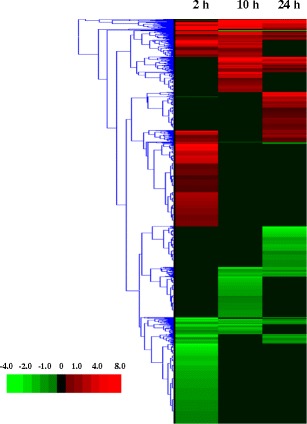
Fig. 1
Fig. 1
Hierarchical clustering of microarray data (heat map) from the analysis of Arabidopsis thaliana genes which changed expression 2, 10, 24 hr after treatment with 200 μM cantharidin. Previously unpublished data from the experiments reported by Bajsa et al. (2011a)
Fig. 2
Fig. 2
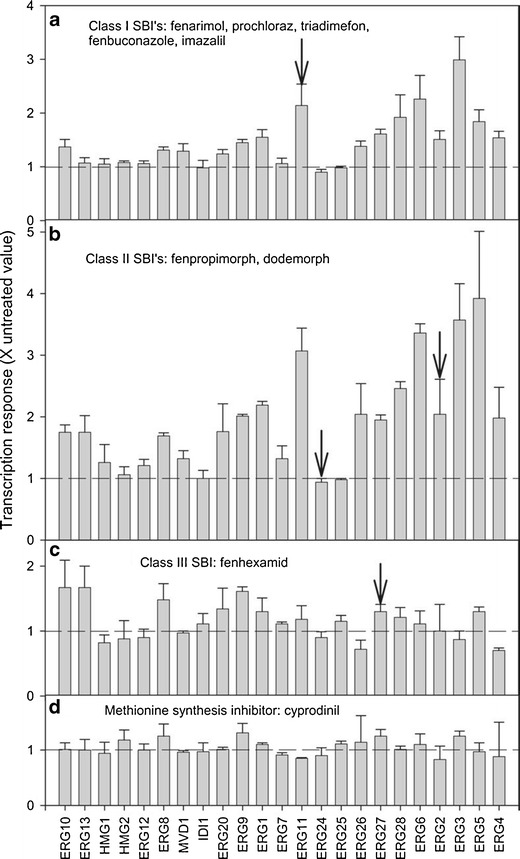
Effects of Class I (a), II (b), and III (c) sterol biosynthesis inhibitors, and a putative methionine biosynthesis inhibitor (cyprodinil, d) on expression levels of genes in the ergosterol pathway. Standard errors are shown in a and b, and standard deviations are shown in c and d. Genes are listed on the x-axis from left to right in the order in which they appear in the pathway. The transcription relative to untreated controls is shown on the y-axis. Dashed horizontal lines on the graphs indicate the level of expression at which no change is seen relative to the control. Arrows indicate gene(s) encoding enzymes targeted by each inhibitor class. Reproduced from Kagan et al. (2005)
Fig. 3
Fig. 3
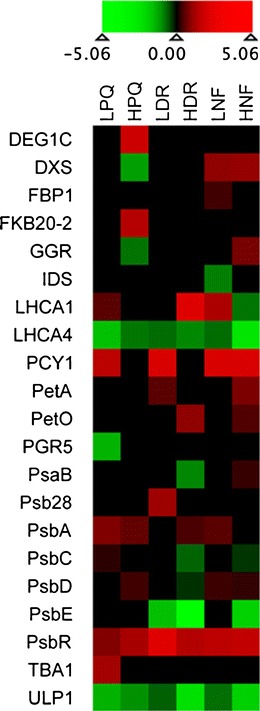
Heat map showing proteins functionally related to the photosynthetic machinery which were significantly changed in Chlamydomonas reinhardtii in response to paraquat (PQ), diuron (DR), and norflurazon (NF) at high (H) and low (L) concentrations. Statistical evaluation was performed with G-test, fold changes are presented as log 2 values. Reproduced from Nestler et al. (2012) with permission
Fig. 4
Fig. 4
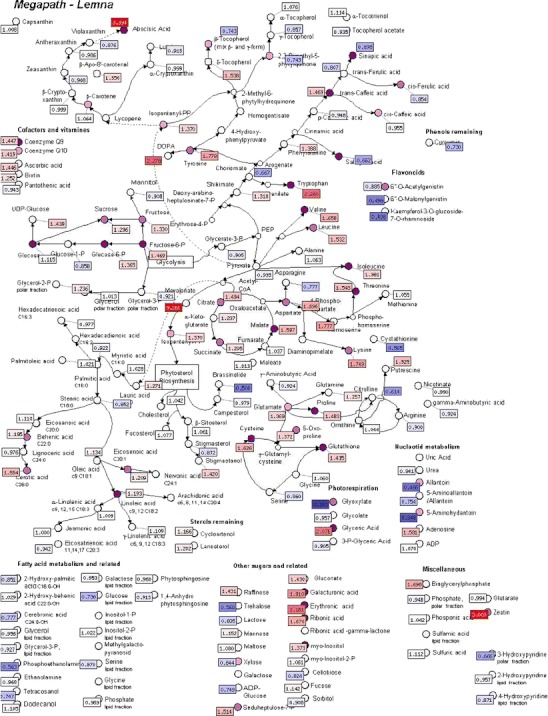
Metabolite profile of Lemna paucicostata treated with 6β-angeloyloxy-10β-hydroxyfurnoermophilane from Ligularia macrophylla. Red flags indicate increases in levels, blue flags indicate decreases in levels. Numerical ratios (treated/untreated) are given within the flags. Nodes of metabolites indicate significance of changes at P < 0.01 (dark), 0.01 < P < 0.05 (middle), or 0.05 < P < 0.1 (light) levels. We thank Klaus Grossmann of BASF SE, Limburgerhof, Germany, Charles Cantrell, of USDA, ARS, Oxford, MS, USA, and Nicole Christiansen of Metanomics, Berlin, Germany for these previously unpublished data
Fig. 5
Fig. 5
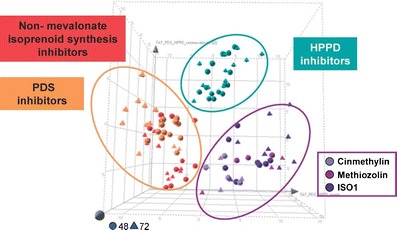
Mode of action classification by cluster analysis of metabolite changes in Lemna paucicostata 48 and 72 hr after treatment with herbicides affecting isoprenoid synthesis. Three different groupings were found using partial least squares-discriminant analysis. Phytoene desaturase (PDS), hydoxyphenylpyruvate deoxygenase (HPPD), and non-mevalonate isoprenoid synthesis inhibitor modes of action contrast with the results from cinmethylin, methiozolin, and ISO1 (see Fig. 7 for structures). From Grossmann et al. (2012a) with permission
Fig. 6
Fig. 6
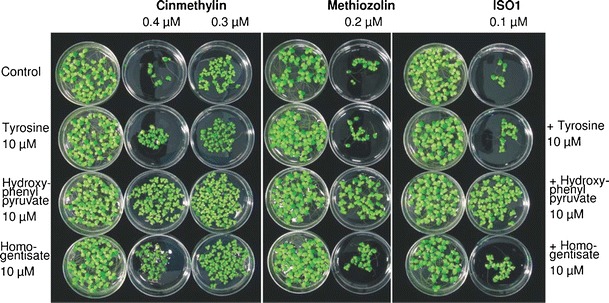
Effects of tyrosine and downstream products of tyrosine amino transferase (4-hyroxyphenylpyruvate and homogentisate) on the growth inhibition of Lemna paucicostata by cinmethylin, methiozolin, and ISO1. From Grossmann et al. (2012a) with permission
Fig. 7
Fig. 7
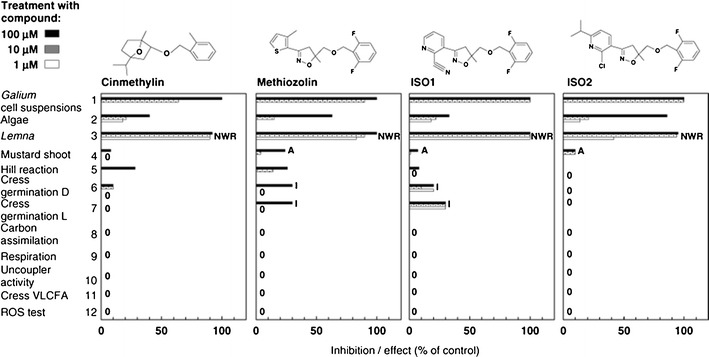
Physionomic profiles of four compounds that are apparently phytotoxic due to inhibition of tyrosine amino transferase. Bioassay abbreviations: D, dark; L, light; VLCFA, very long chain fatty acid; ROS, reactive oxygen species. Symptoms observed: A, tissue desiccation; I, root growth inhibition; N, necrosis of meristematic area; WR, intensified green leaf pigmentation. Reproduced with permission from Grossmann et al. (2012a)

References

    1. Abbas HK, Duke SO, Sheir WT, Duke MV. Inhibition of ceremide synthesis in plants by phytotoxins. In: Upadhyay RK, editor. Advances in Microbial Toxin Research and it Biochemical Exploitation. London: Kluwer Academic/Plenum; 2002. pp. 211–219.
    1. Abdallah, C., Dumas-Gaudot, E., Renaut, J., and Sergeant, K.2012. Gel-based and gel-free quantitative proteomics approaches at a glance. Int. J. Plant Genomics. 2012:Article ID 494572, 17 p. - PMC - PubMed
    1. Aliferis KA, Chysayi-Tokousbalides M. Metabolomic strategy for the investigation of the mode of action of the phytotoxin (5S,8R,13S,16R)-(1)-pyrenophorol using nuclear magnetic resonance fingerprinting. J. Agric. Food Chem. 2006;54:1687–1692. doi: 10.1021/jf0527798. - DOI - PubMed
    1. Aliferis KA, Chysayi-Tokousbalides M. Metabolomics in pesticide research and development: Review and future perspectives. Metabolomics. 2011;7:35–53. doi: 10.1007/s11306-010-0231-x. - DOI
    1. Aliferis KA, Jabaji S. Metabolomics—a robust bioanalytical approach for the discovery of the modes of action of pesticides: A review. Pestic. Biochem. Physiol. 2011;100:105–117. doi: 10.1016/j.pestbp.2011.03.004. - DOI

MeSH terms

LinkOut - more resources