


Synergism between obesity and alcohol in increasing the risk of hepatocellular carcinoma: a prospective cohort study
- PMID: 23355498
- PMCID: PMC3626057
- DOI: 10.1093/aje/kws252
Synergism between obesity and alcohol in increasing the risk of hepatocellular carcinoma: a prospective cohort study
Erratum in
-
Re: "Synergism Between Obesity and Alcohol in Increasing the Risk of Hepatocellular Carcinoma: A Prospective Cohort Study".Am J Epidemiol. 2013 Sep 15;178(6):1012. doi: 10.1093/aje/kwt206. Am J Epidemiol. 2013. PMID: 31795538 Free PMC article. No abstract available.
Abstract
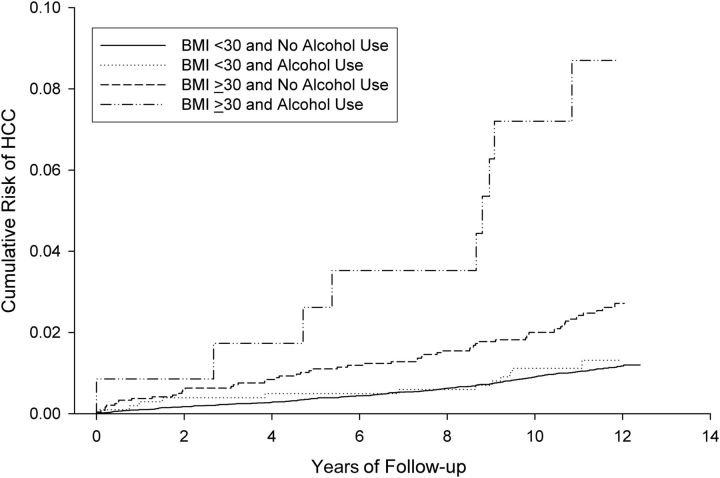
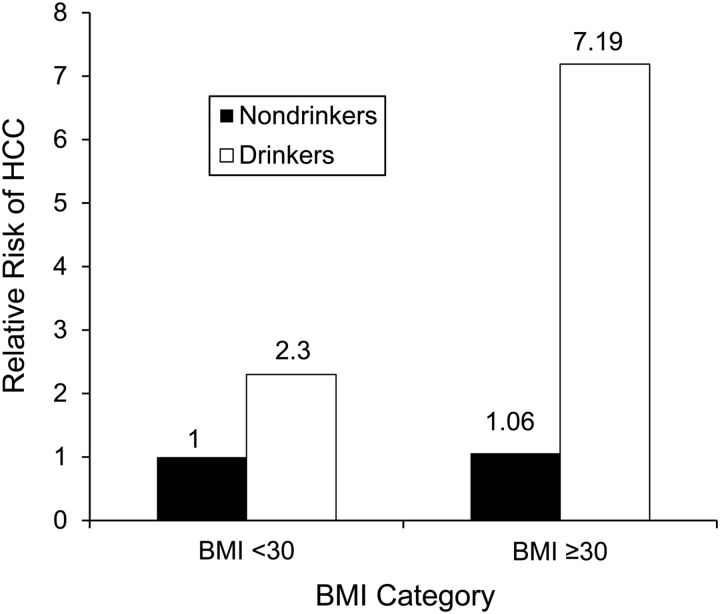
Obesity and alcohol interact to increase the risk of death from liver failure in men. In the present study, we aimed to examine whether obesity and alcohol were multiplicative or additive in increasing the risk of hepatocellular carcinoma (HCC) in both men and women. We conducted a prospective, population-based study of 23,712 Taiwanese residents (50.3% men) from 7 townships who underwent an evaluation for liver disease and were followed for 11.6 years for incident HCC. The mean age was 47 (standard deviation, 10) years and the mean body mass index (weight (kg)/height (m)(2)) was 24 (standard deviation, 3). Overall, 305 cases of HCC were identified over 275,126 person-years of follow-up. Age, male sex, alcohol drinking, cigarette smoking, elevated alanine aminotransferase, serum hepatitis B surface antigen, anti-hepatitis C virus positivity, and diabetes mellitus were each statistically significant predictors of incident HCC in univariate analyses (P < 0.05). Alcohol use and obesity (body mass index ≥30) showed a synergistic association with the risk of incident HCC in both unadjusted analyses (hazard ratio = 7.19, 95% confidence interval: 3.69, 14.00; P < 0.01) and multivariable-adjusted analyses (age, sex, smoking, serum alanine aminotransferase, serum hepatitis B surface antigen, anti-hepatitis C virus antibody, and diabetes mellitus) (hazard ratio = 3.82, 95% confidence interval: 1.94, 7.52; P < 0.01). Relative excess risks due to interaction, attributable proportion, and synergy index were 4.83, 0.67, and 4.53, respectively, suggesting a multiplicative interaction between alcohol use and obesity. Obesity and alcohol synergistically increase the risk of incident HCC.
Figures
Comment in
-
RE: "Synergism between obesity and alcohol in increasing the risk of hepatocellular carcinoma: a prospective cohort study".Am J Epidemiol. 2013 Sep 15;178(6):1010-1. doi: 10.1093/aje/kwt202. Epub 2013 Aug 28. Am J Epidemiol. 2013. PMID: 23985130 No abstract available.
-
Author reply: To PMID 23355498.Am J Epidemiol. 2013 Sep 15;178(6):1011-2. doi: 10.1093/aje/kwt205. Am J Epidemiol. 2013. PMID: 24171206 No abstract available.
References
-
- World Health Organization. The Global Burden of Disease: 2004 Update. Geneva, Switzerland: World Health Organization; 2008. (http://www.who.t/healthinfo/global_burden_disease/2004_report_update/en/.... ). (Accessed June 29, 2011).
-
- Calle EE, Rodriguez C, Walker-Thurmond K, et al. Overweight, obesity, and mortality from cancer in a prospectively studied cohort of U.C. adults. N Engl J Med. 2003;348(17):1625–1638. - PubMed
-
- Everhart JE, Ruhl CE. Burden of digestive diseases in the United States Part III: liver, biliary tract, and pancreas. Gastroenterology. 2009;136(4):1134–1144. - PubMed
-
- Yu MW, Hsu FC, Sheen IS, et al. Prospective study of hepatocellular carcinoma and liver cirrhosis in asymptomatic chronic hepatitis B virus carriers. Am J Epidemiol. 1997;145(11):1039–1047. - PubMed
Publication types
MeSH terms
Substances
Grants and funding
LinkOut - more resources
Full Text Sources
Other Literature Sources
Medical
