. 2012:13:51-68.

Current trends in negative immuno-synergy between two sexually transmitted infectious viruses: HIV-1 and HSV-1/2

Affiliations

Current trends in negative immuno-synergy between two sexually transmitted infectious viruses: HIV-1 and HSV-1/2

Aziz Alami Chentoufi et al. Curr Trends Immunol. 2012.

Abstract

In the current era of effective anti-retroviral therapy, immuno-compromised patients with HIV-1 infection do live long enough to suffer diseases caused by many opportunistic infections, such as herpes simplex virus type 1 and/or type 2 (HSV-1/2). An estimated two-third of the 40 million individuals that have contracted HIV-1 worldwide are co-infected with HSV-1/2 viruses, the causative agents of ocular oro-facial and genital herpes. The highest prevalence of HIV and HSV-1/2 infections are confined to the same regions of Sub-Saharan Africa. HSV-1/2 infections affect HIV-1 immunity, and vice versa. While important research gains have been made in understanding herpes and HIV immunity, the cellular and molecular mechanisms underlying the crosstalk between HSV-1/2 and HIV co-infection remain to be fully elucidated. Understanding the mechanisms behind the apparent HSV/HIV negative immuno-synergy maybe the key to successful HSV and HIV vaccines; both are currently unavailable. An effective herpes immunotherapeutic vaccine would in turn - indirectly - contribute in reducing HIV epidemic. The purpose of this review is: (i) to summarize the current trends in understanding the negative immuno-crosstalk between HIV and HSV-1/2 infections; and (ii) to discuss the possibility of developing a novel mucosal herpes immunotherapeutic strategy or even a combined or chimeric immunotherapeutic vaccine that simultaneously targets HIV and HSV-1/2 infections. These new trends in immunology of HSV-1/2 and HIV co-infections should become part of current efforts in preventing sexually transmitted infections. The alternative is needed to balance the ethical and financial concerns associated with the rising number of unsuccessful mono-valent clinical vaccine trials.


Figures
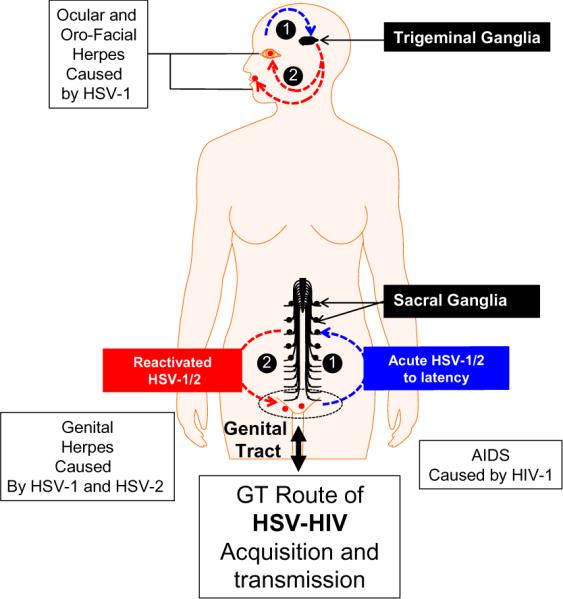
Figure 1
Figure 1. The natural routes of HSV-1/2 and HIV-1 transmission
HSV-1/2 transmitted through the genital tract (GT) replicates locally in this primary mucocutaneous genital site of infection, enters and travels along the sensory nerves to the lumbosacral dorsal root gangli a (sacral ganglia or SG) where it establishes latency. Sporadic spontaneous reactivation of HSV-1/2 from the sensory neurons of SG leads to viral shedding in the genital tract, which can cause recurrent ulcerative genital herpes (blisters). While most cases of genital herpes are caused by HSV-2, reports of HSV-1 genital infection are on the rise. HSV-1 infects the cornea or the mucocutaneous oro-facial sites and then enters and travels along the sensory nerves to the trigeminal ganglia (TG) where it establishes latency. Sporadic spontaneous reactivation of HSV-1 from the sensory neurons of TG leads to viral shedding in the tears and saliva, which can then infect the oro-facial surfaces and cause recurrent ocular (e.g. blinding herpes stromal keratitis or HSK) or oro-facial herpes (e.g. cold sores). HIV-1 is mainly acquired and transmitted through the GT and replicate locally in this primary muco-cutaneous genital site of infection.
Figure 2
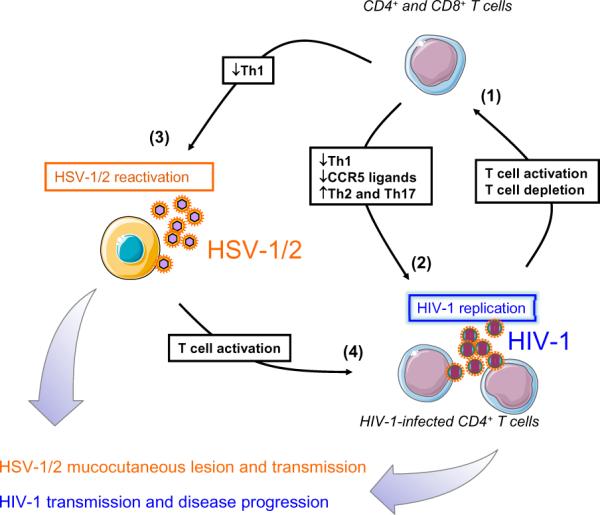
Figure 2. Schematic model of HSV-1/2 and HIV-1 cross talk, the negative HIV/HSV immuno-synergy and its impact on transmission and dissemination
(1) In HIV-infected individuals, viral replication leads to T cell activation and impairment of mainly CD4+ T cell immunity. (2) Consequently, HIV-1-infected individuals have a reduction of Th1 cytokine and CCR5 ligand secretions associated to an increase of the Th2 and Th17 response contributing to ongoing HIV-1 replication of viral reactivation from latently infected cells. (3) The negative effect of HIV-infection on the HSV-specific CD4+ and CD8+ T cell immunity may facilitate HSV-1/2 reactivations. (4) More reactivated HSV-1/2 may lead to immune evasion (e.g. interference with the antigen presenting machinery) which, in turn, enhances ongoing HIV dissemination and induces viral replication from latently infected CD4+ T cells. Thus, HSV and HIV cross talk and the apparent negative immuno-synergy leads to dramatic transmission and dissemination of both viruses.
Figure 3
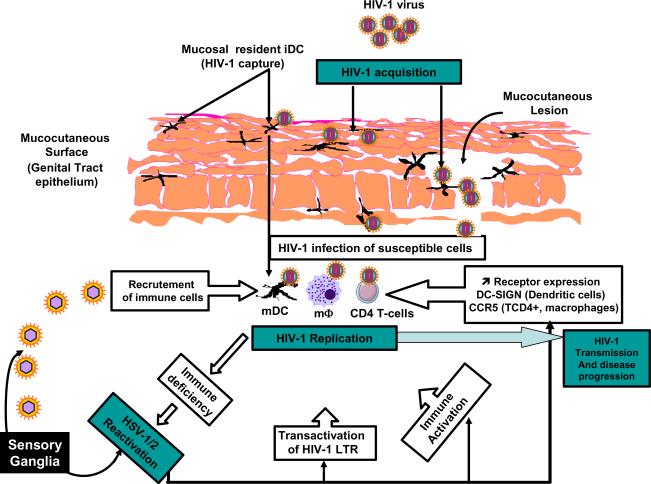
Figure 3
Illustration of the Impact of HSV infection/reactivation on HIV-1 infection, replication, transmission, and disease progression (see details in [7]).
Figure 4
Figure 4. Schematic representation of a prototype multi-epitope chimeric (bi-valent) HIV-HSV lipopeptide vaccine
Several pairs of CD4–CD8 epitopes from both HSV-1 and HIV-1 proteins are synthesized in tandem with GPGPG sequences (spacers) and covalently linked at the N-terminal with a lysine (K) that is pre-coupled with a palmitic acid moiety (PAM).
Figure 5
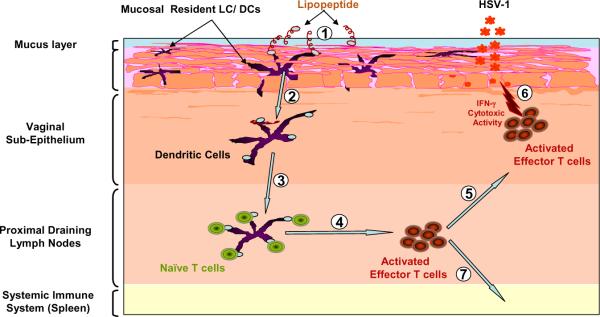
Figure 5. Illustration of mucosal (e.g. intravaginal) immunization with a mono-valent herpes lipopeptide
Lipopeptide antigens applied to intravaginal mucosal epithelium are taken up by mucosal resident APC (e.g. DC/LC), which are activated and migrate into the mucosal effector sites of the draining lymph nodes where antigen presentation to T cells occurs, resulting in subsequent local mucosal immune response.

References

    1. Zhang X, Dervillez X, Chentoufi AA, Badakhshan T, Bettahi I, BenMohamed L. The Journal of Immunololgy. 2012;189:4049. - PMC - PubMed
    1. Dervillez X, Wechsler S, Nesburn AB, BenMohamed L. Future Virology. 2012;4:371. - PMC - PubMed
    1. Dasgupta G, Chentoufi AA, Kalantari M, Falatoonzadeh P, Chun S, Lim CH, Felgner PL, Davies DH, BenMohamed L. J. Virol. 2012;86:4358. - PMC - PubMed
    1. Chentoufi AA, Kritzer E, Yu DM, Nesburn AB, BenMohamed L. Clin. Dev. Immunol. 2012;2012:187585. - PMC - PubMed
    1. Strick LB, Wald A, Celum C. Clin. Infect. Dis. 2006;43:347. - PubMed