. 2013 Jan 28;4(1):11.
doi: 10.1186/scrt159.

Effects of intravenous administration of allogenic bone marrow- and adipose tissue-derived mesenchymal stem cells on functional recovery and brain repair markers in experimental ischemic stroke

Effects of intravenous administration of allogenic bone marrow- and adipose tissue-derived mesenchymal stem cells on functional recovery and brain repair markers in experimental ischemic stroke

María Gutiérrez-Fernández et al. Stem Cell Res Ther. .

Abstract

Introduction: Stem cell therapy can promote good recovery from stroke. Several studies have demonstrated that mesenchymal stem cells (MSC) are safe and effective. However, more information regarding appropriate cell type is needed from animal model. This study was targeted at analyzing the effects in ischemic stroke of acute intravenous (i.v.) administration of allogenic bone marrow- (BM-MSC) and adipose-derived-stem cells (AD-MSC) on functional evaluation results and brain repair markers.

Methods: Allogenic MSC (2 × 10⁶ cells) were administered intravenously 30 minutes after permanent middle cerebral artery occlusion (pMCAO) to rats. Infarct volume and cell migration and implantation were analyzed by magnetic resonance imaging (MRI) and immunohistochemistry. Function was evaluated by the Rogers and rotarod tests, and cell proliferation and cell-death were also determined. Brain repair markers were analyzed by confocal microscopy and confirmed by western blot.

Results: Compared to infarct group, function had significantly improved at 24 h and continued at 14 d after i.v. administration of either BM-MSC or AD-MSC. No reduction in infarct volume or any migration/implantation of cells into the damaged brain were observed. Nevertheless, cell death was reduced and cellular proliferation significantly increased in both treatment groups with respect to the infarct group. At 14 d after MSC administration vascular endothelial growth factor (VEGF), synaptophysin (SYP), oligodendrocyte (Olig-2) and neurofilament (NF) levels were significantly increased while those of glial fiibrillary acid protein (GFAP) were decreased.

Conclusions: i.v. administration of allogenic MSC - whether BM-MSC or AD-MSC, in pMCAO infarct was associated with good functional recovery, and reductions in cell death as well as increases in cellular proliferation, neurogenesis, oligodendrogenesis, synaptogenesis and angiogenesis markers at 14 days post-infarct.


Figures
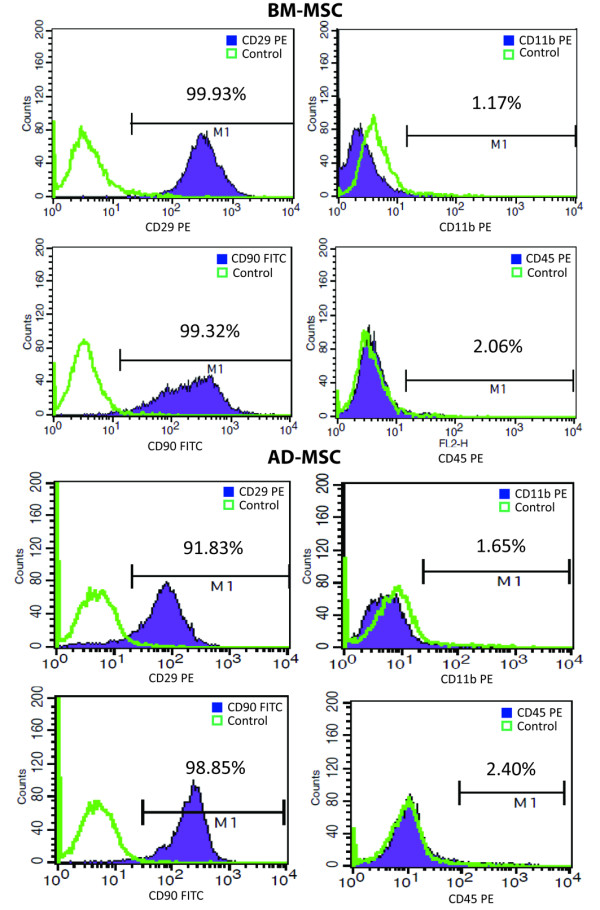
Figure 1
Figure 1
Flow cytometry characterization of bone marrow-derived mesenchymal (BM-MSC) and adipose tissue-derived mesenchymal (AD-MSC) cells before administration. Both BM-MSC (up) and AD-MSC (down) were analyzed before administration. MSC expressed markers CD29 and CD90 (left) and were negative for CD45 and CD11b. Both BM-MSC and AD-MSC showed similar results.
Figure 2
Figure 2
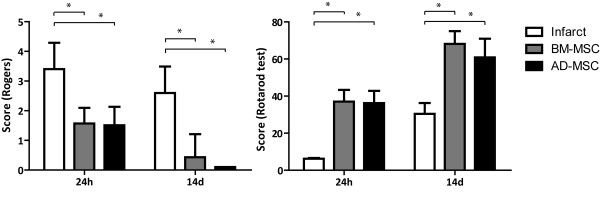
Acute intravenous (i.v.) administration of allogenic bone marrow-derived mesenchymal (BM-MSC) and adipose tissue-derived mesenchymal (AD-MSC) cells improved functional recovery at 24 h and 14 d after permanent middle cerebral artery occlusion (pMCAO). The scores in the Rogers (left) and rotarod tests (right) are shown. Both treatments significantly improved functional recovery with no differences in recovery between the two groups (BM-MSC or AD-MSC). Data are expressed as mean ± SD (n = 10); *P < 0.05.
Figure 3
Figure 3
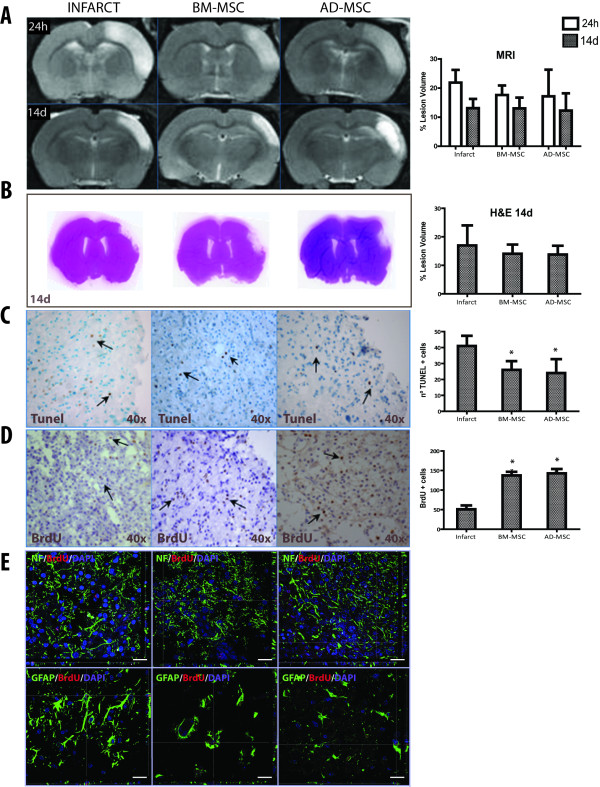
Effects of acute and allogenic intravenous (i.v.) administration of bone marrow-derived mesenchymal (BM-MSC) and adipose tissue-derived mesenchymal (AD-MSC) cells on infarct volume, cell death and cell proliferation after permanent middle cerebral artery occlusion (pMCAO). (A) Magnetic resonance imaging (MRI) showed that infarct volume was not significantly decreased after BM-MSC or AD-MSC administration. (B) H&E staining showed infarct volume was not diminished at 14 d. (C) TUNEL staining at 14 d showed cell death was diminished after BM-MSC and AD-MSC administration. (D) Cell proliferation detected by bromodeoxyuridine (BrdU) staining at 14 d was increased in the BM-MSC and AD-MSC groups. (E) BrdU co-labeling with glial fiibrillary acid protein (GFAP) and neurofilament (NF) in the infarct, BM-MSC and AD-MSC groups in the peri-infarct zone at 14 days (scale bars = 20 μm). Data are expressed as mean ± SD (n = 10); *P < 0.05.
Figure 4
Figure 4
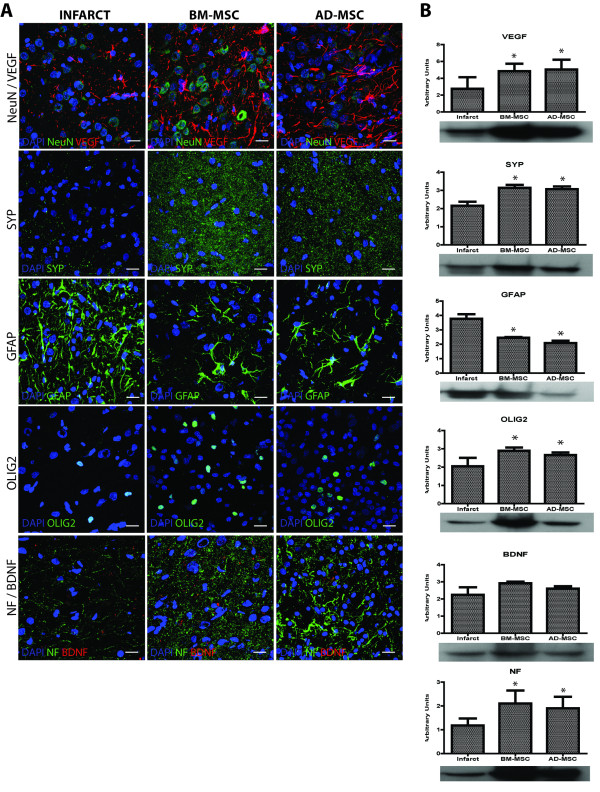
Expression of brain repair markers in the peri-infarct area at 14 d after acute intravenous (i.v.) administration of allogenic bone marrow-derived mesenchymal (BM-MSC) and adipose tissue-derived mesenchymal (AD-MSC) cells in the permanent middle cerebral artery occlusion (pMCAO) model. (A) Confocal images showing the levels of vascular epithelial growth factor (VEGF), neuronal nuclei (NeuN), synaptophysin (SYP), glial fiibrillary acid protein (GFAP), oligodendrocyte (OLIG2), brain-derived neurotrophic factor (BDNF) and neurofilament (NF) at 14 d in the infarct area after BM-MSC and AD-MSC administration (scale bars = 20 μm). (B) Western blot analysis showing that levels of VEGF, SYP, OLIG2, NF and BDNF were augmented at 14 d after BM-MSC and AD-MSC administration. The levels of GFAP were decreased in both groups. There were no significant differences in the results with respect to the cell source. Data are shown as mean ± SD (n = 3);*P < 0.05.

References

    1. Gutiérrez-Fernández M, Fuentes B, Rodríguez-Frutos B, Ramos-Cejudo J, Vallejo-Cremades MT, Díez-Tejedor E. Trophic factors and cell therapy to stimulate brain repair after ischemic stroke. J Cell Mol Med. 2012;16:2280–90. doi: 10.1111/j.1582-4934.2012.01575.x. - DOI - PMC - PubMed
    1. Stem Cell Therapies as an Emerging Paradigm in Stroke Participants. Stem Cell Therapies as an Emerging Paradigm in Stroke (STEPS): bridging basic and clinical science for cellular and neurogenic factor therapy in treating stroke. Stroke. 2009;40:510–15. - PubMed
    1. Glover LE, Tajiri N, Weinbren NL, Ishikawa H, Shinozuka K, Kaneko Y, Watterson DM, Borlongan CV. A Step-up Approach for Cell Therapy in Stroke: Translational Hurdles of Bone Marrow-Derived Stem Cells. Transl Stroke Res. 2012;3:90–98. doi: 10.1007/s12975-011-0127-8. - DOI - PMC - PubMed
    1. Savitz SI, Chopp M, Deans R, Carmichael ST, Phinney D, Wechsler L. Stem Cell Therapy as an Emerging Paradigm for Stroke (STEPS) II. Stroke. 2011;42:825–829. doi: 10.1161/STROKEAHA.110.601914. - DOI - PubMed
    1. Bliss T, Guzman R, Daadi M, Steinberg GK. Cell transplantation therapy for stroke. Stroke. 2007;38:817–826. doi: 10.1161/01.STR.0000247888.25985.62. - DOI - PubMed

Publication types

MeSH terms