


The effect of acute kidney injury on long-term health-related quality of life: a prospective follow-up study
- PMID: 23356544
- PMCID: PMC4057105
- DOI: 10.1186/cc12491
The effect of acute kidney injury on long-term health-related quality of life: a prospective follow-up study
Abstract
Introduction: Acute kidney injury (AKI) is a serious complication in critically ill patients admitted to the Intensive Care Unit (ICU). We hypothesized that ICU survivors with AKI would have a worse health-related quality of life (HRQOL) outcome than ICU survivors without AKI.
Methods: We performed a long-term prospective observational study. Patients admitted for > 48 hours in a medical-surgical ICU were included and divided in two groups: patients who fulfilled RIFLE criteria for AKI and patients without AKI. We used the Short-Form 36 to evaluate HRQOL before admission (by proxy within 48 hours after admission of the patient), at ICU discharge, hospital discharge, 3 and 6 months following ICU discharge (all by patients). Recovery in HRQOL from ICU-admission onwards was assessed using linear mixed modelling.
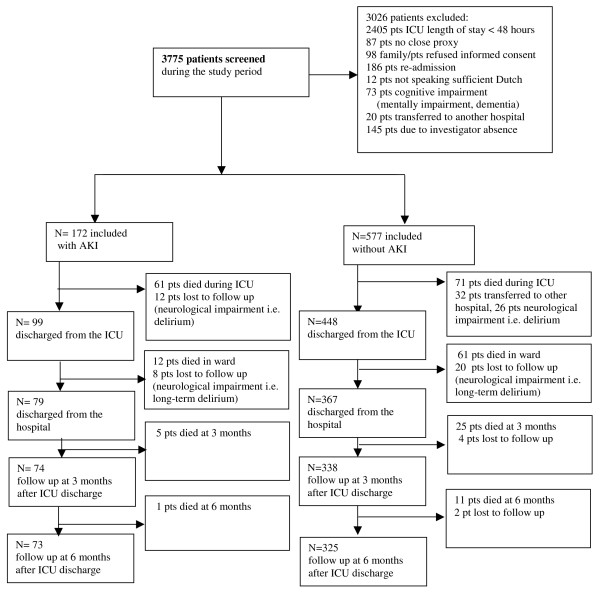
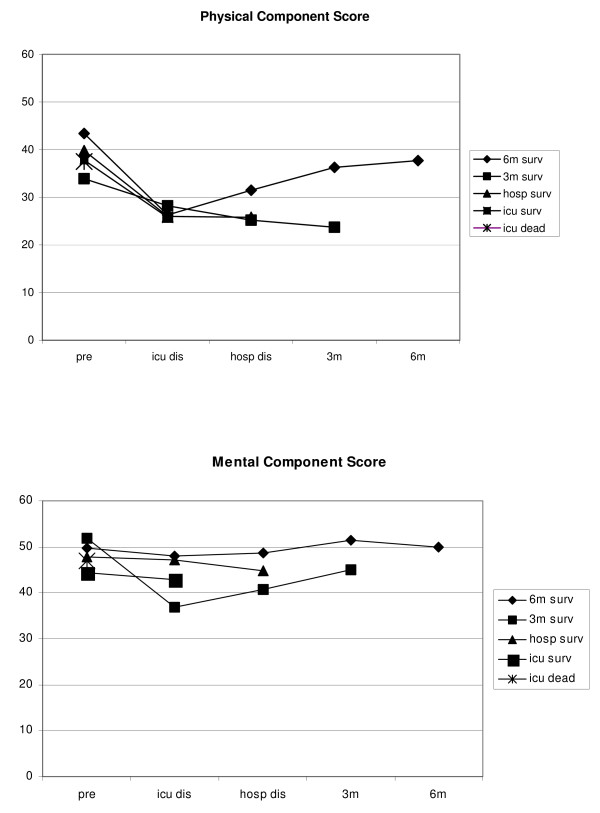
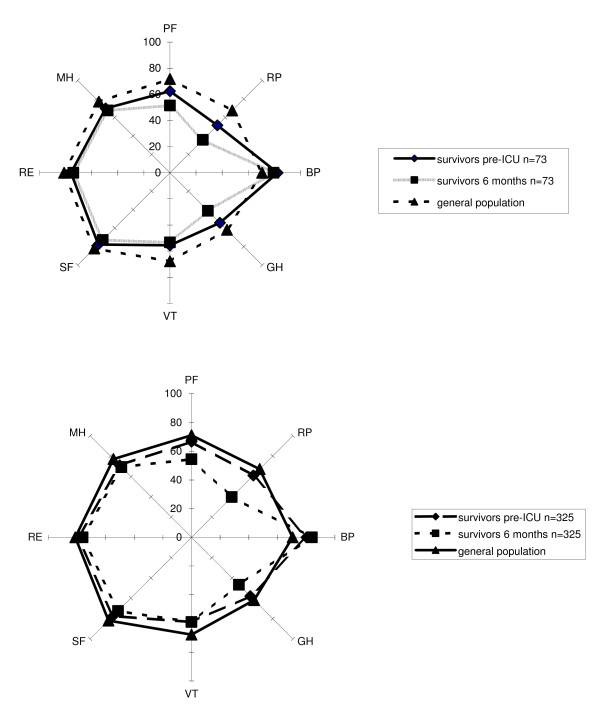
Results: Between September 2000 and January 2007 all admissions were screened for study participation. We included a total of 749 patients. At six months after ICU discharge 73 patients with AKI and 325 patients without AKI could be evaluated. In survivors with and without AKI, the pre-admission HRQOL (by proxy) and at six months after ICU discharge was significantly lower compared with an age matched general population. Most SF-36 dimensions changed significantly over time from ICU discharge. Change over time of HRQOL between the different AKI Rifle classes (Risk, Injury, Failure) showed no significant differences. At ICU discharge, scores were lowest in the group with AKI compared with the group without AKI for the physical functioning, role-physical and general health dimensions. However, there were almost no differences in HRQOL between both groups at six months.
Conclusions: The pre-admission HRQOL (by proxy) of AKI survivors was significantly lower in two dimensions compared with the age matched general population. Six months after ICU discharge survivors with and without AKI showed an almost similar HRQOL. However, compared with the general population with a similar age, HRQOL was poorer in both groups.
Figures
References
-
- Hamel MB, Phillips RS, Davis RB, Desbiens N, Connors AF Jr, Teno JM, Wenger N, Lynn J, Wu AW, Fulkerson W, Tsevat J. Outcomes and cost-effectiveness of initiating dialysis and continuing aggressive care in seriously ill hospitalized adults. SUPPORT Investigators. Study to Understand Prognoses and Preferences for Outcomes and Risks of Treatments. Ann Intern Med. 1997;17:195–202. - PubMed
Publication types
MeSH terms
LinkOut - more resources
Full Text Sources
Other Literature Sources
