Review
. 2013 Apr;16(2):207-12.
doi: 10.1016/j.mib.2013.01.003. Epub 2013 Jan 26.

Exploiting social evolution in biofilms

Affiliations
Review

Exploiting social evolution in biofilms

Kerry E Boyle et al. Curr Opin Microbiol. 2013 Apr.

Abstract

Bacteria are highly social organisms that communicate via signaling molecules, move collectively over surfaces and make biofilm communities. Nonetheless, our main line of defense against pathogenic bacteria consists of antibiotics-drugs that target individual-level traits of bacterial cells and thus, regrettably, select for resistance against their own action. A possible solution lies in targeting the mechanisms by which bacteria interact with each other within biofilms. The emerging field of microbial social evolution combines molecular microbiology with evolutionary theory to dissect the molecular mechanisms and the evolutionary pressures underpinning bacterial sociality. This exciting new research can ultimately lead to new therapies against biofilm infections that exploit evolutionary cheating or the trade-off between biofilm formation and dispersal.


Figures

Fig. 1
Fig. 1
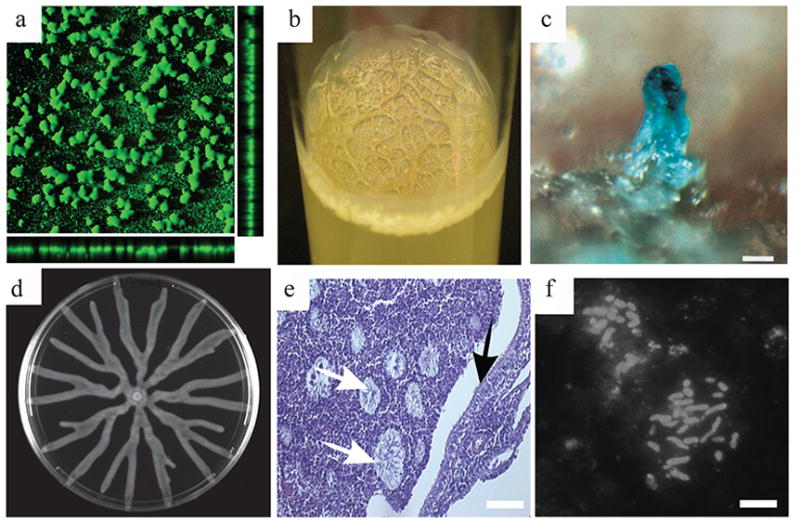
Microbial social traits. a) Vibrio cholera wild type rugose biofilm (10x magnification). b) V. cholera wild type rugose pellicle (a and b images contributed by Yildiz laboratory, UC Santa Cruz). c) A fruiting body in Bacillus subtilis (reprinted with permission from [37]). d) A Pseudomonas aeruginosa swarming colony (9 cm wide). e) P. aeruginosa macrocolonies in obstructed cystic fibrosis bronchus (reprinted with permission from [38]). f) cystic fibrosis lung P. aeruginosa macrocolonies stained with antibodies against P. aeruginosa (reprinted with permission from [38]) (scale: c-50 μm, e-100 μm, f-10 μm).
Fig. 2
Fig. 2
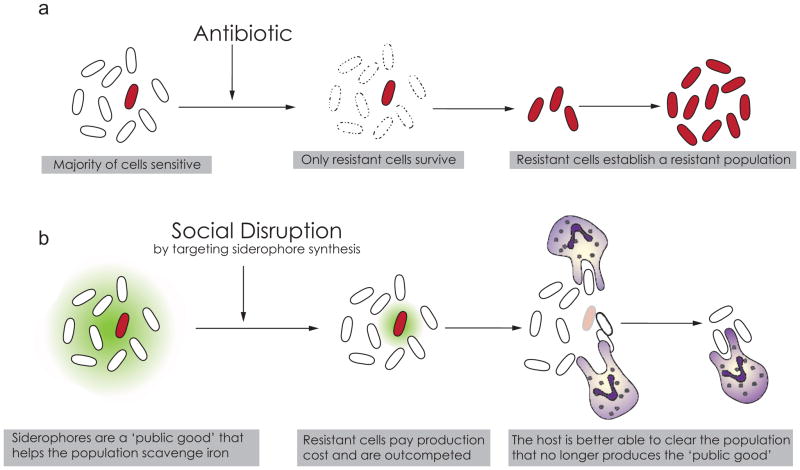
Antibiotics versus social disruption. Traditional antibiotic approaches (a) are prone to emergence of resistance. Strategies based on social evolutionary theory (b) can shift selection away from resistance allowing the immune system to clear the weakened infection.
Fig. 3
Fig. 3
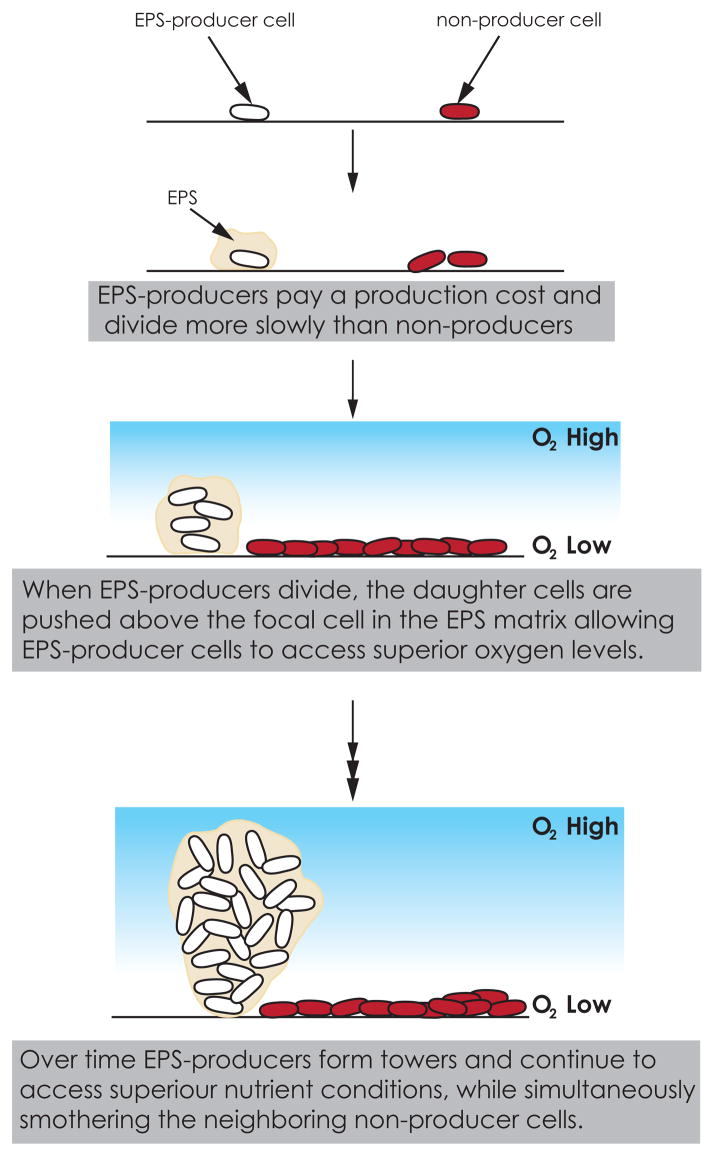
EPS-producers in biofilm competition with non-producers. Even when EPS-producers have a significantly slower growth rate than non-producers because of costly EPS production, they are able to win in direct competitions with non-producers due to their ability to access superior nutrient conditions [19, 21].
Fig. 4
Fig. 4
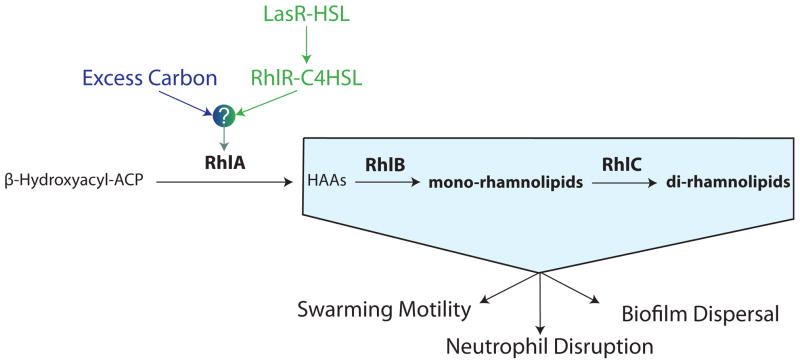
The pathway for synthesis of rhamnolipid biosurfactants in P. aeruginosa. Expression of the enzyme RhlA is the rate-limiting step for rhamnolipid synthesis [34] and implements a molecular decision-making process by which bacteria start producing rhamnolipids. The process requires the integration of quorum sensing (Las and Rhl systems) and metabolic cues [35]. The molecular details of the integration, represented here by a question mark, remain unknown.

References

    1. Costerton JW. Bacterial Biofilms: A Common Cause of Persistent Infections. Science. 1999;284(5418):1318–1322. - PubMed
    1. Greenberg EP. Microbe Magazine. ASC; 2010. Sociomicrobiology: A personal perspective on an emerging research area.
    1. Bérdy J. Thoughts and facts about antibiotics- Where we are now and where we are heading.pdf. The Journal of Antibiotics. 2012;65:441. - PubMed
    1. Jimenez PN, et al. The multiple signaling systems regulating virulence in Pseudomonas aeruginosa. Microbiol Mol Biol Rev. 2012;76(1):46–65. - PMC - PubMed
    1. Khalil AS, Collins JJ. Synthetic biology: applications come of age. Nature Reviews Genetics. 2010;11(5):367–379. - PMC - PubMed

Publication types

LinkOut - more resources