. 2013:3:1151.
doi: 10.1038/srep01151. Epub 2013 Jan 28.

Spontaneous synchronization of arm motion between Japanese macaques

Affiliations

Spontaneous synchronization of arm motion between Japanese macaques

Yasuo Nagasaka et al. Sci Rep. 2013.

Abstract

Humans show spontaneous synchronization of movements during social interactions; this coordination has been shown to facilitate smooth communication. Although human studies exploring spontaneous synchronization are increasing in number, little is known about this phenomenon in other species. In this study, we examined spontaneous behavioural synchronization between monkeys in a laboratory setting. Synchronization was quantified by changes in button-pressing behaviour while pairs of monkeys were facing one another. Synchronization between the monkeys was duly observed and it was participant-partner dependent. Further tests confirmed that the speed of button pressing changed to harmonic or sub-harmonic levels in relation to the partner's speed. In addition, the visual information from the partner induced a higher degree of synchronization than auditory information. This study establishes advanced tasks for testing social coordination in monkeys, and illustrates ways in which monkeys coordinate their actions to establish synchronization.


Figures
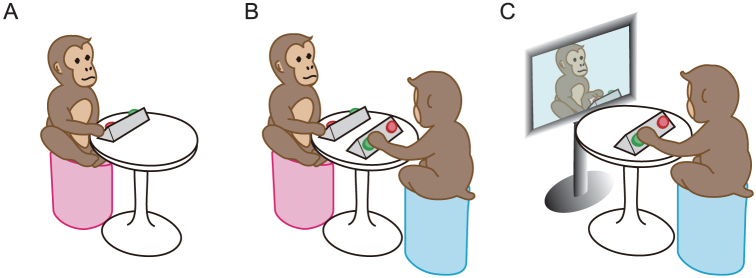
Figure 1
Figure 1. Training and experimental settings.
(A) Solo condition. Each monkey was individually trained on the BP task (‘Solo condition'). (B) Paired condition. The monkeys were tested (Test 1) in pairs immediately after learning the BP task. (C) Video play-back (vMonkey) condition. In order to manipulate the BP speed of a partner, and to control the auditory and visual characteristics of a partner, the partner was replaced by vMonkey (Tests 2 and 3).
Figure 2
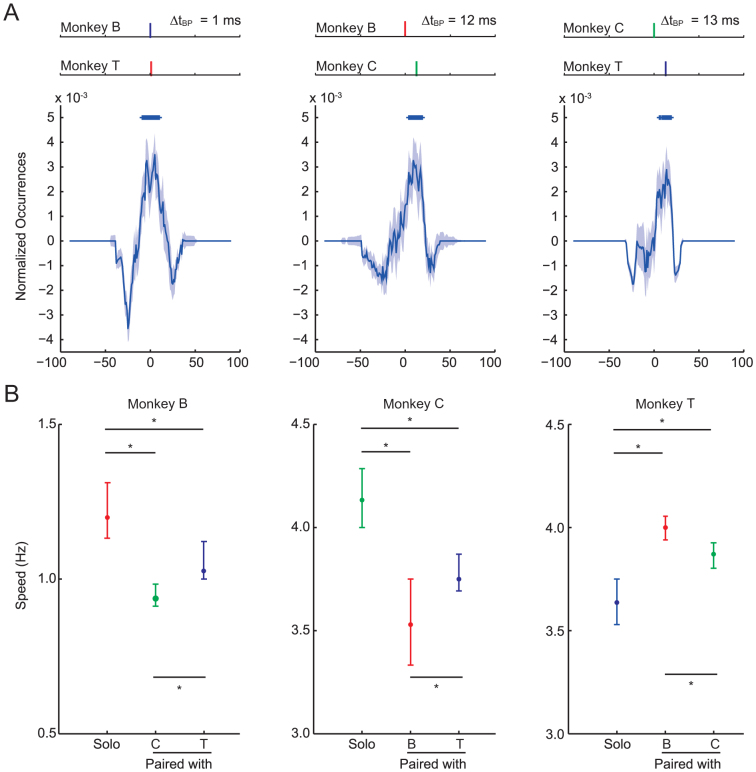
Figure 2. Synchrony, partner dependency, and harmonics in BP speed.
(A) Synchrony of BP in the Paired condition. Top panels show the time-locked structure with a fixed delay (ΔtBP) between paired monkeys for each pair. The monkey presented on top was assigned as the reference for identifying ΔtBP. ΔtBP was found at 1, 12, and 13 ms for pairs B-T, B-C, and C-T, respectively. Bottom panels show the difference of the distribution of ΔtBP calculated between real data and shuffled data for each pair. + indicates ΔtBP (p < 0.05, Wilcoxon signed-rank test with Bonferroni correction). The shaded areas show the 95% confidence interval of the median. (B) BP speeds for each monkey under Solo and Paired conditions. In the paired condition, BP speeds were partner dependent (p < 0.05, Wilcoxon signed rank test; see text for details). The BP speeds in paired monkeys were matched or close to the harmonics of the two animals (e.g., the BP speeds in Monkeys B and T were 1.0 and 4.0 Hz, respectively, when the monkeys were paired, see text for details). For all monkeys, significant differences were found between the Solo and each Paired condition (p < 0.05, Wilcoxon signed rank test see Supplementary information for details). Error bars represent the 95% confidence interval of the median.
Figure 3
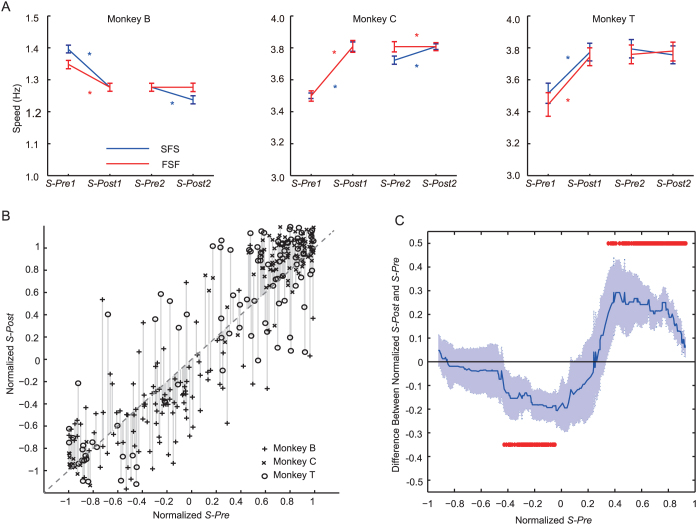
Figure 3. The change in BP speed in the monkeys before and after speed switching of vMonkey.
(A) The change in BP speed for each monkey in trial phases under each condition. The median of 10 BPs before and after of each speed-switch were compared (S-Pre1 vs. S-Post1, and S-Pre2 vs. S-Post2). The blue and red lines represent the Slow-Fast-Slow (SFS) and Fast-Slow-Fast (FSF) conditions, respectively. Asterisks represent a significant difference between before and after speed switching (p < 0.05, Wilcoxon rank-sum test; see text for details). Error bars represent the 95% confidence interval of the median. (B) The normalized S-Pre (including S-Pre1 and S-Pre2) and S-Post (including S-Post1 and S-Post2) scores for all trials. The data from different monkeys are represented with different symbols. The vertical lines represent the distances between normalized S-Post and S-Pre. The diagonal dashed line represents normalized S-Post = normalized S-Pre. (C) The median distance between normalized S-Post and S-Pre. The red asterisks indicate significant differences of the medians from zero (p < 0.05, Wilcoxon signed-rank test). The shaded area represents the 95% confidence interval of the median.
Figure 4
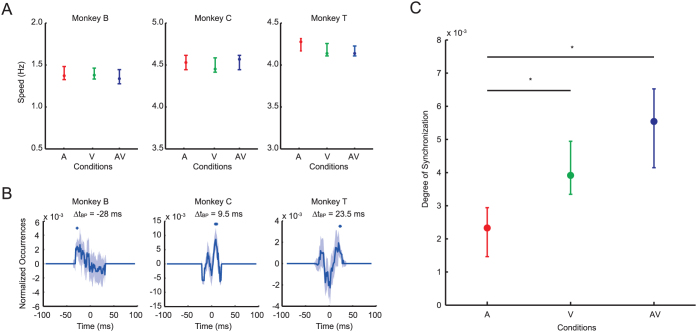
Figure 4. Effects of visual and auditory modalities of vMonkey on BP speed and synchrony.
(A) BP speeds for each monkey under conditions ‘A', ‘V', and ‘AV'. No significant difference was found in the BP speed among the A, V, and AV conditions for all monkeys (p > 0.05, Kruskal-Wallis test). Error bars represent the 95% confidence interval of the median. (B) Synchrony of BP for each monkey under the AV condition. vMonkey was assigned as the reference. ΔtBP was found at −28, 9.5, and 23.5 ms for Monkeys B, C, and T represented by + (p < 0.05, Wilcoxon signed-rank test with Bonferroni correction). The shaded areas show the 95% confidence interval of the median. (C) The degree of synchronization under each condition. Asterisks indicate significant differences (p < 0.05, repeated measure one-way analysis of variance and following multi-comparison tests). The V and AV conditions were significantly higher than the A condition (p < 0.05). No significant difference was found between the V and AV conditions (p > 0.05). Error bars represent the 95% confidence interval of the mean.

References

    1. Sebanz N., Bekkering H. & Knoblich G. Joint action: bodies and minds moving together. Trends Cogn Sci 10, 70–76 (2006). - PubMed
    1. Chartrand T. L. & Bargh J. A. The chameleon effect: the perception-behavior link and social interaction. J Pers Soc Psychol 76, 893–910 (1999). - PubMed
    1. Oullier O., de Guzman G. C., Jantzen K. J., Lagarde J. & Kelso J. A. Social coordination dynamics: measuring human bonding. Soc Neurosci 3, 178–192 (2008). - PMC - PubMed
    1. Richardson M. J., Marsh K. L. & Schmidt R. C. Effects of visual and verbal interaction on unintentional interpersonal coordination. J Exp Psychol Hum Percept Perform 31, 62–79 (2005). - PubMed
    1. Honma M., Kumada T., Osada Y. & Nagai M. The synchronized stepping -Automatic imitation behavior between persons-. The Japanese Journal of Psychonomic Science 27, 127–128 (2008).

Publication types

LinkOut - more resources