


Serum uric acid predicts both current and future components of the metabolic syndrome
- PMID: 23360433
- PMCID: PMC3661030
- DOI: 10.1089/met.2012.0151
Serum uric acid predicts both current and future components of the metabolic syndrome
Abstract
Background: Uric acid (UA) is known to be associated with excess adiposity and insulin resistance. Our aim was to investigate the relationship between UA and the factors associated with the metabolic syndrome and type 2 diabetes mellitus (T2DM), both initially and longitudinally.
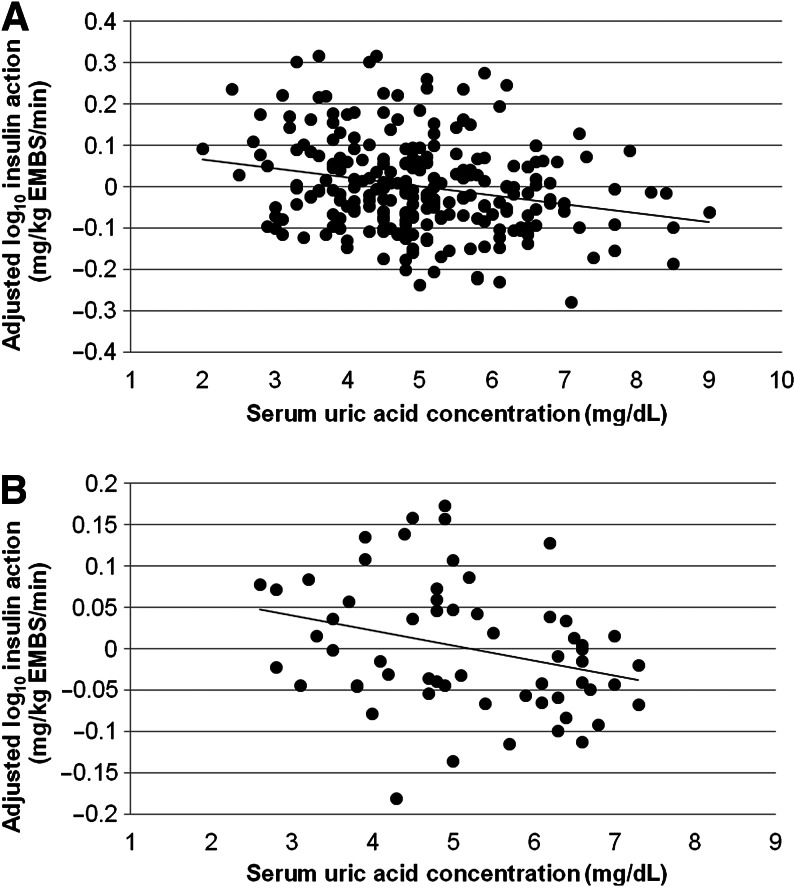
Methods: Serum UA was assessed as a potential determinant of concurrent blood pressure, serum lipids, glucose regulation measured via an oral glucose tolerance test (OGTT), acute insulin response (AIR), and insulin action (M) measured with hyperinsulinemic-euglycemic clamps in 245 participants (72% Native American, 56% male). UA was also assessed as a predictor of the above variables in 60 participants with follow-up data available (median follow-up time=11.2 years [interquartile range (IQR)=8.1, 13.6 years]. The impact of UA on the risk of T2DM was determined as 36 of the 245 participants developed T2DM after the baseline visit.
Results: UA was negatively associated with both concurrent and future M, such that for every 1 mg/dL increase in serum UA, M decreased 7.6% (P<0.001) and future M decreased 6.3% (P=0.02). However, UA was not associated with AIR (P=0.7). UA concentrations were a predictor of T2DM [hazard risk ratio (HRR)=1.5; P=0.02]. UA was positively associated with both concurrent blood pressure and lipids and also predicted future increases in blood pressure and total cholesterol.
Conclusions: Not only did UA associate with concomitant insulin action, blood pressure, and lipids, it also predicted future declines in insulin action and T2DM. UA is a potential target for preventing decreases in insulin sensitivity and rises in blood pressure and cholesterol.
Figures
References
-
- Glynn RJ. Campion EW. Silbert JE. Trends in serum uric acid levels 1961–1980. Arthritis Rheum. 1983;26:87–93. - PubMed
-
- Schwarzmeier JD. Marktl W. Moser K. Lujf A. Fructose induced hyperuricemia. Effects of fructose on the de novo synthesis of adenine nucleotides in the liver and skeletal muscles of rats. Res Exp Med (Berl) 1974;162:341–346. - PubMed
-
- Bray GA. Nielsen SJ. Popkin BM. Consumption of high-fructose corn syrup in beverages may play a role in the epidemic of obesity. Am J Clin Nutr. 2004;79:537–543. - PubMed
-
- Nakanishi N. Okamoto M. Yoshida H, et al. Serum uric acid and risk for development of hypertension and impaired fasting glucose or type II diabetes in Japanese male office workers. Eur J Epidemiol. 2003;18:523–530. - PubMed
-
- Yoo TW. Sung KC. Shin HS, et al. Relationship between serum uric acid concentration and insulin resistance and metabolic syndrome. Circ J. 2005;69:928–933. - PubMed
Publication types
MeSH terms
Substances
Grants and funding
LinkOut - more resources
Full Text Sources
Other Literature Sources
Medical