. 2013 Mar;31(3):227-9.
doi: 10.1038/nbt.2501. Epub 2013 Jan 29.

Efficient genome editing in zebrafish using a CRISPR-Cas system

Affiliations

Efficient genome editing in zebrafish using a CRISPR-Cas system

Woong Y Hwang et al. Nat Biotechnol. 2013 Mar.

Abstract

In bacteria, foreign nucleic acids are silenced by clustered, regularly interspaced, short palindromic repeats (CRISPR)--CRISPR-associated (Cas) systems. Bacterial type II CRISPR systems have been adapted to create guide RNAs that direct site-specific DNA cleavage by the Cas9 endonuclease in cultured cells. Here we show that the CRISPR-Cas system functions in vivo to induce targeted genetic modifications in zebrafish embryos with efficiencies similar to those obtained using zinc finger nucleases and transcription activator-like effector nucleases.


Conflict of interest statement

Conflict of Interest Statement

J.K.J. has a financial interest in Transposagen Biopharmaceuticals. J.K.J.’s interests were reviewed and are managed by Massachusetts General Hospital and Partners HealthCare in accordance with their conflict of interest policies.

Figures

Figure 1
Figure 1
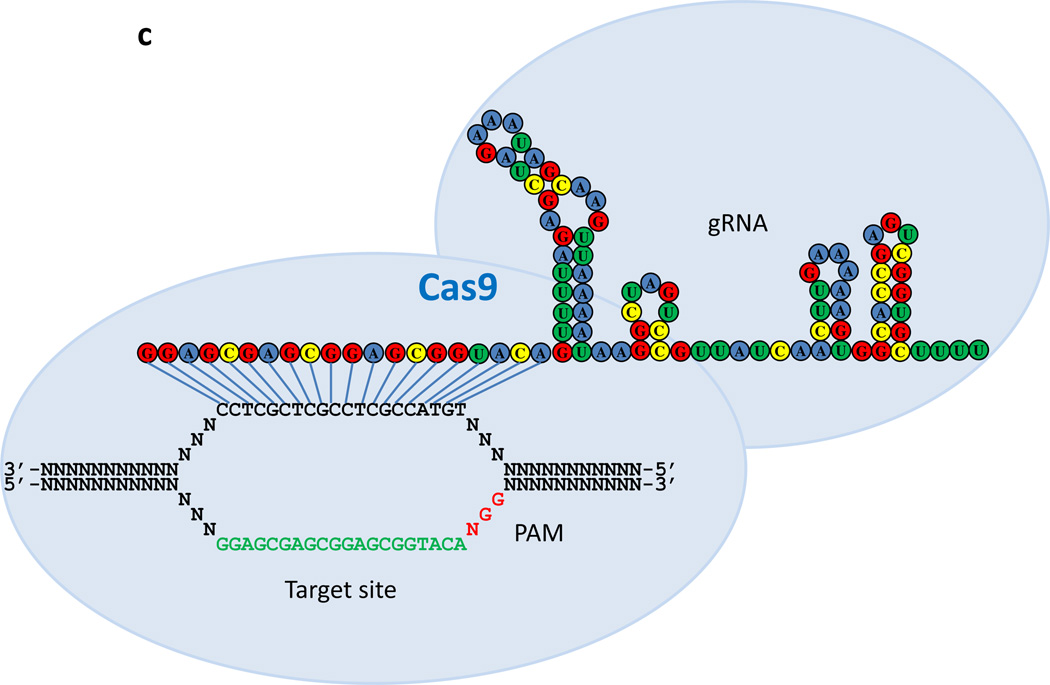
Schematic illustrating naturally occurring and engineered RNA-guided nuclease systems. (A) Naturally occurring dual RNA-guided Cas9 nuclease. crRNA interacts with the complementary strand of the DNA target site harboring an adjacent PAM sequence (green and red text, respectively), tracrRNA base pairs with the crRNA, and the overall complex is recognized and cleaved by Cas9 nuclease (light blue shape). Folding of the crRNA and tracrRNA molecules depicted as predicted by Mfold and the association of the crRNA to the tracrRNA depicted is partially based on the model previously proposed by Jinek et al. (B) Engineered gRNA/Cas9 system previously used in vitro. gRNA composed of portions of the crRNA and tracrRNA from (A) is illustrated interacting with the DNA target site. Folding of gRNA is as predicted by Mfold. (C) Modified engineered gRNA/Cas9 system used in vivo in this study. Components are illustrated the same way as in (B) except the gRNA contains additional sequence from the 3’ end of the tracrRNA. Folding of gRNA is as predicted by Mfold.
Figure 1
Figure 1
Schematic illustrating naturally occurring and engineered RNA-guided nuclease systems. (A) Naturally occurring dual RNA-guided Cas9 nuclease. crRNA interacts with the complementary strand of the DNA target site harboring an adjacent PAM sequence (green and red text, respectively), tracrRNA base pairs with the crRNA, and the overall complex is recognized and cleaved by Cas9 nuclease (light blue shape). Folding of the crRNA and tracrRNA molecules depicted as predicted by Mfold and the association of the crRNA to the tracrRNA depicted is partially based on the model previously proposed by Jinek et al. (B) Engineered gRNA/Cas9 system previously used in vitro. gRNA composed of portions of the crRNA and tracrRNA from (A) is illustrated interacting with the DNA target site. Folding of gRNA is as predicted by Mfold. (C) Modified engineered gRNA/Cas9 system used in vivo in this study. Components are illustrated the same way as in (B) except the gRNA contains additional sequence from the 3’ end of the tracrRNA. Folding of gRNA is as predicted by Mfold.
Figure 1
Figure 1
Schematic illustrating naturally occurring and engineered RNA-guided nuclease systems. (A) Naturally occurring dual RNA-guided Cas9 nuclease. crRNA interacts with the complementary strand of the DNA target site harboring an adjacent PAM sequence (green and red text, respectively), tracrRNA base pairs with the crRNA, and the overall complex is recognized and cleaved by Cas9 nuclease (light blue shape). Folding of the crRNA and tracrRNA molecules depicted as predicted by Mfold and the association of the crRNA to the tracrRNA depicted is partially based on the model previously proposed by Jinek et al. (B) Engineered gRNA/Cas9 system previously used in vitro. gRNA composed of portions of the crRNA and tracrRNA from (A) is illustrated interacting with the DNA target site. Folding of gRNA is as predicted by Mfold. (C) Modified engineered gRNA/Cas9 system used in vivo in this study. Components are illustrated the same way as in (B) except the gRNA contains additional sequence from the 3’ end of the tracrRNA. Folding of gRNA is as predicted by Mfold.
Figure 2
Figure 2
Targeted indel mutations induced by engineered gRNA/Cas9 at the tia1l and gsk3b genes. For each gene, the wild-type sequence is shown at the top with the target sites highlighted in yellow and the PAM sequence highlighted as red underlined text. Deletions are shown as red dashes highlighted in grey and insertions as lower case letters highlighted in blue. The net change in length caused by each indel mutation is to the right of each sequence (+, insertion; −, deletion). Note that some alterations have both insertions and deletions of sequence and in these instances the alterations are enumerated in the parentheses. The number of times each mutant allele was isolated is shown in brackets.

Comment in

  • RNA-guided gene editing.
    de Souza N. de Souza N. Nat Methods. 2013 Mar;10(3):189. doi: 10.1038/nmeth.2389. Nat Methods. 2013. PMID: 23565557 No abstract available.

References

    1. Wiedenheft B, Sternberg SH, Doudna JA. RNA-guided genetic silencing systems in bacteria and archaea. Nature. 2012;482:331–338. - PubMed
    1. Horvath P, Barrangou R. CRISPR/Cas, the immune system of bacteria and archaea. Science. 2010;327:167–170. - PubMed
    1. Terns MP, Terns RM. CRISPR-based adaptive immune systems. Curr Opin Microbiol. 2011;14:321–327. - PMC - PubMed
    1. Barrangou R, et al. CRISPR provides acquired resistance against viruses in prokaryotes. Science. 2007;315:1709–1712. - PubMed
    1. Brouns SJ, et al. Small CRISPR RNAs guide antiviral defense in prokaryotes. Science. 2008;321:960–964. - PMC - PubMed

Publication types