. 2013:4:1418.
doi: 10.1038/ncomms2433.

Interferon-induced transmembrane protein-3 genetic variant rs12252-C is associated with severe influenza in Chinese individuals

Affiliations

Interferon-induced transmembrane protein-3 genetic variant rs12252-C is associated with severe influenza in Chinese individuals

Yong-Hong Zhang et al. Nat Commun. 2013.

Abstract

The SNP rs12252-C allele alters the function of interferon-induced transmembrane protein-3 increasing the disease severity of influenza virus infection in Caucasians, but the allele is rare. However, rs12252-C is much more common in Han Chinese. Here we report that the CC genotype is found in 69% of Chinese patients with severe pandemic influenza A H1N1/09 virus infection compared with 25% in those with mild infection. Specifically, the CC genotype was estimated to confer a sixfold greater risk for severe infection than the CT and TT genotypes. More importantly, because the risk genotype occurs with such a high frequency, its effect translates to a large population-attributable risk of 54.3% for severe infection in the Chinese population studied compared with 5.4% in Northern Europeans. Interferon-induced transmembrane protein-3 genetic variants could, therefore, have a strong effect of the epidemiology of influenza in China and in people of Chinese descent.


Conflict of interest statement

The authors declare no competing financial interests.

Figures
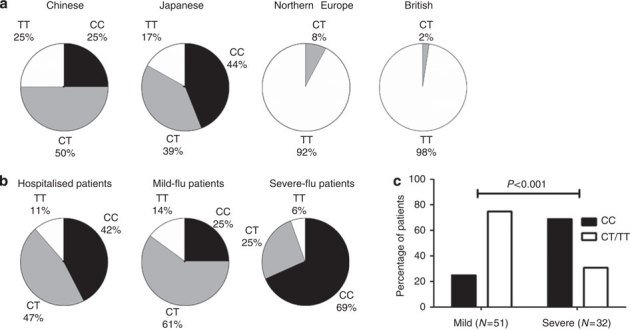
Figure 1
Figure 1. C allele at SNP 12252 associated with disease severity in acutely influenza A (H1N1)pdm/09 infected Chinese individuals.
(a) Allele frequencies were obtained from the 1,000 genomes project: allele frequencies vary significantly among different populations. (b) Allele frequencies obtained from Influenza A pH1N1/09 confirmed patients from Beijing You’an Hospital. (c) Proportion of mild versus severe flu patients carrying CC or CT/TT genotype with confirmed Influenza A pH1N1/09 infection from Beijing You’an Hospital.
Figure 2
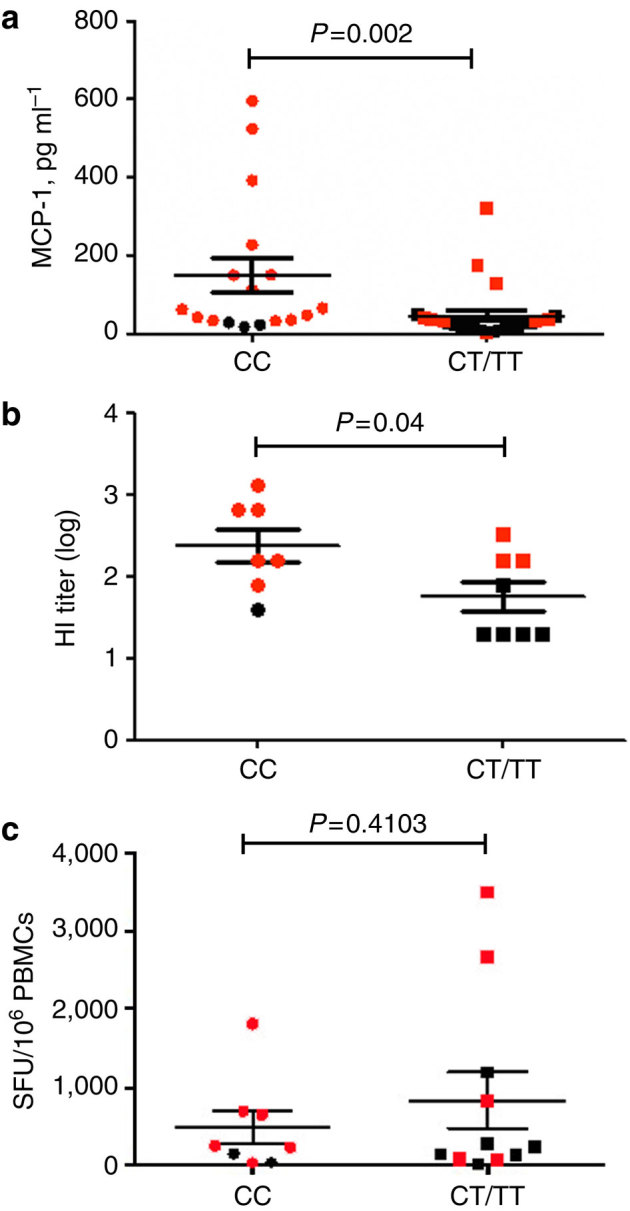
Figure 2. C allele at SNP 12252 is associated with higher serum MCP-1 and antibody level, the data points were color coded in the figure for severe (red) and mild (black) disease.
(a) Serum MCP-1 levels in patients with CC and CT/TT genotype. (b) Influenza A virus (H1N1)pdm/09-specific antibody levels in patients with CC genotype and CT/TT genotype. (c). Overall influenza A virus (H1N1)pdm/09-specific T-cell responses in patients with CC genotype and CT/TT genotype.

References

    1. Brass AL, et al. The IFITM proteins mediate cellular resistance to influenza A H1N1 virus, West Nile virus, and dengue virus. Cell. 2009;139:1243–1254. doi: 10.1016/j.cell.2009.12.017. - DOI - PMC - PubMed
    1. Feeley EM, et al. IFITM3 inhibits influenza A virus infection by preventing cytosolic entry. Plos Pathog. 2011;7:e1002337. doi: 10.1371/journal.ppat.1002337. - DOI - PMC - PubMed
    1. Schoggins JW, et al. A diverse range of gene products are effectors of the type I interferon antiviral response. Nature. 2011;472:481–485. doi: 10.1038/nature09907. - DOI - PMC - PubMed
    1. Everitt AR, et al. IFITM3 restricts the morbidity and mortality associated with influenza. Nature. 2012;484:519–523. doi: 10.1038/nature10921. - DOI - PMC - PubMed
    1. Weidner JM, et al. Interferon-induced cell membrane proteins, IFITM3 and tetherin, inhibit vesicular stomatitis virus infection via distinct mechanisms. J Virol. 2010;84:12646–12657. doi: 10.1128/JVI.01328-10. - DOI - PMC - PubMed

Publication types

MeSH terms