Review
. 2013 Aug;70(15):2743-56.
doi: 10.1007/s00018-013-1265-9. Epub 2013 Jan 30.

Mechanisms of Mediator complex action in transcriptional activation

Affiliations
Review

Mechanisms of Mediator complex action in transcriptional activation

Suraiya A Ansari et al. Cell Mol Life Sci. 2013 Aug.

Abstract

Mediator is a large multisubunit complex that plays a central role in the regulation of RNA Pol II transcribed genes. Conserved in overall structure and function among eukaryotes, Mediator comprises 25-30 protein subunits that reside in four distinct modules, termed head, middle, tail, and CDK8/kinase. Different subunits of Mediator contact other transcriptional regulators including activators, co-activators, general transcription factors, subunits of RNA Pol II, and specifically modified histones, leading to the regulated expression of target genes. This review is focused on the interactions of specific Mediator subunits with diverse transcription regulators and how those interactions contribute to Mediator function in transcriptional activation.


Figures
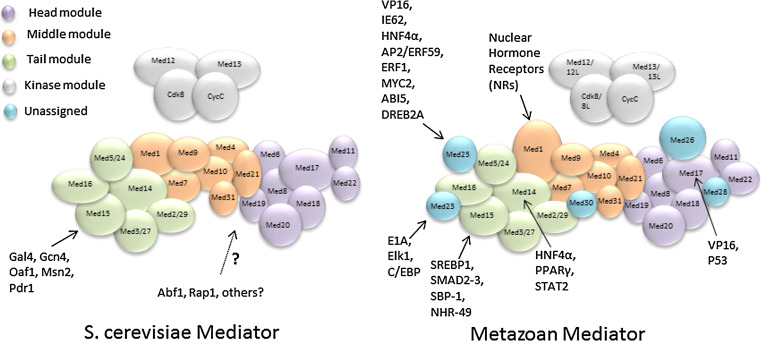
Fig. 1
Fig. 1
Interactions of transcriptional activators with Mediator complex. Organization of the yeast and metazoan Mediator complexes is adapted from reference [8]. Abf1 and Rap1 in yeast may interact directly or indirectly with middle or head module subunits, as indicated by the dotted line. Interactions of activators with subunits from metazoan Mediator are mostly derived from studies on mammalian Mediator, but also include some from C. elegans and A. thaliana. See text for more details
Fig. 2
Fig. 2
Interactions of Mediator with other co-activator complexes. a In Saccharomyces cerevisiae, activators make direct contacts to recruit both SAGA and Mediator, which may be independent or interdependent in associating with a particular promoter depending on both the activator and the promoter (dotted double arrow). Swi/Snf and Pol II recruitment generally depends on Mediator, with some possible exceptions. b In mammalian cells, Mediator participates in recruitment of a wide range of co-activators; see text for details. For clarity, interactions not involving Mediator are omitted

References

    1. Lemon B, Tjian R. Orchestrated response: a symphony of transcription factors for gene control. Genes Dev. 2000;14:2551–2569. doi: 10.1101/gad.831000. - DOI - PubMed
    1. Butler JE, Kadonaga JT. The RNA polymerase II core promoter: a key component in the regulation of gene expression. Genes Dev. 2002;16:2583–2592. doi: 10.1101/gad.1026202. - DOI - PubMed
    1. Thomas MC, Chiang CM. The general transcription machinery and general cofactors. Crit Rev Biochem Mol Biol. 2006;41:105–178. doi: 10.1080/10409230600648736. - DOI - PubMed
    1. Belotserkovskaya R, Berger SL. Interplay between chromatin modifying and remodeling complexes in transcriptional regulation. Crit Rev Eukaryot Gene Expr. 1999;9:221–230. doi: 10.1615/CritRevEukarGeneExpr.v9.i3-4.70. - DOI - PubMed
    1. Cosma MP, Tanaka T, Nasmyth K. Ordered recruitment of transcription and chromatin remodeling factors to a cell cycle—and developmentally regulated promoter. Cell. 1999;97:299–311. doi: 10.1016/S0092-8674(00)80740-0. - DOI - PubMed

Publication types

MeSH terms
