


Associations of serum 25-hydroxyvitamin D with overall and breast cancer-specific mortality in a multiethnic cohort of breast cancer survivors
- PMID: 23361338
- PMCID: PMC3731052
- DOI: 10.1007/s10552-013-0158-4
Associations of serum 25-hydroxyvitamin D with overall and breast cancer-specific mortality in a multiethnic cohort of breast cancer survivors
Abstract
Purpose: Despite limited evidence on the association of vitamin D with outcomes in breast cancer survivors, some clinicians advise breast cancer patients to use vitamin D supplements. More evidence is needed to inform these recommendations.
Methods: In the Health, Eating, Activity, and Lifestyle study, we examined associations of post-treatment serum concentrations of 25-hydroxyvitamin D (25(OH)D) on overall and breast cancer-specific mortality in 585 breast cancer survivors from western Washington State, New Mexico, and Los Angeles County. 25(OH)D was measured in stored blood collected 2 years post-enrollment. Outcomes were ascertained from the Surveillance, Epidemiology, and End Results registries and medical records. Cox proportional hazards models were fit to assess associations of serum 25(OH)D with overall and breast cancer-specific mortality.
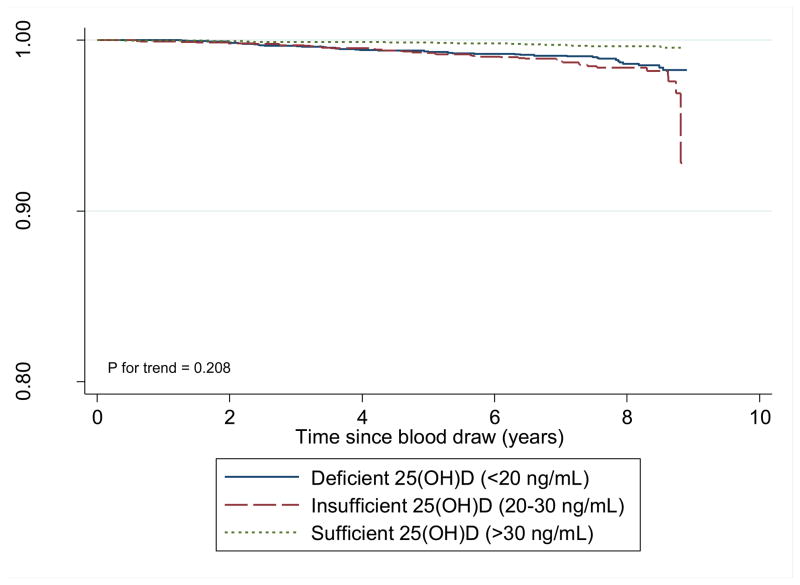
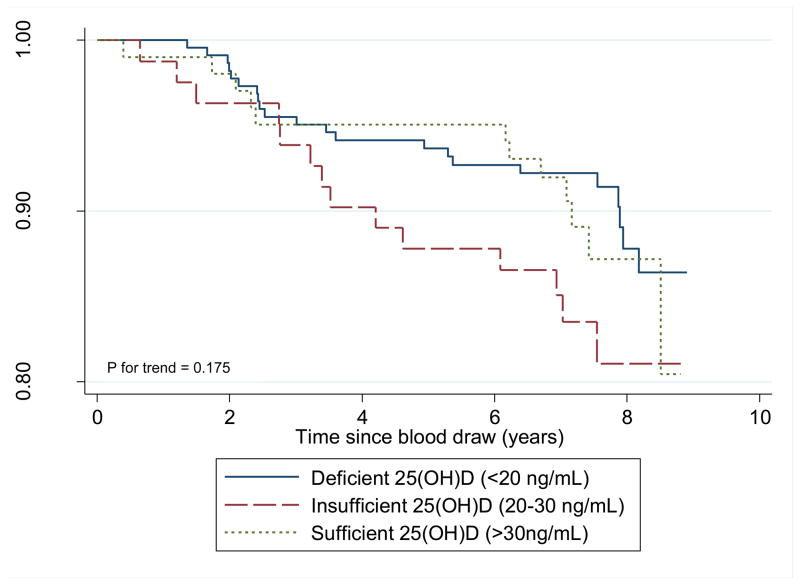
Results: After a median follow-up of 9.2 years; 110 women died, including 48 from breast cancer. Standard cut points classified 211 (31.6 %) women as serum 25(OH)D deficient (<20 ng/mL), 189 (32.2 %) as insufficient (20-30 ng/mL), and 185 (36.2 %) as sufficient (>30 ng/mL). Compared to women with deficient 25(OH)D, those in the sufficient ranges had a decreased risk of overall mortality (age-adjusted HR = 0.58; 95 % CI 0.36-0.96); however, multivariate adjustments attenuated the association (HR = 0.90; 95 % CI 0.50-1.61). No association was found between serum 25(OH)D and breast cancer-specific mortality (sufficient: HR = 1.21; 95 % CI 0.52-2.80) in multivariate models.
Conclusion: In this breast cancer cohort, higher serum 25(OH)D may be associated with improved survival, but results were not statistically significant and must be interpreted with caution. The potential prognostic effect of vitamin D from diet, supplements, or both should be evaluated in future larger studies with additional endpoints from breast cancer patients.
Conflict of interest statement
No potential conflicts of interest were disclosed.
Figures
References
-
- Schwartz GG, Blot WJ. Vitamin D status and cancer incidence and mortality: something new under the sun. Journal of the National Cancer Institute. 2006;98:428–30. - PubMed
-
- Deeb KK, Trump DL, Johnson CS. Vitamin D signalling pathways in cancer: potential for anticancer therapeutics. Nature reviews. 2007;7:684–700. - PubMed
-
- Holick MF. Vitamin D: importance in the prevention of cancers, type 1 diabetes, heart disease, and osteoporosis. The American journal of clinical nutrition. 2004;79:362–71. - PubMed
-
- Tuohimaa P. Vitamin D, aging, and cancer. Nutrition reviews. 2008;66:S147–52. - PubMed
Publication types
MeSH terms
Substances
Grants and funding
- R25 CA094880/CA/NCI NIH HHS/United States
- N01 CN005228/CN/NCI NIH HHS/United States
- R25-CA094880/CA/NCI NIH HHS/United States
- U54 CA116847/CA/NCI NIH HHS/United States
- MO1-RR-0997/RR/NCRR NIH HHS/United States
- N01 PC067010/PC/NCI NIH HHS/United States
- N01-CN-75036-20/CN/NCI NIH HHS/United States
- M01 RR000037/RR/NCRR NIH HHS/United States
- K05 CA136967/CA/NCI NIH HHS/United States
- U54-CA116847/CA/NCI NIH HHS/United States
- MO1-RR-0037/RR/NCRR NIH HHS/United States
- M01 RR000997/RR/NCRR NIH HHS/United States
- N01-CN-05228/CN/NCI NIH HHS/United States
- N01-HD-3-3175/HD/NICHD NIH HHS/United States
LinkOut - more resources
Full Text Sources
Other Literature Sources
Medical
