Review
. 2013 Apr;242(4):371-9.
doi: 10.1002/dvdy.23936. Epub 2013 Mar 1.

Cell-autonomous sex determination outside of the gonad

Affiliations
Review

Cell-autonomous sex determination outside of the gonad

Arthur P Arnold et al. Dev Dyn. 2013 Apr.

Abstract

Background: The classic model of sex determination in mammals states that the sex of the individual is determined by the type of gonad that develops, which in turn determines the gonadal hormonal milieu that creates sex differences outside of the gonads. However, XX and XY cells are intrinsically different because of the cell-autonomous sex-biasing action of X and Y genes.

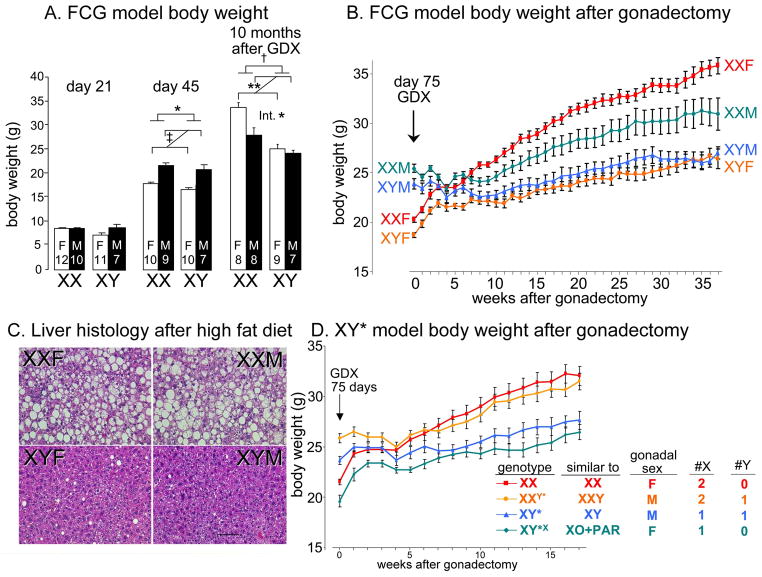
Results: Recent studies of mice, in which sex chromosome complement is independent of gonadal sex, reveal that sex chromosome complement has strong effects contributing to sex differences in phenotypes such as metabolism. Adult mice with two X chromosomes (relative to mice with one X chromosome) show dramatically greater increases in body weight and adiposity after gonadectomy, irrespective of their gonadal sex. When fed a high-fat diet, XX mice develop striking hyperinsulinemia and fatty liver, relative to XY mice. The sex chromosome effects are modulated by the presence of gonadal hormones, indicating an interaction of the sex-biasing effects of gonadal hormones and sex chromosome genes.

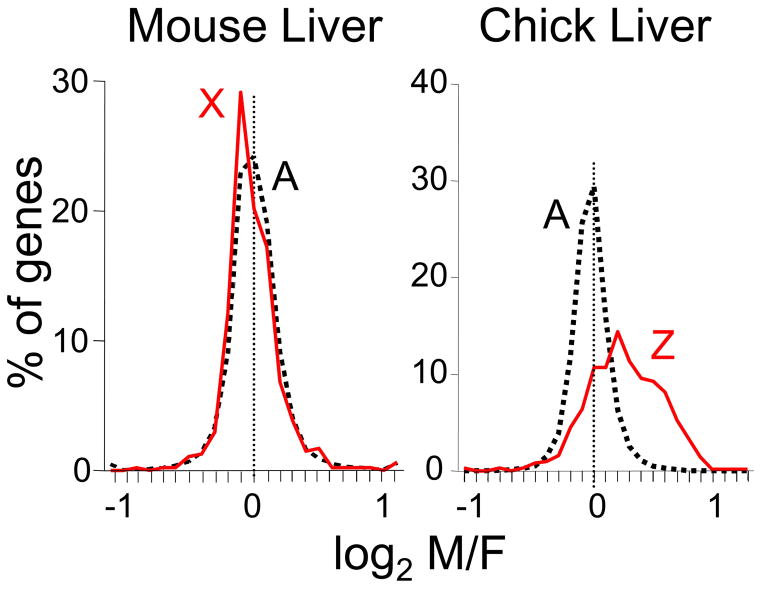
Conclusions: Other cell-autonomous sex chromosome effects are detected in mice in many phenotypes. Birds (relative to eutherian mammals) are expected to show more widespread cell-autonomous sex determination in non-gonadal tissues, because of ineffective sex chromosome dosage compensation mechanisms.


Figures

Figure 1
Figure 1
Cell-autonomous effects of sex chromosomes contribute to sex differences in body weight and metabolism in mice. A. Four core genotypes (FCG) mice show little sex difference in body weight at 21 days (weaning). After puberty at day 45, gonadal males weigh more than females. Ten months after gonadectomy (GDX, performed at 75 days of age), XX mice are 24% heavier than XY mice, and an interaction (Int) between sex chromosome complement and gonadal sex is apparent because XX gonadal females are heavier than gonadal males, but XY gonadal males and females are not different. * p<0.05, ** p<0.01 B. Body weight in gonadally intact mice at day 75 and after GDX at day 75. The sex difference caused by gonadal secretions disappears in the first month after GDX, after which XX mice gain more weight than XY mice. XXM, XX gonadal males; XYM, XY gonadal males; XXF, XX gonadal females; XYF, XY gonadal females. C. Liver histology after eating a high fat diet (beginning four weeks after gonadectomy for a total of 16 weeks) shows that XX mice have dramatically greater accumulation of triglycerides in the liver, relative to XY mice, irrespective of gonadal sex. D. Four types of progeny of XY* fathers were compared to assess the effects of one vs. two X chromosomes, or of the Y chromosome. After GDX at 75 days, mice with the equivalent of two X chromosomes gain more weight and fat than mice with one X chromosome, and the presence of the Y chromosome has no apparent effect. From (Chen et al. 2012).
Figure 2
Figure 2
Effective sex chromosome dosage compensation in the mouse compared with ineffective dosage compensation in the chick embryo. Microarray mRNA expression profiling was conducted in adult mice and chick embryos of both sexes. The graphs show the distribution of M/F ratios of expression of autosomal genes and X or Z chromosome genes. Autosomal genes have modal M/F ratios near 1 (log of zero), but some genes are expressed higher in males or in females. Log2 M/F ratios are rarely greater that 1 (two-fold higher in males) or less than −1 (two-fold higher in females). In mammals such as the mice, M/F ratios for X genes show a distribution closely matched to autosomal genes, despite the presence of two X chromosomes in females compared to one of males. In birds such as the chick, the distribution of M/F ratios for autosomal genes is similar to that in mammals, but in the absence of chromosome-wide dosage compensation of the Z chromosome, ZZ males have higher expression of Z genes compared to ZW females, for most Z genes. From (Itoh et al. 2007).
Figure 3
Figure 3
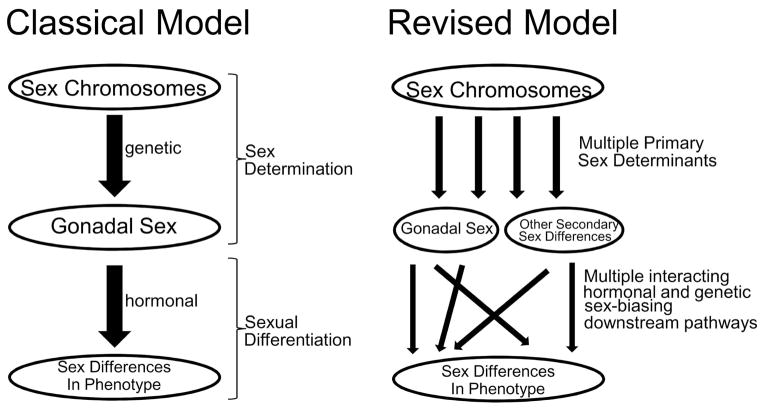
Schematic contrast of sex determination models. In the classical model of sex determination of vertebrates with heteromorphic sex chromosomes (left), sex determination is defined as the processes leading to differentiation of the gonads, which then secrete gonadal hormones that cause sexual differentiation of non-gonadal tissues. The revised model recognizes multiple primary parallel-acting factors encoded by the sex chromosomes, which activate numerous secondary downstream pathways, hormonal and genetic, that interact with each other (summing with each other or reducing the effects of each other) to cause or reduce sex differences in phenotype. In the revised model, gonadal secretions dominate as the most important group of secondary factors causing sex differences in phenotype of eutherian mammals.

References

    1. Abel JL, Rissman EF. Location, location, location: Genetic regulation of neural sex differences. Rev Endocr Metab Disord. 2011;13:151–161. - PMC - PubMed
    1. Abel JM, Witt DM, Rissman EF. Sex Differences in the Cerebellum and Frontal Cortex: Roles of Estrogen Receptor Alpha and Sex Chromosome Genes. Neuroendocrinol. 2011;93:230–240. - PMC - PubMed
    1. Agate RJ, Grisham W, Wade J, Mann S, Wingfield J, Schanen C, Palotie A, Arnold AP. Neural not gonadal origin of brain sex differences in a gynandromorphic finch. Proc Natl Acad Sci USA. 2003;100:4873–4878. - PMC - PubMed
    1. Arnold AP. Genetically triggered sexual differentiation of brain and behavior. Horm Behav. 1996;30:495–505. - PubMed
    1. Arnold AP. Sex chromosomes and brain gender. Nat Rev Neurosci. 2004;5:701–708. - PubMed

Publication types

Substances

LinkOut - more resources