


Impact of a home-based social welfare program on care for palliative patients in the Basque Country (SAIATU Program)
- PMID: 23363526
- PMCID: PMC3576230
- DOI: 10.1186/1472-684X-12-3
Impact of a home-based social welfare program on care for palliative patients in the Basque Country (SAIATU Program)
Abstract
Background: SAIATU is a program of specially trained in-home social assistance and companionship which, since February 2011, has provided support to end-of-life patients, enabling the delivery of better clinical care by healthcare professionals in Osakidetza (Basque Health Service), in Guipúzcoa (Autonomous Community of the Basque Country).In January 2012, a retrospective observational study was carried out, with the aim of describing the characteristics of the service and determining if the new social service and the associated socio-health co-ordination had produced any effect on the use of healthcare resources by end-of-life patients.The results of a comparison of a cohort of cases and controls demonstrated evidence that the program could reduce the use of hospital resources and promote the continuation of living at home, increasing the home-based activity of primary care professionals.The objective of this study is to analyse whether a program of social intervention in palliative care (SAIATU) results in a reduction in the consumption of healthcare resources and cost by end-of-life patients and promotes a shift towards a more community-based model of care.
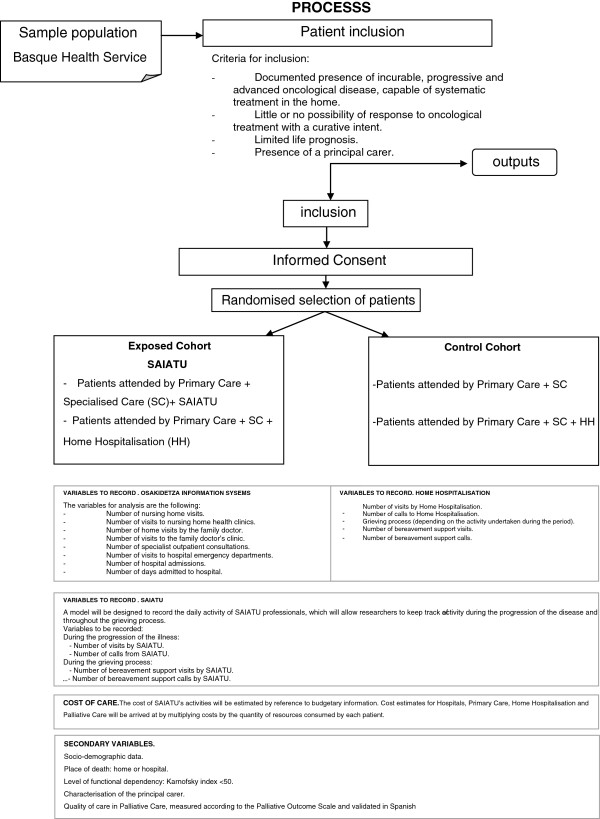
Method/design: Comparative prospective cohort study, with randomised selection of patients, which will systematically measure patient characteristics and their consumption of resources in the last 30 days of life, with and without the intervention of a social support team trained to provide in-home end-of-life care.For a sample of approximately 150 patients, data regarding the consumption of public healthcare resources, SAIATU activity, home hospitalisation teams, and palliative care will be recorded. Such data will also include information dealing with the socio-demographic and clinical characteristics of the patients and attending carers, as well as particular characteristics of patient outcomes (Karnofsky Index), and of the outcomes of palliative care received (Palliative Outcome Scale).Ethical approval for the study was given by the Clinical Research Ethics Committee of Euskadi (CREC-C) on 10 Dec 2012.
Discussion: The results of this prospective study will assist in verifying or disproving the hypothesis that the in-home social care offered by SAIATU improves the efficiency of healthcare resource usage by these patients (quality of life, symptom control).This project represents a dramatic advance with respect to other studies conducted to date, and demonstrates how, through the provision of personnel trained to provide social care for patients in the advanced stages of illness, and through strengthening the co-ordination of such social services with existing healthcare system resources, the resulting holistic structure obtains cost savings within the health system and improves the efficiency of the system as a whole.
Figures
References
-
- Estrategia en Cuidados Paliativos del Sistema Nacional de Salud. Madrid: Ministerio de Sanidad y Consumo; 2007. Spain. Available in: http://www.google.es/url?sa=t&rct=j&q=&esrc=s&source=web&cd=1&ved=0CDQQF....
-
- Estrategia para afrontar el reto de la cronicidad en Euskadi. Gobierno Vasco. Spain: Departamento de Sanidad y Consumo; 2010. Available in: http://www.google.es/url?sa=t&rct=j&q=&esrc=s&source=web&cd=2&ved=0CDoQF....
-
- Ley 39/2006, de 14 de diciembre, de Promoción de la Autonomía Personal y Atención a las personas en situación de dependencia. BOE. 2006;299:2006. Available in: http://www.boe.es/buscar/doc.php?id=BOE-A-2006-21990.
LinkOut - more resources
Full Text Sources
Other Literature Sources
Research Materials
