


Comparative study of IS6110 restriction fragment length polymorphism and variable-number tandem-repeat typing of Mycobacterium tuberculosis isolates in the Netherlands, based on a 5-year nationwide survey
- PMID: 23363841
- PMCID: PMC3666783
- DOI: 10.1128/JCM.03061-12
Comparative study of IS6110 restriction fragment length polymorphism and variable-number tandem-repeat typing of Mycobacterium tuberculosis isolates in the Netherlands, based on a 5-year nationwide survey
Abstract
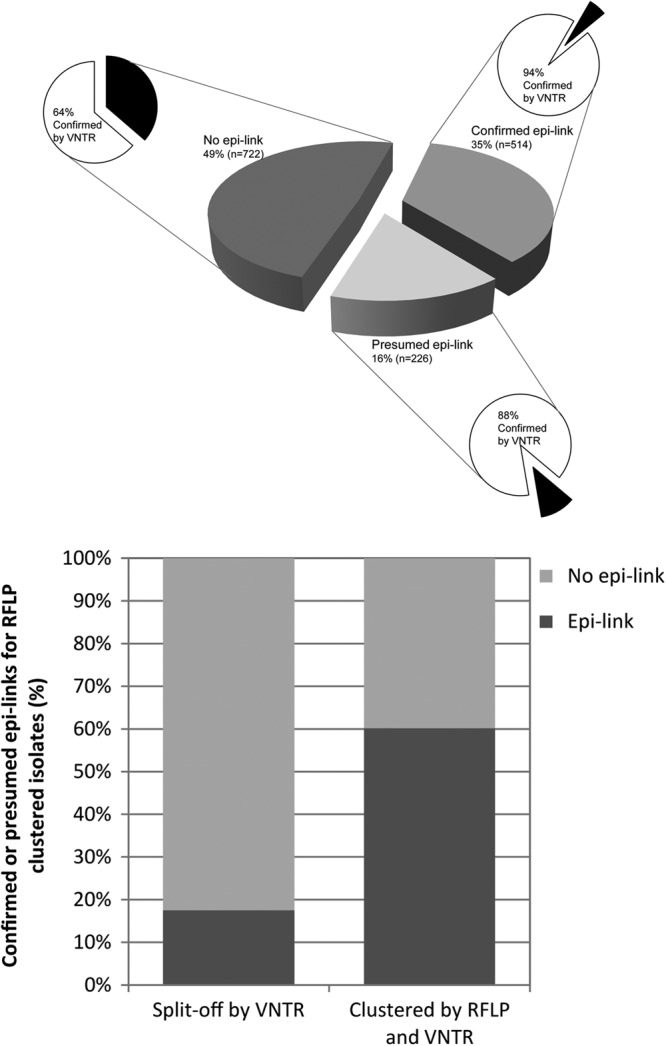
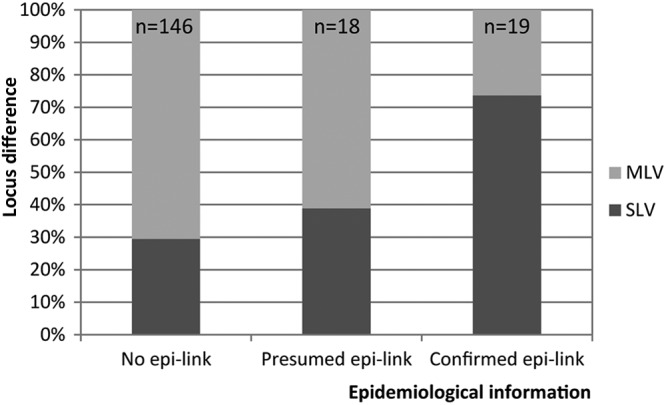
In order to switch from IS6110 and polymorphic GC-rich repetitive sequence (PGRS) restriction fragment length polymorphism (RFLP) to 24-locus variable-number tandem-repeat (VNTR) typing of Mycobacterium tuberculosis complex isolates in the national tuberculosis control program in The Netherlands, a detailed evaluation on discriminatory power and agreement with findings in a cluster investigation was performed on 3,975 tuberculosis cases during the period of 2004 to 2008. The level of discrimination of the two typing methods did not differ substantially: RFLP typing yielded 2,733 distinct patterns compared to 2,607 in VNTR typing. The global concordance, defined as isolates labeled unique or identically distributed in clusters by both methods, amounted to 78.5% (n = 3,123). Of the remaining 855 cases, 12% (n = 479) of the cases were clustered only by VNTR, 7.7% (n = 305) only by RFLP typing, and 1.8% (n = 71) revealed different cluster compositions in the two approaches. A cluster investigation was performed for 87% (n = 1,462) of the cases clustered by RFLP. For the 740 cases with confirmed or presumed epidemiological links, 92% were concordant with VNTR typing. In contrast, only 64% of the 722 cases without an epidemiological link but clustered by RFLP typing were also clustered by VNTR typing. We conclude that VNTR typing has a discriminatory power equal to IS6110 RFLP typing but is in better agreement with findings in a cluster investigation performed on an RFLP-clustering-based cluster investigation. Both aspects make VNTR typing a suitable method for tuberculosis surveillance systems.
Figures
References
-
- Prodinger WM. 2007. Molecular epidemiology of tuberculosis: toy or tool? A review of the literature and examples from Central Europe. Wien Klin. Wochenschr. 119:80–89 - PubMed
-
- van Soolingen D. 2001. Molecular epidemiology of tuberculosis and other mycobacterial infections: main methodologies and achievements. J. Intern. Med. 249:1–26 - PubMed
-
- Garcia de Viedma D, Mokrousov I, Rastogi N. 2011. Innovations in the molecular epidemiology of tuberculosis. Enferm. Infecc. Microbiol. Clin. 29(Suppl 1):8–13 - PubMed
-
- van Soolingen D, Arbeit RD. 2001. Dealing with variation in molecular typing of Mycobacterium tuberculosis: low-intensity bands and other challenges. J. Med. Microbiol. 50:749–751 - PubMed
Publication types
MeSH terms
Substances
LinkOut - more resources
Full Text Sources
Other Literature Sources
Miscellaneous
