


Vitamin D supplementation and calcium absorption during caloric restriction: a randomized double-blind trial
- PMID: 23364004
- PMCID: PMC3578405
- DOI: 10.3945/ajcn.112.044909
Vitamin D supplementation and calcium absorption during caloric restriction: a randomized double-blind trial
Abstract
Background: Weight loss (WL) is associated with a decrease in calcium absorption and may be one mechanism that induces bone loss with weight reduction.
Objective: Because vitamin D supplementation has been shown to increase true fractional calcium absorption (TFCA), the goal of this study was to examine the effect of vitamin D during WL or weight maintenance (WM).
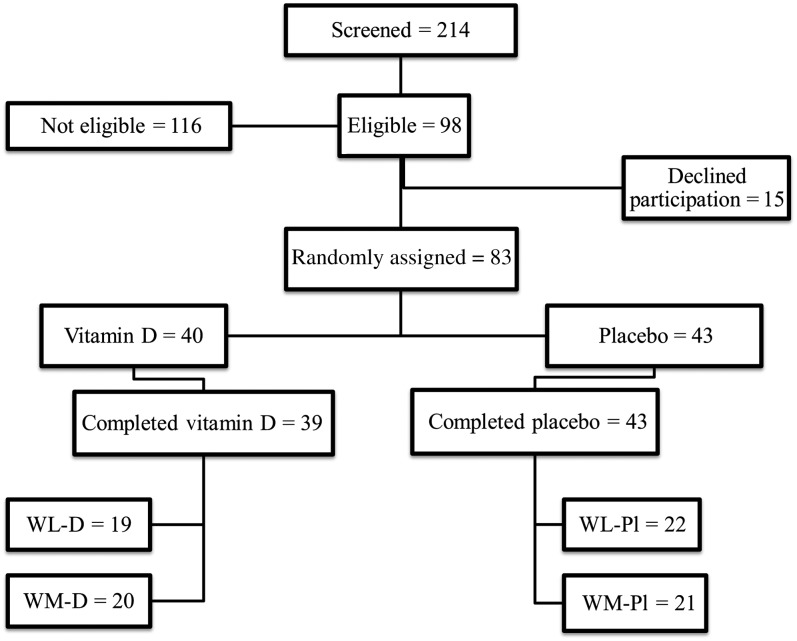
Design: A randomized, placebo-controlled, double-blind 6-wk study was conducted in 82 postmenopausal women [BMI (in kg/m(2); ±SD): 30.2 ± 3.7] with 25-hydroxyvitamin D [25(OH)D] concentrations <70 nmol/L during either WL or WM. All women were given 10 μg vitamin D(3)/d and 1.2 g Ca/d and either weekly vitamin D(3) (375 μg) or a placebo equivalent to 63 μg (2500 IU)/d and 10 μg (400 IU)/d, respectively. We measured TFCA with the use of dual-stable isotopes, 25(OH)D, parathyroid hormone, estradiol, calcitriol, and urinary calcium at baseline and 6 wk in weight loss and vitamin D(3)-supplementation (WL-D; n = 19), weight maintenance and vitamin D(3)-supplementation (WM-D; n = 20), weight loss and placebo (n = 22), and weight maintenance and placebo (n = 21) groups.
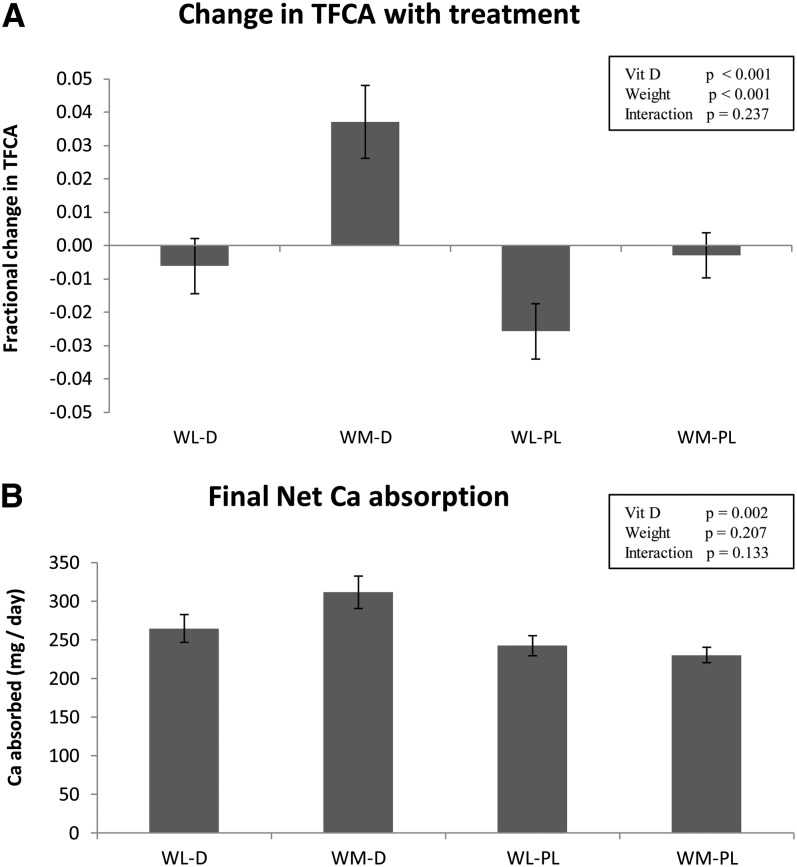
Results: WL groups lost 3.8 ± 1.1% of weight with no difference between vitamin D(3) supplementation and the placebo. The rise in serum 25(OH)D was greatest in the WL-D group (19.8 ± 14.5 nmol/L) compared with in WM-D (9.1 ± 10.3 nmol/L) and placebo groups (1.5 ± 10.9 nmol/L). TFCA increased with vitamin D(3) supplementation compared with placebo treatment (P < 0.01) and decreased during WL compared with WM. Serum 25(OH)D or 1,25-dihyroxyvitamin D did not correlate with TFCA.
Conclusion: These data show that vitamin D supplementation increases TFCA and that WL decreases TFCA and suggest that, when calcium intake is 1.2 g/d, either 10 or 63 μg vitamin D/d is sufficient to maintain the calcium balance. This trial was registered at clinicaltrials.gov as NCT00473031.
Figures
References
-
- Norman AW. Intestinal calcium absorption: a vitamin D-hormone-mediated adaptive response. Am J Clin Nutr 1990;51:290–300 - PubMed
-
- Seamans KM, Cashman KD. Existing and potentially novel functional markers of vitamin D status: a systematic review. Am J Clin Nutr 2009;89:1997S–2008S - PubMed
-
- Heaney RP, Dowell MS, Hale CA, Bendich A. Calcium absorption varies within the reference range for serum 25-hydroxyvitamin D. J Am Coll Nutr 2003;22:142–6 - PubMed
-
- Barger-Lux MJ, Heaney RP. Calcium absorptive efficiency is positively related to body size. J Clin Endocrinol Metab 2005;90:5118–20 - PubMed
Publication types
MeSH terms
Substances
Associated data
Grants and funding
LinkOut - more resources
Full Text Sources
Other Literature Sources
Medical
Miscellaneous
