


Analysing post-apartheid gender and racial transformation in medical education in a South African province
- PMID: 23364091
- PMCID: PMC3556715
- DOI: 10.3402/gha.v6i0.19810
Analysing post-apartheid gender and racial transformation in medical education in a South African province
Abstract
Introduction: In light of global concerns about insufficient numbers of doctors, midwives, and nurses, the World Health Organization (WHO) has identified the scale-up of the production of medical professionals who are competent and responsive to community needs as urgent and necessary. Coincident with this imperative, South African medical schools have also had to consider redressing apartheid-era inequities in access to medical education and changing the racial and gender profile of medical graduates to be representative of the population. In this article, we explore progress and challenges with regard to transformation, defined as intentional and planned changes aimed at addressing historical disadvantages, in the Gauteng Province of South Africa.
Methods: A cross-sectional, descriptive analysis was conducted using data on medical school admissions and graduations from the Health and Education Departments for the period 1999-2011. Admission and graduation statistics of 1999, 2005, 2008, and 2011 were analysed according to race and gender.
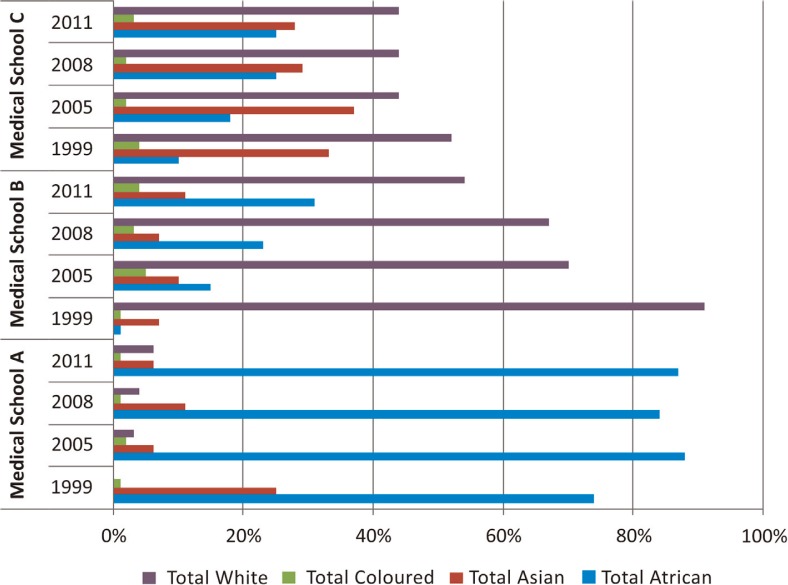
Results: The results show that there has been progress in transforming the race and gender composition of medical students and graduates, in line with the transformation strategies of the South African government. In 1999, black African enrolments and graduates were conspicuously low in two of the three medical schools in the Gauteng province. By 2011, an almost six-fold increase in black African student enrolments was seen in one medical school that was previously designated as a white institution. In contrast, at the historically black medical school, whites only represented 0.40% of enrolments in 1999 and 7.4% in 2011. Since 1999, the number and proportion of female medical enrolments and graduates has also increased substantially.
Conclusion: While there has been progress with redressing historical disparities and inequities in terms of race and gender, further efforts are needed to ensure that student intakes and graduations are in line with the South African population profile.
Keywords: gender; inequalities; medical education; race; transformation.
Figures
References
-
- Woollard RF. Caring for a common future: medical schools’ social accountability. Med Educ. 2006;40:301–13. - PubMed
-
- Frenk J, Chen L, Bhutta ZA, Cohen J, Crisp N, Evans T, et al. Health professionals for a new century: transforming education to strengthen health systems in an interdependent world. Revista Peruana de Medicina Experimental y Salud Pública. 2011;28:337–41. - PubMed
-
- World Health Organisation. Transformative scale up of health professional education [Internet] Geneva: Switzerland: 2011. Available from: www.who.int/hrh/resources/transformativeeducation/en/index.html [cited 12 September 2012]
-
- Aina TA. Beyond reforms: the politics of higher education transformation in Africa. Afr Stud Rev. 2010;53:21–40.
-
- Maassen P, Cloete N. Global reform trends in higher education. Transform Higher Educ. 2006;10:7–33.
MeSH terms
LinkOut - more resources
Full Text Sources
Other Literature Sources
