Review
doi: 10.1099/vir.0.049296-0.
Epub 2013 Jan 30.
Recent developments in human immunodeficiency virus-1 latency research
Affiliations
- PMID: 23364195
- PMCID: PMC3709588
- DOI: 10.1099/vir.0.049296-0
Item in Clipboard
Review
Recent developments in human immunodeficiency virus-1 latency research
J Gen Virol.
2013 May.
Abstract
Almost 30 years after its initial discovery, infection with the human immunodeficiency virus-1 (HIV-1) remains incurable and the virus persists due to reservoirs of latently infected CD4(+) memory T-cells and sanctuary sites within the infected individual where drug penetration is poor. Reactivating latent viruses has been a key strategy to completely eliminate the virus from the host, but many difficulties and unanswered questions remain. In this review, the latest developments in HIV-persistence and latency research are presented.
Figures
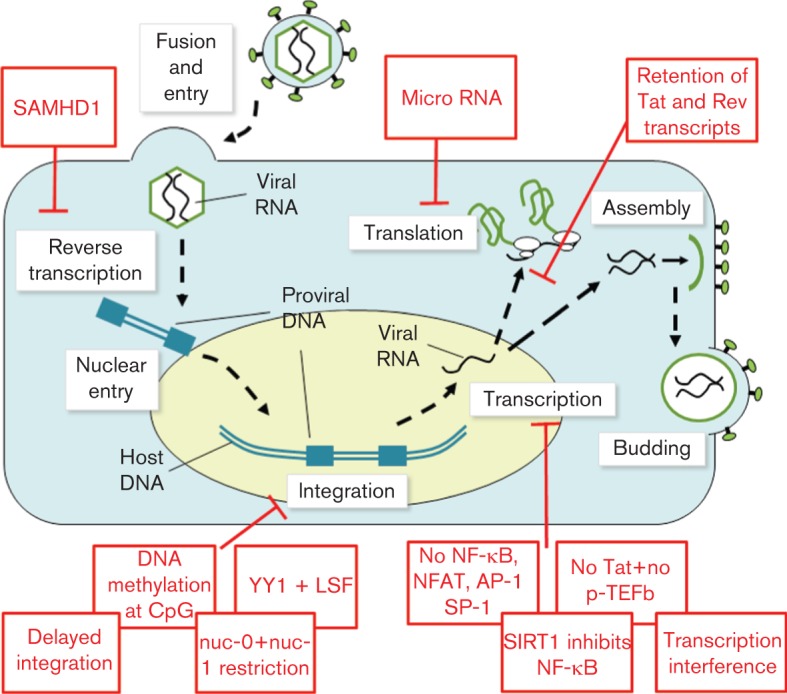
A summary of the multiple obstacles blocking productive HIV-1 infection of resting CD4+ T-cells. Inhibition of virus replication occurs at multiple steps during the viral life cycle. Transcription interference refers to promoter occlusion and the collision of RNA polymerases that hinder efficient viral gene expression.
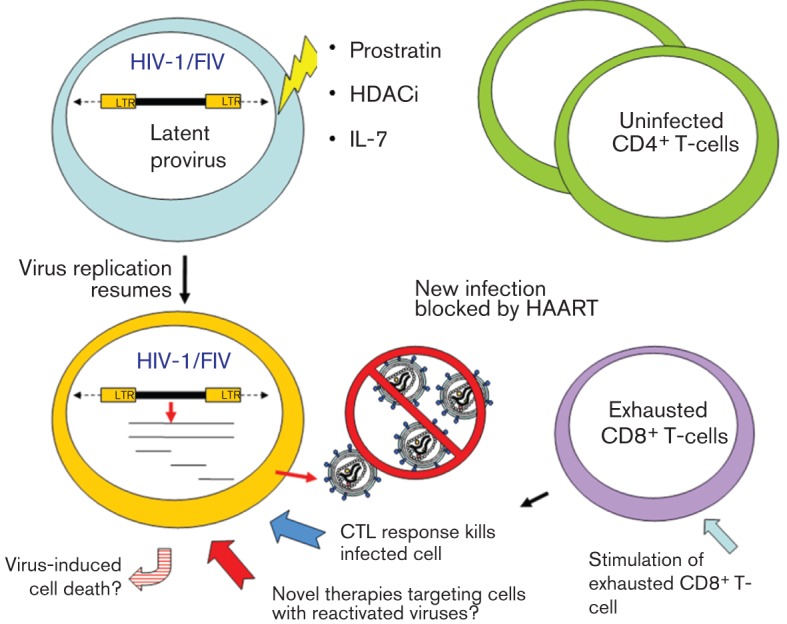
A theoretical scheme to eliminate the latent HIV-1 reservoir within the resting T-cell population. Virus replication in latently infected cells could be reactivated by, for example, treatments with prostratin, histone deacetylase inhibitors (HDACi) or IL-7. Meanwhile the CTL responses of the patient could be restored by stimulation with viral antigens and cytokines. Although the reactivation of the latent virus may not lead to the apoptosis of the infected cell as previously assumed, the restored CTL response or the use of novel drug-delivery technologies may allow the specific targeting of the infected cells for destruction.
References
-
- Anderson J., Li M.-J., Palmer B., Remling L., Li S., Yam P., Yee J.-K., Rossi J., Zaia J., Akkina R. (2007). Safety and efficacy of a lentiviral vector containing three anti-HIV genes–CCR5 ribozyme, tat-rev siRNA, and TAR decoy–in SCID-hu mouse-derived T cells. Mol Ther 15, 1182–1188 - PubMed
Publication types
MeSH terms
Substances
Grants and funding
LinkOut - more resources
Full Text Sources
Other Literature Sources
Medical
Research Materials