


Real-time ultrasound-guided spinal anaesthesia: a prospective observational study of a new approach
- PMID: 23365568
- PMCID: PMC3556419
- DOI: 10.1155/2013/525818
Real-time ultrasound-guided spinal anaesthesia: a prospective observational study of a new approach
Abstract
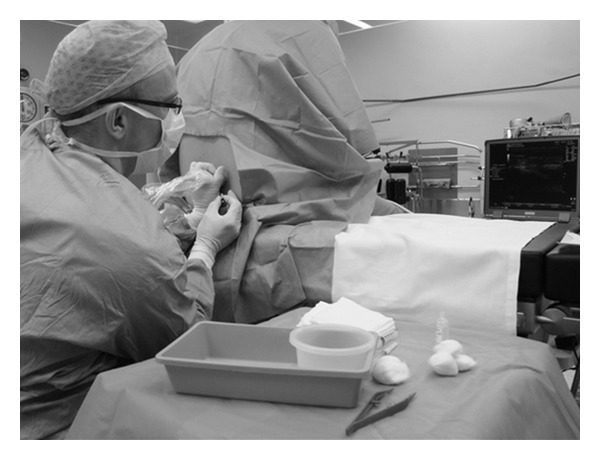
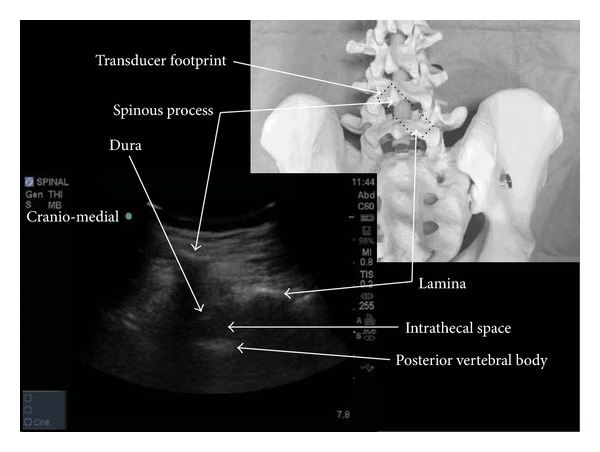
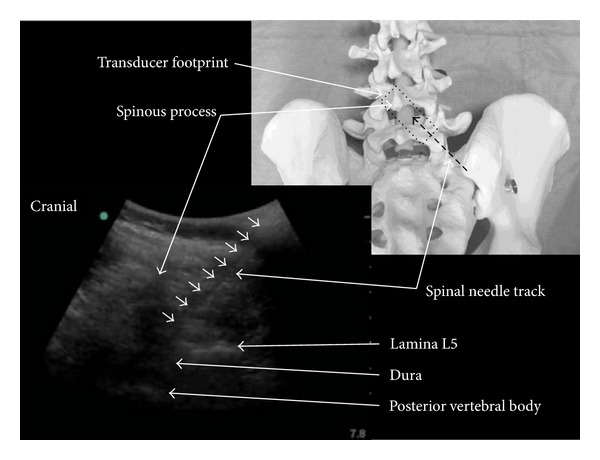
Identification of the subarachnoid space has traditionally been achieved by either a blind landmark-guided approach or using prepuncture ultrasound assistance. To assess the feasibility of performing spinal anaesthesia under real-time ultrasound guidance in routine clinical practice we conducted a single center prospective observational study among patients undergoing lower limb orthopaedic surgery. A spinal needle was inserted unassisted within the ultrasound transducer imaging plane using a paramedian approach (i.e., the operator held the transducer in one hand and the spinal needle in the other). The primary outcome measure was the success rate of CSF acquisition under real-time ultrasound guidance with CSF being located in 97 out of 100 consecutive patients within median three needle passes (IQR 1-6). CSF was not acquired in three patients. Subsequent attempts combining landmark palpation and pre-puncture ultrasound scanning resulted in successful spinal anaesthesia in two of these patients with the third patient requiring general anaesthesia. Median time from spinal needle insertion until intrathecal injection completion was 1.2 minutes (IQR 0.83-4.1) demonstrating the feasibility of this technique in routine clinical practice.
Figures
References
-
- Bier A. Versuche über cocainisirung des rückenmarkes. Deutsch Zeitschrift für Chirurgie. 1899;51(3):352–358.
-
- Broadbent CR, Maxwell WB, Ferrie R, Wilson DJ, Gawne-Cain M, Russell R. Ability of anaesthetists to identify a marked lumbar interspace. Anaesthesia. 2000;55(11):1122–1126. - PubMed
-
- Wulf H. Epidural anaesthesia and spinal haematoma. Canadian Journal of Anaesthesia. 1996;43(12):1260–1271. - PubMed
-
- Flaatten H, Felthaus J, Larsen R, Bernhardsen S, Klausen H. Postural post-dural puncture headache after spinal and epidural anaesthesia. A randomised, double-blind study. Acta Anaesthesiologica Scandinavica. 1998;42(7):759–764. - PubMed
-
- Harrison DA, Langham BT. Spinal anaesthesia for urological surgery. A survey of failure rate, postdural puncture headache and patient satisfaction. Anaesthesia. 1992;47(10):902–903. - PubMed
LinkOut - more resources
Full Text Sources
Other Literature Sources
Medical
