. 2012:2012:1366-9.
doi: 10.1109/EMBC.2012.6346192.

Implementation of activity-dependent synaptic plasticity rules for a large-scale biologically realistic model of the hippocampus

Affiliations

Implementation of activity-dependent synaptic plasticity rules for a large-scale biologically realistic model of the hippocampus

Brian S Robinson et al. Annu Int Conf IEEE Eng Med Biol Soc. 2012.

Abstract

A large-scale computational model of the hippocampus should consider plasticity at different time scales in order to capture the non-stationary information processing behavior of the hippocampus more accurately. This paper presents a computational model that describes hippocampal long-term potentiation/depression (LTP/LTD) and short-term plasticity implemented in the NEURON simulation environment. The LTP/LTD component is based on spike-timing-dependent plasticity (STDP). The short-term plasticity component modifies a previously defined deterministic model at a population synapse level to a probabilistic model that can be implemented at a single synapse level. The plasticity mechanisms are validated and incorporated into a large-scale model of the entorhinal cortex projection to the dentate gyrus. Computational expense of the added plasticity was also evaluated and shown to increase simulation time by less than a factor of two. This model can be easily included in future large-scale hippocampal simulations to investigate the effects of LTP/LTD and short-term plasticity in conjunction with other biological considerations on system function.


Figures

Fig 1
Fig 1
Diagram of short-term plasticity and STDP implementation. Short-term plasticity determines the vesicle release probability based on the presynaptic spike train timing. For each presynaptic spike, vesicle release either occurs or not based on the vesicle release probability. With each vesicle release, there is a momentary increase in synaptic conductance. STDP determines the magnitude of the increase in synaptic conductance based on the relative timing of vesicle release and postsynaptic spiking.
Fig. 2
Fig. 2
STDP function in a single synapse during a simulation. The vertical dotted line in the bottom plot indicates the timing of presynaptic events.
Fig. 3
Fig. 3
Traces of D variable with 20 Hz stimulus for 10 consecutive presynaptic events.
Fig. 4
Fig. 4
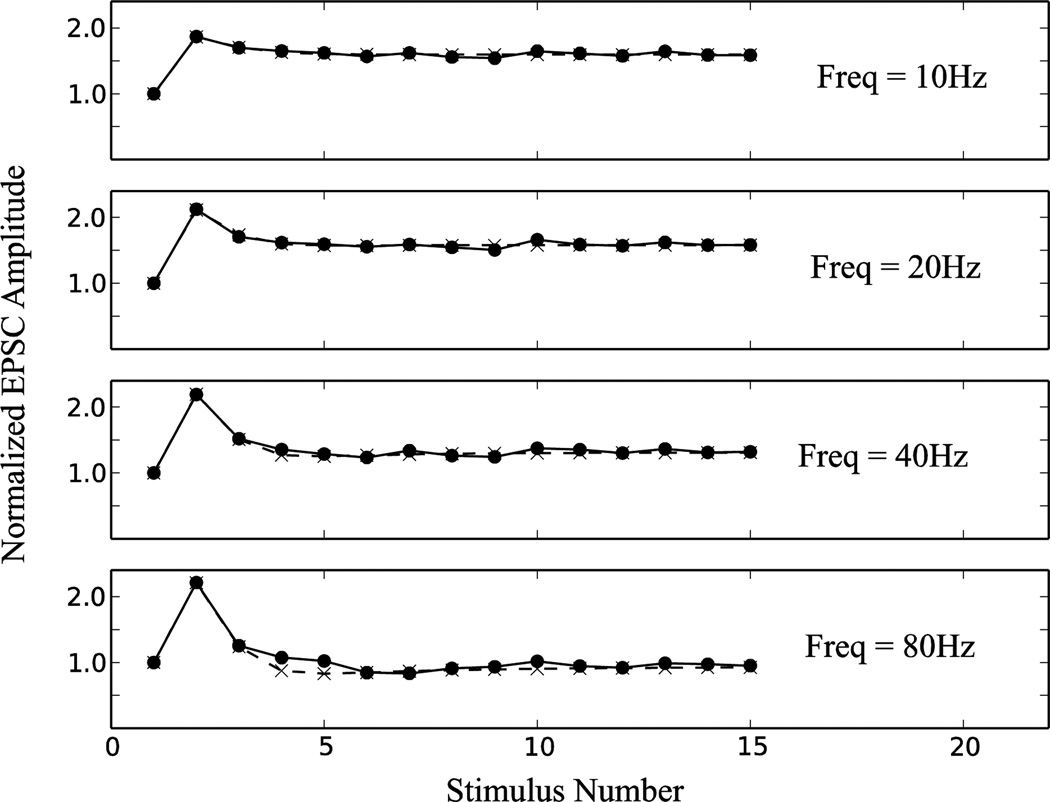
Normalized EPSC amplitude comparison between deterministic model (dashed line) and probabilistic model (solid line).
Fig. 5
Fig. 5
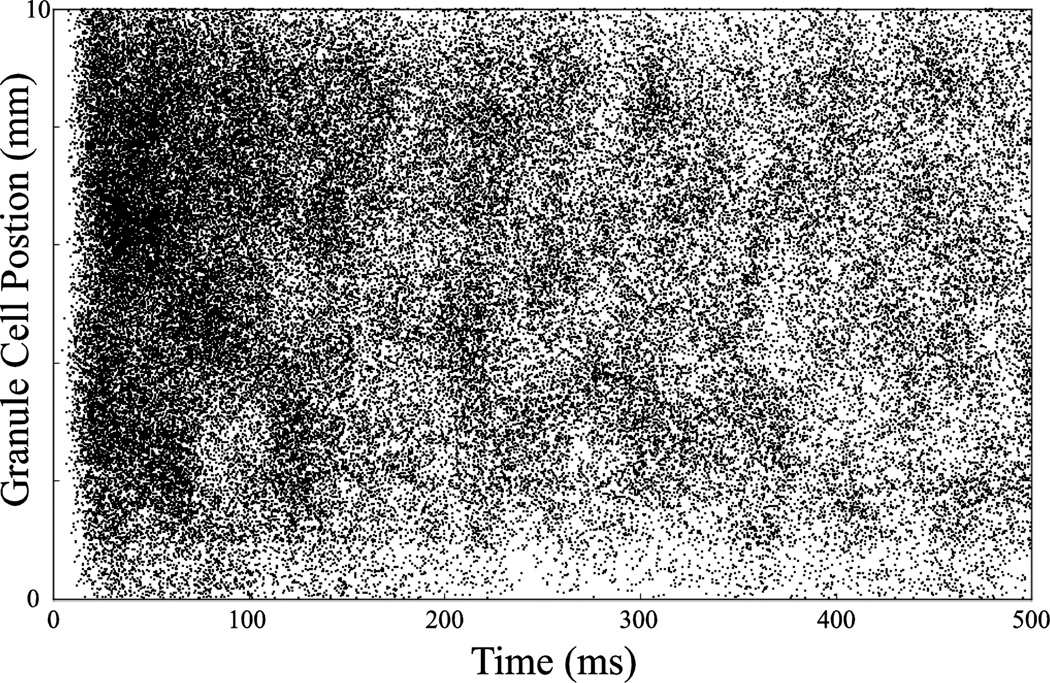
Example raster plot of spiking activity of large-scale simulation. Granule cell position refers to position along septotemporal axis of the DG.
Fig. 6
Fig. 6
Simulation time with 100,000 DG granule cells, 11,000 EC cells, ~3000 synapses per granule cell, 200ms simulated biological time.

References

    1. Hendrickson PJ, Yu GJ, Robinson BS, Song D, Berger TW. Toward a Large-Scale Biologically Realistic Model of the Hippocampus; 34th Annual International Conference of the IEEE EMBS; 2012. - PMC - PubMed
    1. Yu GJ, Robinson BS, Hendrickson PJ, Song D, Berger TW. Implementation of a Topographically Constrained Connectivity for a Large-Scale Biologically Realistic Model of the Hippocampus; 34th Annual International Conference of the IEEE EMBS; 2012. - PMC - PubMed
    1. Caporale N, Dan Y. Spike timing-dependent plasticity: a Hebbian learning rule. Annual review of neuroscience. 2008 Jan.31:25–46. - PubMed
    1. Fioravante D, Regehr WG. Short-term forms of presynaptic plasticity. Current opinion in neurobiology. 2011 Apr.21(2):269–274. - PMC - PubMed
    1. Hines ML, Carnevale NT. The NEURON simulation environment. Neural computation. 1997 Aug.9(6):1179–1209. - PubMed

Publication types

LinkOut - more resources