


How input fluctuations reshape the dynamics of a biological switching system
- PMID: 23367979
- PMCID: PMC5836738
- DOI: 10.1103/PhysRevE.86.061910
How input fluctuations reshape the dynamics of a biological switching system
Abstract
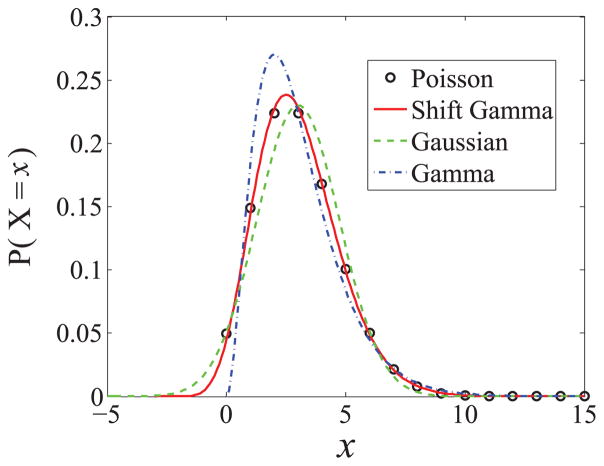
An important task in quantitative biology is to understand the role of stochasticity in biochemical regulation. Here, as an extension of our recent work [Phys. Rev. Lett. 107, 148101 (2011)], we study how input fluctuations affect the stochastic dynamics of a simple biological switch. In our model, the on transition rate of the switch is directly regulated by a noisy input signal, which is described as a non-negative mean-reverting diffusion process. This continuous process can be a good approximation of the discrete birth-death process and is much more analytically tractable. Within this setup, we apply the Feynman-Kac theorem to investigate the statistical features of the output switching dynamics. Consistent with our previous findings, the input noise is found to effectively suppress the input-dependent transitions. We show analytically that this effect becomes significant when the input signal fluctuates greatly in amplitude and reverts slowly to its mean.
Figures


References
-
- Rao CV, Wolf DM, Arkin A. Nature (London) 2002;420:231. - PubMed
-
- Elowitz MB, Levine AJ, Siggia ED, Swain PD. Science. 2002;207:1183. - PubMed
-
- Blake WJ, Kærn M, Cantor CR, Collins JJ. Nature (London) 2003;422:633. - PubMed
-
- Kærn M, Elston TC, Blake WJ, Collins JJ. Nat Rev Genetics. 2005;6:451. - PubMed
Publication types
MeSH terms
Grants and funding
LinkOut - more resources
Full Text Sources