. 2012 Aug 15;1(1):16.
doi: 10.1186/2001-1326-1-16.

Contribution of uric acid to cancer risk, recurrence, and mortality

Affiliations

Contribution of uric acid to cancer risk, recurrence, and mortality

Mehdi A Fini et al. Clin Transl Med. .

Abstract

Two risk factors for the development and progression of cancers that are amenable to life style modification are chronic inflammation and the metabolic syndrome. This review proposes two new targets that may mechanistically integrate inflammation and metabolic syndrome, have been largely ignored, and are known to be druggable. Recent evidence has demonstrated that elevated serum uric acid (hyperuricemia) is associated with excess cancer risk, recurrence, and mortality. Although uric acid (UA) can function as a systemic antioxidant, its pro-inflammatory properties have been postulated to play an important role in the pathogenesis of cancer. Furthermore, obesity, Type 2 Diabetes Mellitus (T2DM), and the metabolic syndrome (MetS) are also associated with excess cancer, chronic inflammation, and with hyperuricemia, suggesting that UA may represent an important link between these disorders and the development of cancer. While pharmacological modulation of hyperuricemia could in principal augment anti-cancer therapeutic strategies, some cancer cells express low intracellular levels of the enzyme Xanthine Oxidoreductase (XOR) that are associated with increased cancer aggressiveness and poor clinical outcome. Thus, systemic pharmacological inhibition of XOR may worsen clinical outcome, and specific strategies that target serum uric acid (SUA) without inhibiting tumor cell XOR may create new therapeutic opportunities for cancer associated with hyperuricemia. This review will summarize the evidence that elevated SUA may be a true risk factor for cancer incidence and mortality, and mechanisms by which UA may contribute to cancer pathogenesis will be discussed in the hope that these will identify new opportunities for cancer management.


Figures
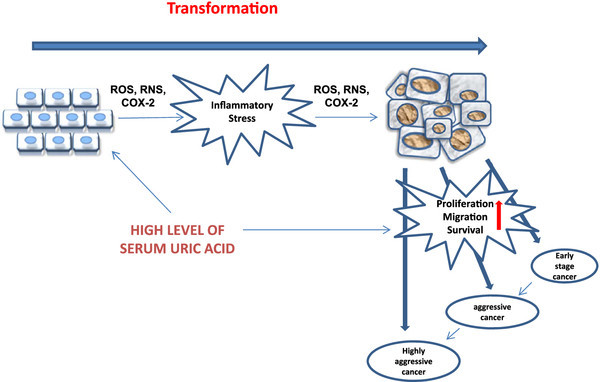
Figure 1
Figure 1
Hyperuricemia contributes to tumorigenesis by promoting both transformation and tumor cell proliferation, migration, and survival. High levels of extracellular UA present in the serum or in the local microenvironment of tumor cells exerts many pro-inflammatory effects that contribute to tumorigenesis. While extracellular UA has antioxidant effects that may protect normal cells from transformation, entry of UA into cells can generate inflammatory stress that arises from the effects of intracellular UA on ROS/RNS generation and COX-2 activation. Stimulation of cancer cells by UA further promotes proliferation, migration, and survival that mediates progression from early stage cancer to highly aggressive cancer.
Figure 2
Figure 2
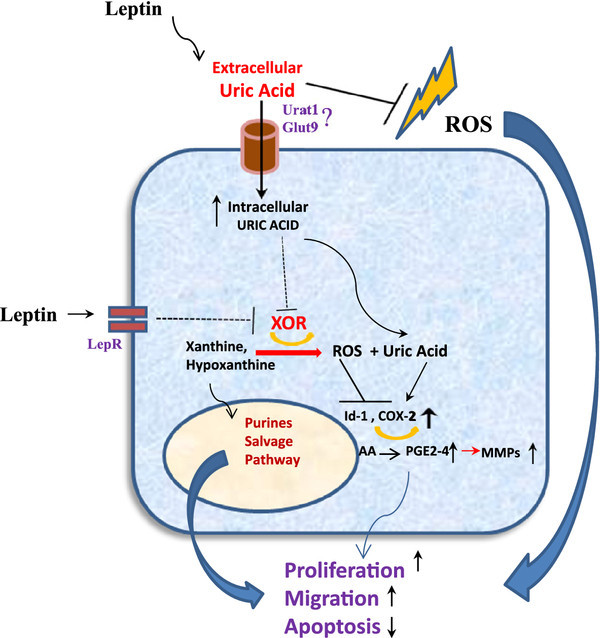
Elevated UA and reduced intracellular XOR contribute to tumor cell proliferation, migration, and survival. ROS scavenging properties of extracellular UA are postulated to promote cancer cell growth and survival in part by protecting cells from oxidative stress induced apoptosis. This arises because tumor cells in general exhibit poor capacity to survive oxidative stress compared with normal cells and may therefore be protected by the antioxidant ROS scavenging properties of UA (J-Shaped dose–response curve; [32]). Loss of XOR expression in the most aggressive cancer cells also contributes to tumor cell proliferation, migration, and survival. In cells showing high level XOR expression, XOR modulates COX-2 and MMP expression reducing migratory activity [136]. However, loss of XOR expression in cancer cells increases COX-2 levels, MMP expression, and migratory activity. Loss of XOR expression may arise for many reasons, including the entry of UA into cancer cells. Import of UA into XOR deficient cancer cells may further promote proliferation and survival in part by stimulating expression of COX-2. The diminished XOR expression found in aggressive cancer cells would result in shunting the XOR substrates hypoxanthine and xanthine into the salvage pathway, providing substrates for nucleotide synthesis, tumor growth, and proliferation. The independent effects of leptin on cancer cells notwithstanding [85,113], the elevated levels of leptin observed in MetS associated cancer may also drive these processes both by inducing hyperuricemia and by down regulating cancer cell XOR.
Figure 3
Figure 3
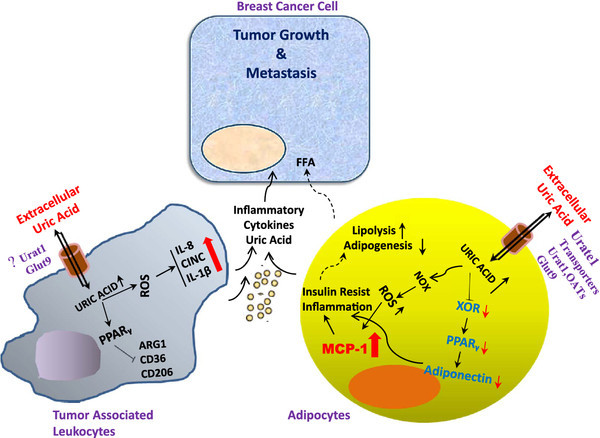
Hypothesis for the protumorigenic role of UA in the breast cancer microenvironment. UA is postulated to enter tumor associated and/or distant adipocytes through a UA-specific transporter (likely URAT1) where it activates the NADPH Oxidase (NOX), generating ROS. As observed in other inflammatory environments, UA at both normo- and hyperuricemic levels may simultaneously increase steady state mRNA expression of the leukocyte chemokine MCP-1 and decrease expression of the anti-inflammatory protein adiponectin. In addition, UA entering adipocytes may down-regulate expression of XOR which is known as a crucial upstream regulator of PPAR-γ, a master regulator of adipogenesis and adiponectin expression. Furthermore, as previously shown, UA may reduce levels of the macrophage antiinflammatory markers Arginase-1, CD36, and CD206, an effect transduced in part by inhibition of PPARγ sumoylation that in turn promotes macrophage inflammatory activation. Presently, the identity of the UA transporter mediating macrophage response to UA has not been identified. As an endogenous product of leukocytes, XOR activity may exert many effects on inflammatory potential, cytokine synthesis, and lipid uptake. Together, these findings support the hypothesis that hyperuricemia might be partially responsible for the low grade inflammation present in the breast tumor microenvironment that contributes to tumor cell proliferation and metastasis.

References

    1. Hille R. Molybdenum-containing hydroxylases. Arch Biochem Biophys. 2005;433(1):107–116. doi: 10.1016/j.abb.2004.08.012. - DOI - PubMed
    1. Oxipurinol: alloxanthine, Oxyprim, oxypurinol. Drugs R D. 2004;5(3):171–175. doi: 10.2165/00126839-200405030-00008. - DOI - PubMed
    1. Pacher P, Nivorozhkin A, Szabo C. Therapeutic effects of xanthine oxidase inhibitors: renaissance half a century after the discovery of allopurinol. Pharmacol Rev. 2006;58(1):87–114. doi: 10.1124/pr.58.1.6. - DOI - PMC - PubMed
    1. Ames BN, Cathcart R, Schwiers E, Hochstein P. Uric acid provides an antioxidant defense in humans against oxidant- and radical-caused aging and cancer: a hypothesis. Proceedings of the National Academy of Sciences of the United States of America. 1981;78(11):6858–6862. doi: 10.1073/pnas.78.11.6858. - DOI - PMC - PubMed
    1. Becker BF. Towards the physiological function of uric acid. Free radical biology & medicine. 1993;14(6):615–631. doi: 10.1016/0891-5849(93)90143-I. - DOI - PubMed