


A robust multi-shot scan strategy for high-resolution diffusion weighted MRI enabled by multiplexed sensitivity-encoding (MUSE)
- PMID: 23370063
- PMCID: PMC3602151
- DOI: 10.1016/j.neuroimage.2013.01.038
A robust multi-shot scan strategy for high-resolution diffusion weighted MRI enabled by multiplexed sensitivity-encoding (MUSE)
Abstract
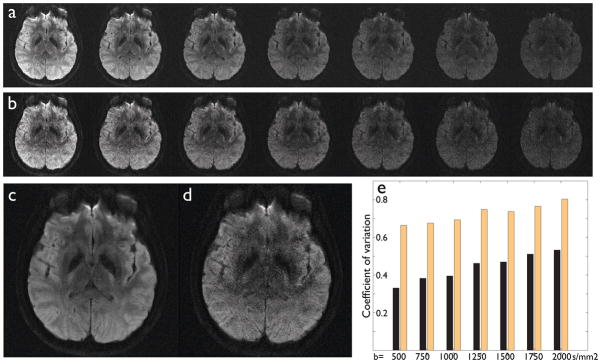
Diffusion weighted magnetic resonance imaging (DWI) data have been mostly acquired with single-shot echo-planar imaging (EPI) to minimize motion induced artifacts. The spatial resolution, however, is inherently limited in single-shot EPI, even when the parallel imaging (usually at an acceleration factor of 2) is incorporated. Multi-shot acquisition strategies could potentially achieve higher spatial resolution and fidelity, but they are generally susceptible to motion-induced phase errors among excitations that are exacerbated by diffusion sensitizing gradients, rendering the reconstructed images unusable. It has been shown that shot-to-shot phase variations may be corrected using navigator echoes, but at the cost of imaging throughput. To address these challenges, a novel and robust multi-shot DWI technique, termed multiplexed sensitivity-encoding (MUSE), is developed here to reliably and inherently correct nonlinear shot-to-shot phase variations without the use of navigator echoes. The performance of the MUSE technique is confirmed experimentally in healthy adult volunteers on 3Tesla MRI systems. This newly developed technique should prove highly valuable for mapping brain structures and connectivities at high spatial resolution for neuroscience studies.
Copyright © 2013 Elsevier Inc. All rights reserved.
Figures
References
-
- Anderson AW, Gore JC. Analysis and correction of motion artifacts in diffusion weighted imaging. Magn Reson Med. 1994 Sep;32 (3):379–87. - PubMed
-
- Andersson JLR, Skare S. A model-based method for retrospective correction of geometric distortions in diffusion-weighted epi. Neuroimage. 2002 May;16 (1):177–99. - PubMed
-
- Atkinson D, Counsell S, Hajnal JV, Batchelor PG, Hill DLG, Larkman DJ. Nonlinear phase correction of navigated multi-coil diffusion images. Magn Reson Med. 2006 Nov;56 (5):1135–9. - PubMed
-
- Atkinson D, Porter DA, Hill DL, Calamante F, Connelly A. Sampling and reconstruction effects due to motion in diffusion-weighted interleaved echo planar imaging. Magn Reson Med. 2000 Jul;44 (1):101–9. - PubMed
Publication types
MeSH terms
Grants and funding
LinkOut - more resources
Full Text Sources
Other Literature Sources
Medical
