. 2014 Jul;53(7):566-77.
doi: 10.1002/mc.22008. Epub 2013 Jan 31.

Anticancer activity of fish oils against human lung cancer is associated with changes in formation of PGE2 and PGE3 and alteration of Akt phosphorylation

Affiliations

Anticancer activity of fish oils against human lung cancer is associated with changes in formation of PGE2 and PGE3 and alteration of Akt phosphorylation

Peiying Yang et al. Mol Carcinog. 2014 Jul.

Abstract

The beneficial effects of omega-3 fatty acids are believed to be due in part to selective alteration of arachidonate metabolism that involves cyclooxygenase (COX) enzymes. Here we investigated the effect of eicosapentaenoic acid (EPA) on the proliferation of human non-small cell lung cancer A549 (COX-2 over-expressing) and H1299 (COX-2 null) cells as well as their xenograft models. While EPA inhibited 50% of proliferation of A549 cells at 6.05 µM, almost 80 µM of EPA was needed to reach similar levels of inhibition of H1299 cells. The formation of prostaglandin (PG)E3 in A549 cells was almost threefold higher than that of H1299 cells when these cells were treated with EPA (25 µM). Intriguingly, when COX-2 expression was reduced by siRNA or shRNA in A549 cells, the antiproliferative activity of EPA was reduced substantially compared to that of control siRNA or shRNA transfected A549 cells. In line with this, dietary menhaden oil significantly inhibited the growth of A549 tumors by reducing tumor weight by 58.8 ± 7.4%. In contrast, a similar diet did not suppress the development of H1299 xenograft. Interestingly, the ratio of PGE3 to PGE2 in A549 was about 0.16 versus only 0.06 in H1299 xenograft tissues. Furthermore, PGE2 up-regulated expression of pAkt, whereas PGE3 downregulated expression of pAkt in A549 cells. Taken together, the results of our study suggest that the ability of EPA to generate PGE3 through the COX-2 enzyme might be critical for EPA-mediated tumor growth inhibition which is at least partly due to down-regulation of Akt phosphorylation by PGE3.

Keywords: COX-2; NSCLC cells; antiproliferative activity; fish oil EPA; prostaglandins.


Figures

Figure 1
Figure 1
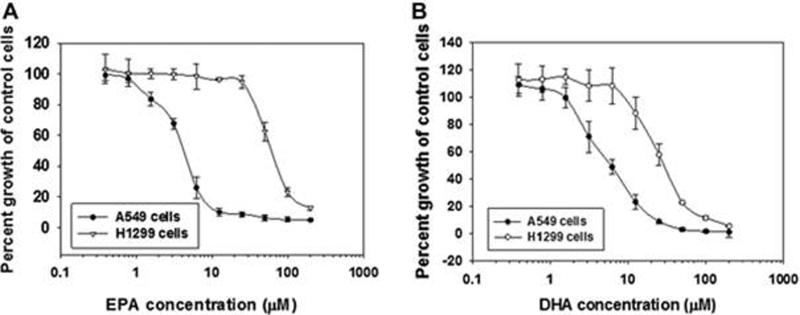
The anti-proliferative effect of EPA and DHA in human non-small cell lung cancer A549 (COX-2 constitutively expressed) and H1299 (COX-2 lacking) cells. A. Exposure of A549 and H1299 cells to EPA for 72 hours produced an 8-fold stronger inhibition of cell proliferation to A549 cells than that in H1299 cells. B. Both A549 and H1299 cells were treated with DHA for 72 hrs. The anti-proliferative effect of DHA in A549 cells was only 5-fold stronger than that in H1299 cells.
Figure 2
Figure 2
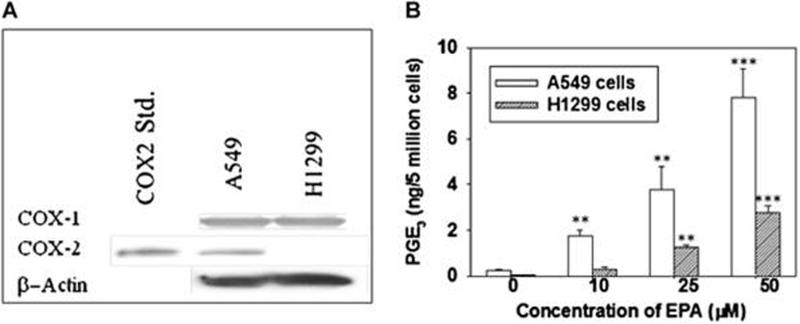
The expression of COX-1 and COX-2 in A549 and H1299 cells and the relatively formation of PGE2 and PGE3 is shown for both cell line. A. A549 and H1299 cells were collected, lysed, and protein levels of COX-1 and COX-2 determined by Western blotting with relevant antibodies. B. Cells (5 × 10⁶) were treated with EPA (25 to 100 μM) for 20 min at 37°C followed by extraction with hexane and ethyl acetate (:1) as described in Material and Methods. The formation of PGE3 by EPA in A549 cells was markedly higher than that in H1299 cells. * P < 0.05, ** P < 0.01, and *** P < 0.005 versus control vehicle treated. Data are presented as the means ± SDs of three independent experiments.
Figure 3
Figure 3
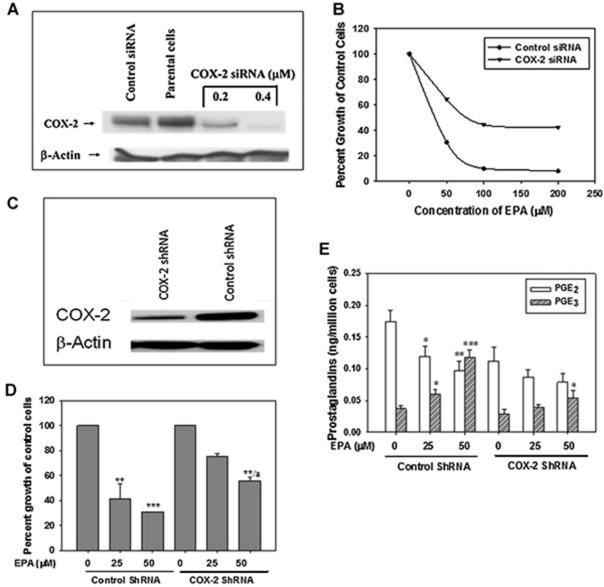
Decreasing the expression of COX-2 protein and formation of PGE3 in A549 cells affects cell sensitivity to EPA. A, Cells were transfected for 24 hr with either control siRNA or COX-2 siRNA (0.2-0.4 μM). Cells transfected with COX-2 siRNA resulted in approximately an 85% reduction of COX-2 protein compared to control siRNA transfected cells. The reduction of the COX-2 expression was concentration dependent. B. Cells exhibiting knockdown of COX-2 protein were less sensitive to EPA implying that the COX-2 target is necessary to retain sensitivity of A549 cells to EPA treatment. C. COX-2 expression was noticeably reduced in stably COX-2 knockdown A549 cells; D. COX-2 stably knockdown A549 cells were much less sensitive to EPA treatment than that in control-ShRNA transfected A549 cells. * P < 0.05, ** P < 0.01, and *** P < 0.005 versus control vehicle treated. a p< 0.05 versus control shRNA treated with 50 μM EPA. Data are presented as the means ± SDs of three independent experiments. E. The effect of EPA in the formation of PGE2 and PGE3 in control shRNA and COX-2 shRNA transfected A549 cells. While EPA was able to inhibit PGE2 formation and concomitantly increased production of PGE3 in the control shRNA transfected A549 cell, the effect of EPA on reduction of PGE2 and formation of PGE3 in COX-2 shRNA transfected A549 cells were relatively weaker comparing to that of control shRNA transfected cells. * P < 0.05, ** P < 0.01, and *** P < 0.005 versus control vehicle treated. Data are presented as the means ± SDs of three independent experiments.
Figure 4
Figure 4
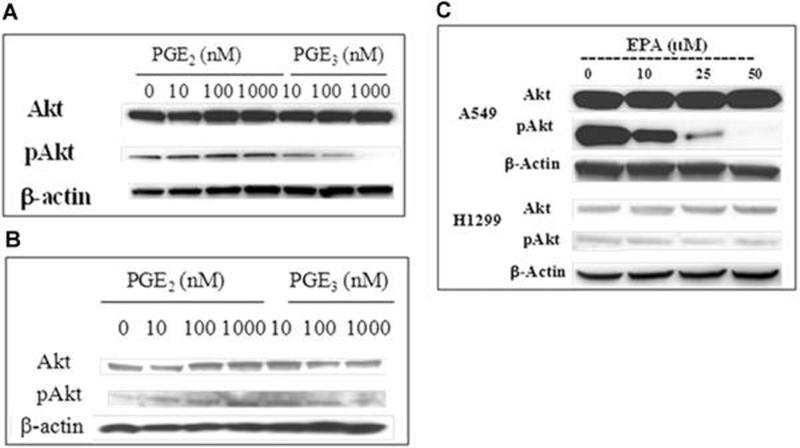
The effect of PGE2, PGE3, and EPA on expression of Akt and pAkt in H1299 and A549 cells. Cells (2 × 10⁶) were plated and allowed to attach overnight. They were then serum starved for 24 hrs followed by treatment with PGE2, PGE3 (10 to 1000 nM) or EPA (10 to 50 uM) for an additional 24 hrs. Cells were then harvested, proteins extracted and subjected to measurement of Akt and pAkt proteins by immunoblotting. A. A549 cells treated with PGE2 and PGE3; B; H1299 cells cells treated with PGE2 and PGE3; C A549 and H1299 treated with EPA. The data are representative of two sets of experiments with similar results.
Figure 5
Figure 5
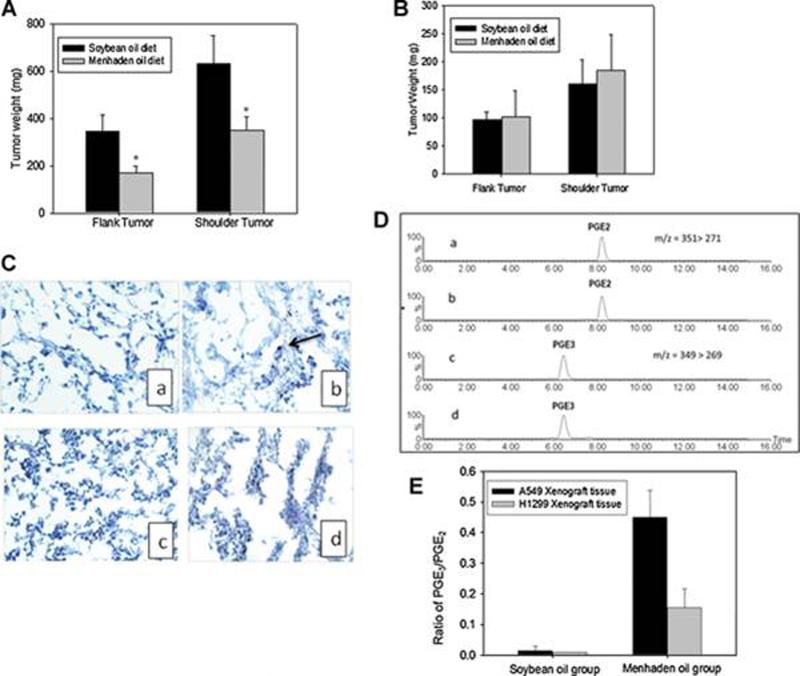
Antitumor efficacy of the menhaden oil in human non-small cell lung cancer A549 and H1299 xenograt models. A. Menhaden oil significantly inhibited the tumor growth implanted in both flank and shoulder positions in comparison to that of soybean oil treated A549 group (n = 10) ; B. the tumor weight of both flank and shoulder in H1299 bearing mice fed on the menhaden oil diet was similar to that of the control group (n=10). C. IHC staining of cleaved caspase 3 in A549 (a & b) and H1299 (c&d) xengraft tissues. a. A549 soybean; b A549 menhaden oil; c. H1299 soybean; d. H1299 menhaden oil. D. Representive of ion chromatogram of PGE2 and PGE3 in A549 xenograft tumor tissues. E. Endogenous levels of PGE2 and PGE3 in both A549 and H1299 xenograft tissues measured by LC/MS/MS method as described in Material and Methods. Menhaden oil markedly enhanced the ratio of PGE3 over PGE2 in A549 xenograft tissues while only a moderately enhancement of this ratio was observed in H1299 xenograft tissues (n=5). * P < 0.05 versus soybean diet treated group. Data are presented as mean ± SD.

References

    1. Jemal A, Siegel R, Ward E, Hao Y, Xu J, Thun MJ. Cancer statistics, 2009. CA Cancer J Clin. 2009;59:225–249. - PubMed
    1. Smith CJ, Perfetti TA, King JA. Perspectives on pulmonary inflammation and lung cancer risk in cigarette smokers. Inhal Toxicol. 2006;18:667–677. - PubMed
    1. Moysich KB, Menezes RJ, Ronsani A, et al. Regular aspirin use and lung cancer risk. BMC Cancer. 2002;2:31. - PMC - PubMed
    1. Lee JM, Yanagawa J, Peebles KA, Sharma S, Mao JT, Dubinett SM. Inflammation in lung carcinogenesis: new targets for lung cancer chemoprevention and treatment. Crit Rev Oncol Hematol. 2008;66:208–217. - PMC - PubMed
    1. Harris RE, Beebe-Donk J, Doss H, Burr Doss D. Aspirin, ibuprofen, and other non-steroidal anti-inflammatory drugs in cancer prevention: a critical review of non-selective COX-2 blockade (review) Oncol Rep. 2005;13:559–583. - PubMed

Publication types

MeSH terms