Long-term outcomes of arteriovenous thigh grafts in hemodialysis patients: a comparison with tunneled dialysis catheters
- PMID: 23371958
- PMCID: PMC3641621
- DOI: 10.2215/CJN.09240912
Long-term outcomes of arteriovenous thigh grafts in hemodialysis patients: a comparison with tunneled dialysis catheters
Abstract
Background and objective: Arteriovenous thigh grafts are a potential vascular access option in hemodialysis patients who have exhausted all upper-limb sites. This study compared the outcomes of thigh grafts with outcomes obtained with dialysis catheters.
Design, setting, participants, & measurements: A prospective vascular access database was queried to identify 209 thigh grafts placed from January 1, 2003, to June 30, 2011. The following were calculated: secondary graft survival (from graft creation to permanent failure), assisted primary graft survival (from graft creation to first thrombosis), and infection-free graft survival (from graft creation to first graft infection). Graft outcomes were compared with those observed with 472 tunneled internal jugular dialysis catheters.
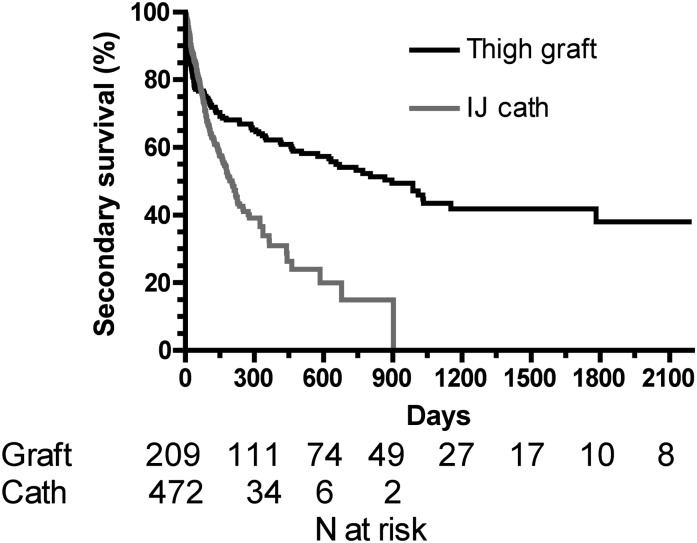
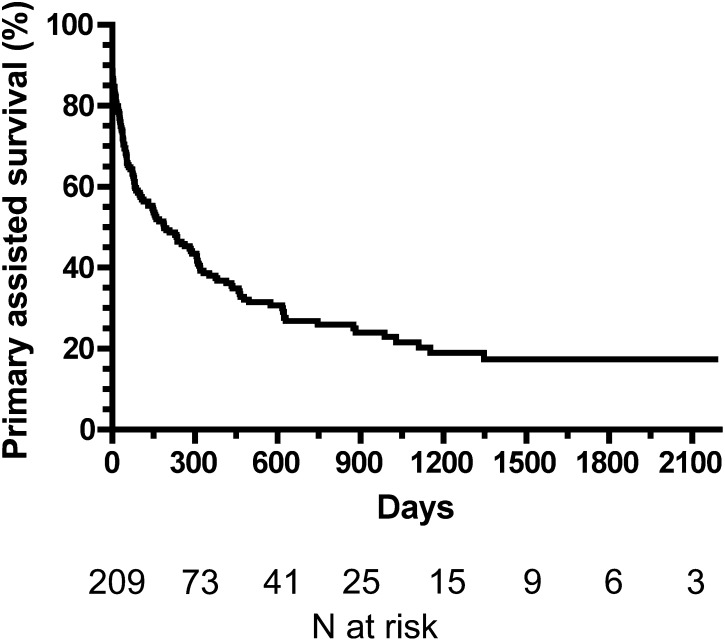
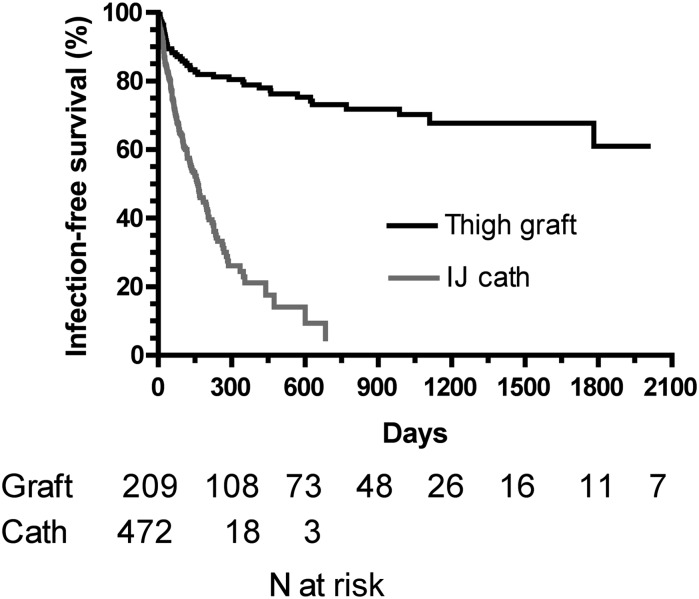
Results: The median duration of patient follow-up was 340 days for grafts and 91 days for catheters. The surgical technical failure rate of thigh grafts was 8.1% and was higher in patients with vascular disease (hazard ratio [HR], 2.94; 95% confidence interval [CI], 1.07-8.04; P=0.03). Secondary and assisted primary graft survival rates at 1, 2, and 5 years were 62%, 54%, and 38% and 38%, 27%, and 17%, respectively. Infection-free graft survival rates at 1, 2, and 5 years were 79%, 73%, and 61%. Secondary survival was much worse for dialysis catheters than thigh grafts (HR, 4.44; 95% CI, 3.65-5.22; P<0.001). Likewise, infection-free survival was far worse for catheters than for thigh grafts (HR, 3.77; 95% CI, 2.80-4.82; P<0.001).
Conclusions: Thigh grafts are a viable vascular option in patients who have exhausted upper-extremity options. Outcomes with thigh grafts are superior to those obtained with dialysis catheters.
Figures
Comment in
-
Lifting the veil: insights into vascular access options.Clin J Am Soc Nephrol. 2013 May;8(5):708-10. doi: 10.2215/CJN.03070313. Epub 2013 Apr 18. Clin J Am Soc Nephrol. 2013. PMID: 23599407 No abstract available.
References
-
- Vascular Access 2006 Work Group: Clinical practice guidelines for vascular access. Am J Kidney Dis 48[suppl 1]: S176–S247, 2006 - PubMed
-
- Allon M: Current management of vascular access. Clin J Am Soc Nephrol 2: 786–800, 2007 - PubMed
-
- Bhandari S, Wilkinson A, Sellars L: Saphenous vein forearm grafts and gortex thigh grafts as alternative forms of vascular access. Clin Nephrol 44: 325–328, 1995 - PubMed
-
- Khadra MH, Dwyer AJ, Thompson JF: Advantages of polytetrafluoroethylene arteriovenous loops in the thigh for hemodialysis access. Am J Surg 173: 280–283, 1997 - PubMed
-
- Miller CD, Robbin ML, Barker J, Allon M: Comparison of arteriovenous grafts in the thigh and upper extremities in hemodialysis patients. J Am Soc Nephrol 14: 2942–2947, 2003 - PubMed
Publication types
MeSH terms
LinkOut - more resources
Full Text Sources
Other Literature Sources
Medical