


Circulating endothelial progenitor cell and platelet microparticle impact on platelet activation in hypertension associated with hypercholesterolemia
- PMID: 23372649
- PMCID: PMC3556069
- DOI: 10.1371/journal.pone.0052058
Circulating endothelial progenitor cell and platelet microparticle impact on platelet activation in hypertension associated with hypercholesterolemia
Abstract
Aim: The purpose of this project was to evaluate the influence of circulating endothelial progenitor cells (EPCs) and platelet microparticles (PMPs) on blood platelet function in experimental hypertension associated with hypercholesterolemia.
Methods: Golden Syrian hamsters were divided in six groups: (i) control, C; (ii) hypertensive-hypercholesterolemic, HH; (iii) 'prevention', HHin-EPCs, HH animals fed a HH diet and treated with EPCs; (iv) 'regression', HHfin-EPCs, HH treated with EPCs after HH feeding; (v) HH treated with PMPs, HH-PMPs, and (vi) HH treated with EPCs and PMPs, HH-EPCs-PMPs.
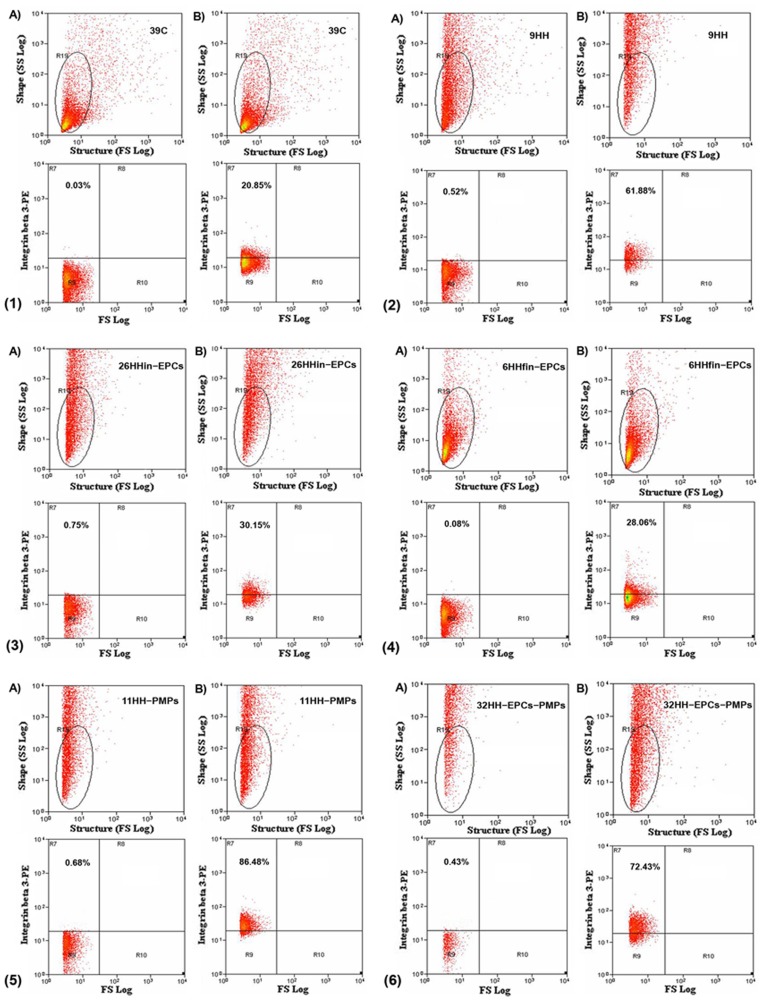
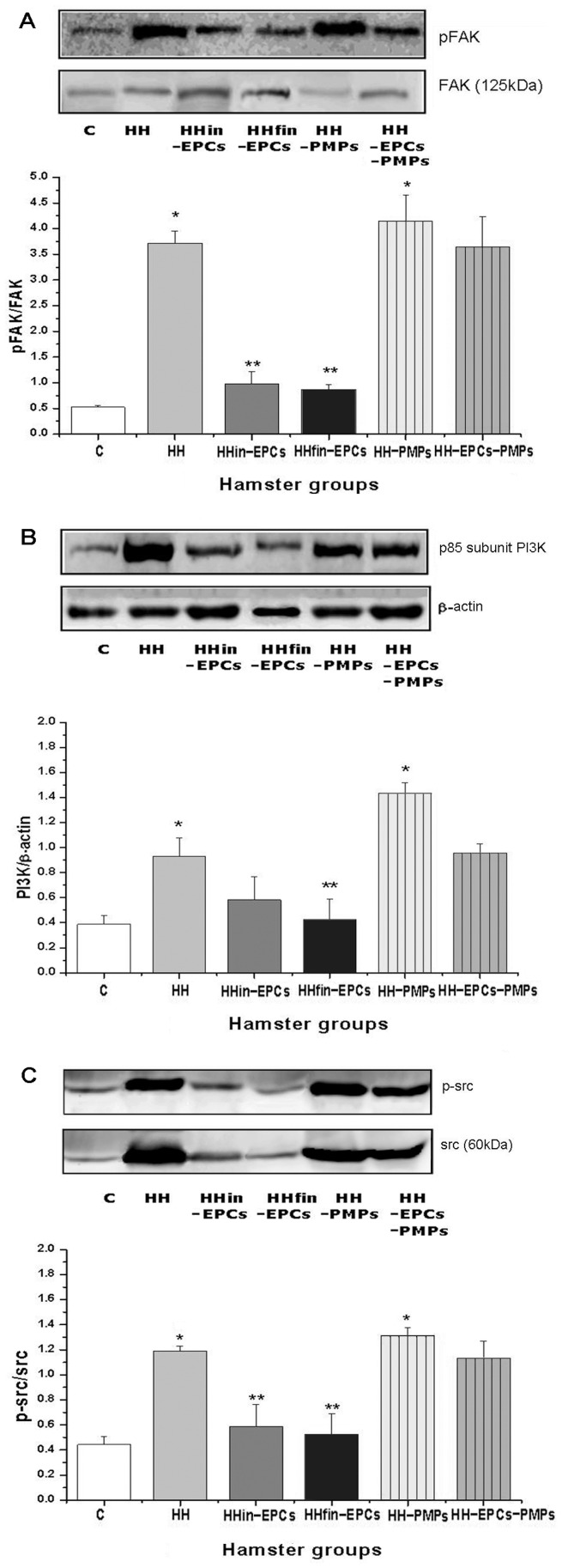
Results: Compared to HH group, the platelets from HHin-EPCs and HHfin-EPCs groups showed a reduction of: (i) activation, reflected by decreased integrin 3β, FAK, PI3K, src protein expression; (ii) secreted molecules as: SDF-1, MCP-1, RANTES, VEGF, PF4, PDGF and (iii) expression of pro-inflammatory molecules as: SDF-1, MCP-1, RANTES, IL-6, IL-1β; TFPI secretion was increased. Compared to HH group, platelets of HH-PMPs group showed increased activation, molecules release and proteins expression. Compared to HH-PMPs group the combination EPCs with PMPs treatment induced a decrease of all investigated platelet molecules, however not comparable with that recorded when EPC individual treatment was applied.
Conclusion: EPCs have the ability to reduce platelet activation and to modulate their pro-inflammatory and anti-thrombogenic properties in hypertension associated with hypercholesterolemia. Although, PMPs have several beneficial effects in combination with EPCs, these did not improve the EPC effects. These findings reveal a new biological role of circulating EPCs in platelet function regulation, and may contribute to understand their cross talk, and the mechanisms of atherosclerosis.
Conflict of interest statement
Figures

References
-
- Schmidt-Lucke C, Rössig L, Fichtlscherer S, Vasa M, Britten M, et al. (2005) Reduced number of circulating endothelial progenitor cells predicts future cardiovascular events: proof of concept for the clinical importance of endogenous vascular repair. Circulation 111: 2981–2987. - PubMed
-
- Heiss C, Keymel S, Niesler U, Ziemann J, Kelm M, et al. (2005) Impaired progenitor cell activity in age-related endothelial dysfunction. J Am Col. Cardiol 45: 1441–1448. - PubMed
-
- Urbich C, Dimmeler S (2005) Risk factors for coronary artery disease, circulating endothelial progenitor cells, and the role of HMG-CoA reductase inhibitors. Kidney Int 67: 1672–1676. - PubMed
-
- Dernbach E, Randriamboavonjy V, Fleming I, Zeiher AM, Dimmeler S, et al. (2008) Impaired interaction of platelets with endothelial progenitor cells in patients with cardiovascular risk factors. Basic Res Cardiol 103: 572–581. - PubMed
-
- Georgescu A, Alexandru N, Andrei E, Titorencu I, Dragan E, et al. (2012) Circulating microparticles and endothelial progenitor cells in atherosclerosis; pharmacological effects of irbesartan. J Thromb Haemost 10(4): 680–91. - PubMed
Publication types
MeSH terms
Substances
LinkOut - more resources
Full Text Sources
Other Literature Sources
Medical
Miscellaneous
