


The miRNA profile of human pancreatic islets and beta-cells and relationship to type 2 diabetes pathogenesis
- PMID: 23372846
- PMCID: PMC3555946
- DOI: 10.1371/journal.pone.0055272
The miRNA profile of human pancreatic islets and beta-cells and relationship to type 2 diabetes pathogenesis
Abstract
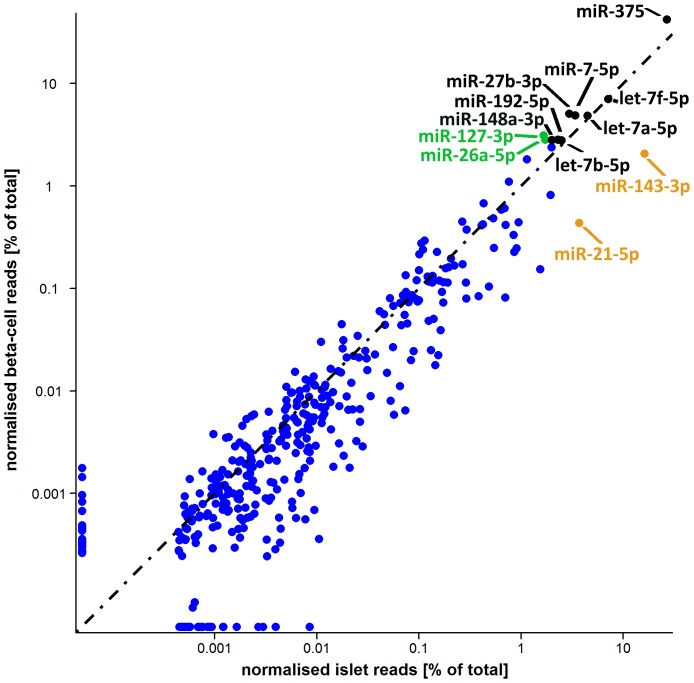
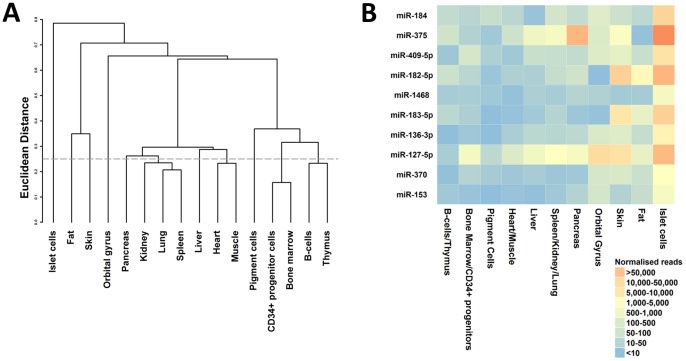
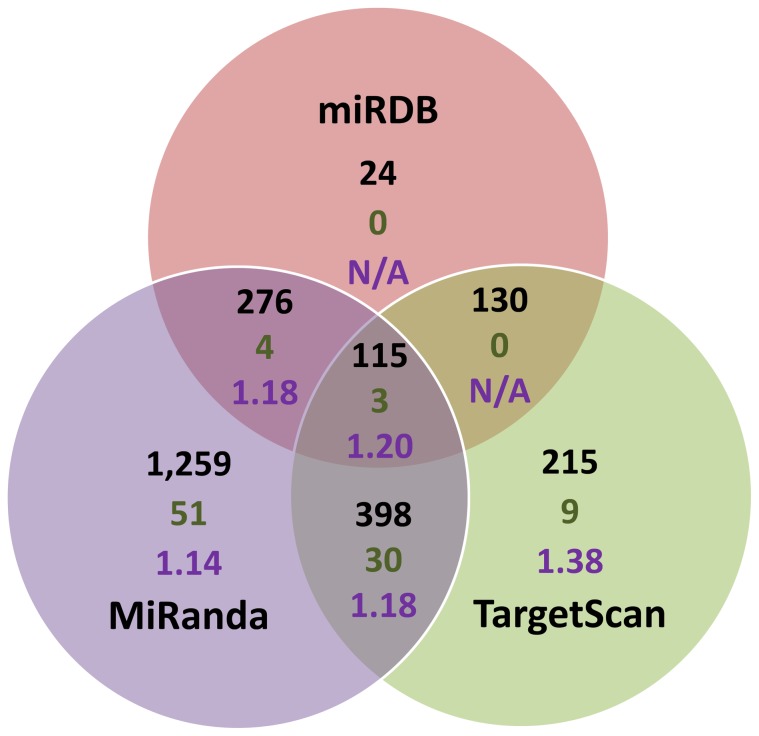
Recent advances in the understanding of the genetics of type 2 diabetes (T2D) susceptibility have focused attention on the regulation of transcriptional activity within the pancreatic beta-cell. MicroRNAs (miRNAs) represent an important component of regulatory control, and have proven roles in the development of human disease and control of glucose homeostasis. We set out to establish the miRNA profile of human pancreatic islets and of enriched beta-cell populations, and to explore their potential involvement in T2D susceptibility. We used Illumina small RNA sequencing to profile the miRNA fraction in three preparations each of primary human islets and of enriched beta-cells generated by fluorescence-activated cell sorting. In total, 366 miRNAs were found to be expressed (i.e. >100 cumulative reads) in islets and 346 in beta-cells; of the total of 384 unique miRNAs, 328 were shared. A comparison of the islet-cell miRNA profile with those of 15 other human tissues identified 40 miRNAs predominantly expressed (i.e. >50% of all reads seen across the tissues) in islets. Several highly-expressed islet miRNAs, such as miR-375, have established roles in the regulation of islet function, but others (e.g. miR-27b-3p, miR-192-5p) have not previously been described in the context of islet biology. As a first step towards exploring the role of islet-expressed miRNAs and their predicted mRNA targets in T2D pathogenesis, we looked at published T2D association signals across these sites. We found evidence that predicted mRNA targets of islet-expressed miRNAs were globally enriched for signals of T2D association (p-values <0.01, q-values <0.1). At six loci with genome-wide evidence for T2D association (AP3S2, KCNK16, NOTCH2, SCL30A8, VPS26A, and WFS1) predicted mRNA target sites for islet-expressed miRNAs overlapped potentially causal variants. In conclusion, we have described the miRNA profile of human islets and beta-cells and provide evidence linking islet miRNAs to T2D pathogenesis.
Conflict of interest statement
Figures
References
-
- Krol J, Loedige I, Filipowicz W (2010) The widespread regulation of microRNA biogenesis, function and decay. Nat Rev Genet 11: 597–610. - PubMed
-
- Huntzinger E, Izaurralde E (2011) Gene silencing by microRNAs: contributions of translational repression and mRNA decay. Nat Rev Genet 12: 99–110. - PubMed
-
- Abelson JF, Kwan KY, O'Roak BJ, Baek DY, Stillman AA, et al. (2005) Sequence variants in SLITRK1 are associated with Tourette's syndrome. Science 310: 317–320. - PubMed
Publication types
MeSH terms
Substances
Grants and funding
LinkOut - more resources
Full Text Sources
Other Literature Sources
Medical
Molecular Biology Databases
Research Materials
Miscellaneous
