Shape modifications of porous hydroxyapatite prostheses to improve rigid implant fixation: Experience in 12 cases
- PMID: 23372977
- PMCID: PMC3551525
- DOI: 10.4103/2152-7806.105100
Shape modifications of porous hydroxyapatite prostheses to improve rigid implant fixation: Experience in 12 cases
Abstract
Background: Various methods of fixation have been described for custom made hydroxyapatite cranial implants. Their poor malleability limits most of the common used fixation techniques because of the high risk of cranioplasty's fracturing or higher exposure to infections. We present our experience with a new fixation technique, based on an appositely premodified hydroxyapatite implants.
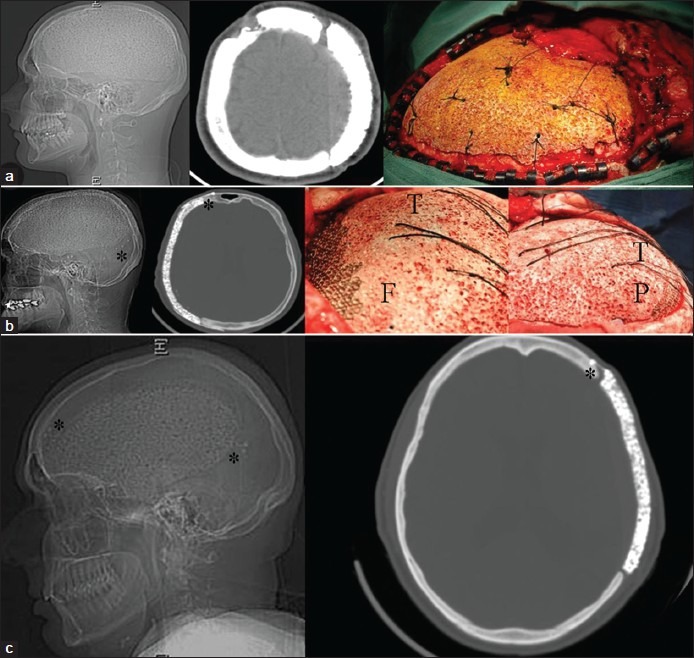
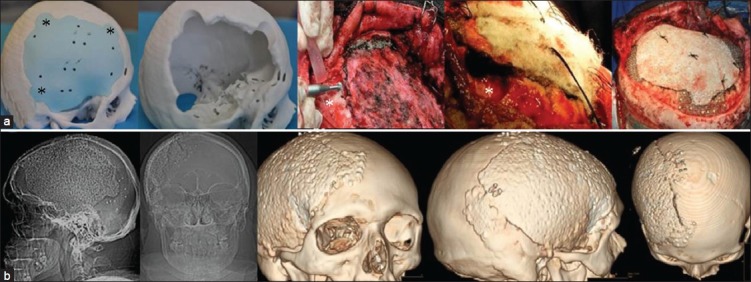
Methods: In a 2-year time period, 12 patients underwent cranioplasty by a modified custom made porous hydroxyapatite implant. Once the three-dimensional computer model of the prostheses was performed, three semicircular extensions placed at strategic positions were drawn and the final prosthesis was realized. At surgery, holes fitting the extensions were drilled into the skull borders and the implant was easily embedded inside the defect. Small titanium meshes overlying the extensions were fixed by screws to the surrounding bone.
Results: A minimal increase of operative times was recorded, with drilling and fixation requiring additional 30 and 15 minutes, respectively. Optimal contact between cranioplasty and skull borders was always observed at control computed tomography (CT) scans. Permanent rigid fixation was obtained in all cases, with good functional and aesthetic results at follow-up.
Conclusions: Modifications of hydroxyapatite implants are obtained without additional costs. The minimal increase of operative times is largely counterbalanced by optimal fixation results. Finally, the bone drilling and the immediate proximity of bone to prosthesis might enhance the potential for osteogenesis and osteointegration.
Keywords: Bone fixation; decompressive craniectomy; hydroxyapatite cranioplasty; osteointegration; prostheses.
Figures
References
-
- Aarabi B, Hesdoffer DC, Ahn ES, Aresco C, Scalea TM, Eisenbergh HM. Outcome following decompressive craniectomy for malignant swelling due to severe head injury. J Neurosurg. 2006;104:469–79. - PubMed
-
- Di Rienzo A, Iacoangeli M, Rychlicki F, Veccia S, Scerrati M. Decompressive craniectomy for medically refractory intracranial hypertension due to meningoencephalitis: Report of three patients. Acta Neurochir (Wien) 2008;150:1057–65. - PubMed
-
- Eppley BL, Hollier L, Stal S. Hydroxyapatite cranioplasty: 2. Clinical experience with a new quick setting material. J Craniofac Surg. 2003;14:209–14. - PubMed
-
- Gooch MR, Gin GE, Kenning TJ, German JW. Complications of cranioplasty following decompressive craniectomy: Analysis of 62 cases. Neurosurg Focus. 2009;26:E9. - PubMed
-
- Hardy H, Tollard E, Derrey S, Delcampe P, Peron JM, Freger P, et al. Tolérance clinique et degré d’ossification des cranioplasties en hydroxyapatite de larges defects osseux. Neurochirurgie. 2012;58:25–9. - PubMed
LinkOut - more resources
Full Text Sources