


Antidepressant treatment reduces serotonin-1A autoreceptor binding in major depressive disorder
- PMID: 23374637
- PMCID: PMC3690146
- DOI: 10.1016/j.biopsych.2012.11.012
Antidepressant treatment reduces serotonin-1A autoreceptor binding in major depressive disorder
Abstract
Background: Chronic selective serotonin reuptake inhibitor (SSRI) administration to rodents desensitizes or downregulates raphe 5-hydroxytryptamine 1A (5-HT1A) autoreceptors. We previously found elevated 5-HT1A binding in antidepressant-naive and not recently medicated major depressive disorder (MDD) and now report the effect of SSRI treatment on 5-HT1A autoreceptors in depressed patients.
Methods: 5-HT1A binding (BPF) was quantified in medication-free subjects using positron emission tomography (PET) with [11C]-WAY-100635 before and after treatment of MDD with an SSRI for 5 to 9 weeks (mean 47 ± 8 days). Nineteen subjects without recent history of antidepressant pharmacotherapy completed both [11C]WAY-100635 PET scans with a metabolite-corrected arterial input function and depression severity was rated before and after the treatment course.
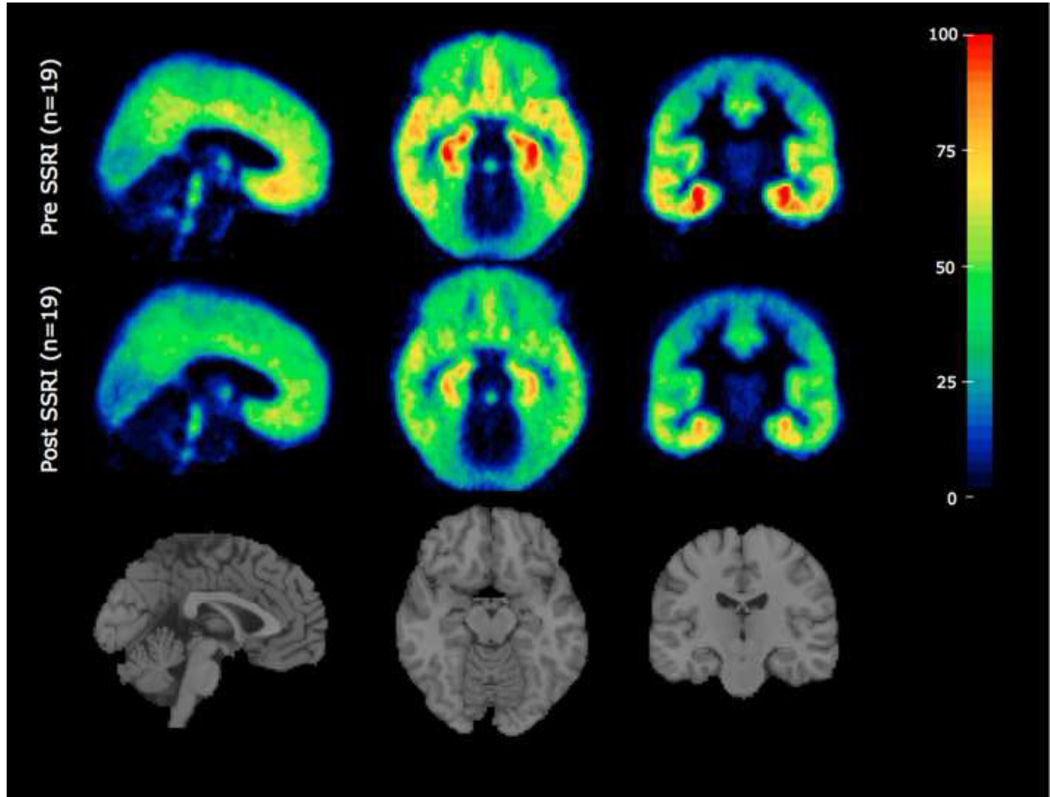
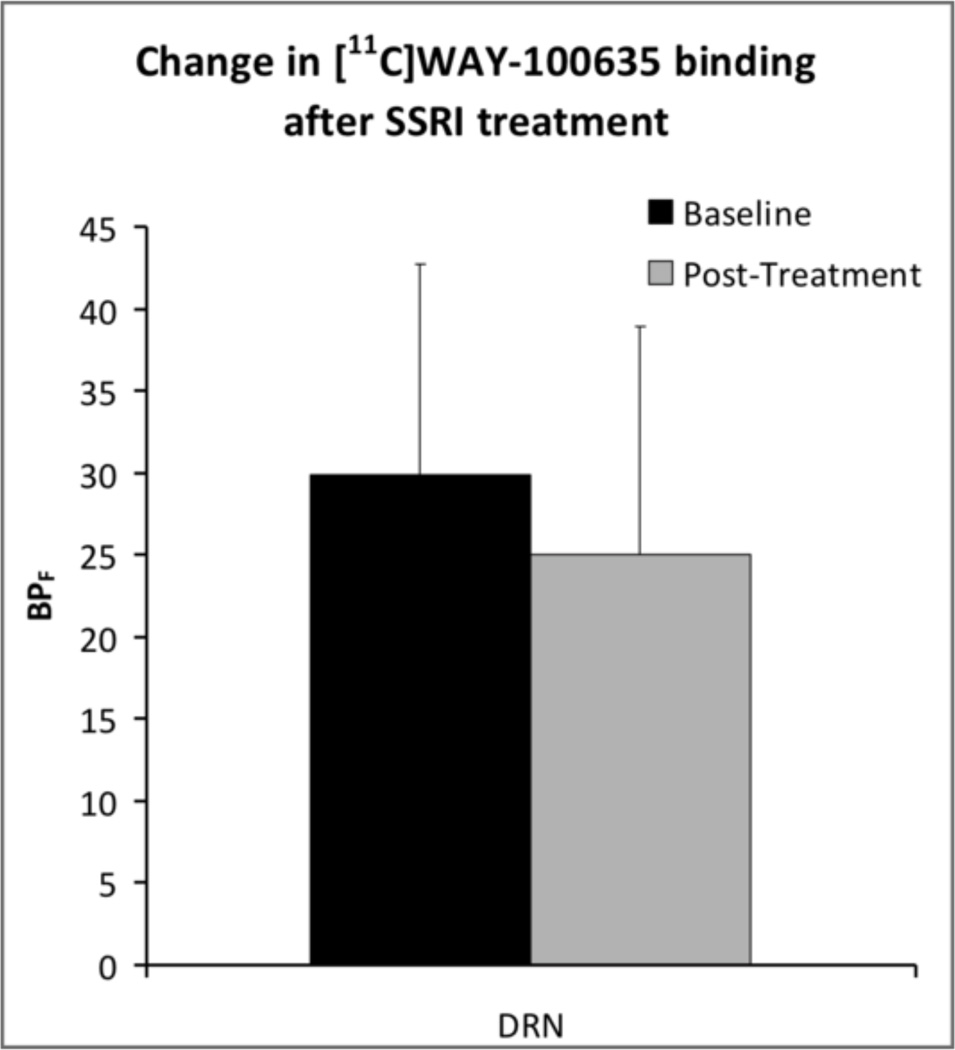
Results: 5-HT1A autoreceptor BPF in the raphe was reduced 18% on SSRI treatment (df = 1,18; F = 5.12; p = .036). However, the degree of reduction in 5-HT1A autoreceptor BPF was unrelated to improvement in depression (df = 1,16; F = 1.27; p = .276).
Conclusions: Downregulation of 5-HT1A autoreceptor binding by SSRI treatment of major depression is consistent with animal studies. This may be a necessary but insufficient requirement for clinical response to SSRIs. A PET agonist ligand that binds selectively to the high-affinity conformation of this receptor can determine whether SSRIs also cause desensitization of the autoreceptor as reported by some rodent studies and whether that effect may be related to clinical response.
Copyright © 2013 Society of Biological Psychiatry. Published by Elsevier Inc. All rights reserved.
Conflict of interest statement
The other authors report no biomedical financial interests or potential conflicts of interest.
Figures
References
-
- Maes M, Leonard BE, Myint AM, Kubera M, Verkerk R. The new '5-HT' hypothesis of depression: Cell-mediated immune activation induces indoleamine 2,3-dioxygenase, which leads to lower plasma tryptophan and an increased synthesis of detrimental tryptophan catabolites (TRYCATs), both of which contribute to the onset of depression. Prog Neuropsychopharmacol Biol Psychiatry. 2010 - PubMed
-
- Zarcone VP, Jr, Berger PA, Brodie KH, Sack R, Barchas JD. The indoleamine hypothesis of depression: an overview and pilot study. Dis Nerv Syst. 1977;38:646–653. - PubMed
-
- Neumeister A. Tryptophan depletion, serotonin, and depression: where do we stand? Psychopharmacology bulletin. 2003;37:99–115. - PubMed
-
- Lanfumey L, Hamon M. 5-HT1 receptors. Curr Drug Targets CNS Neurol Disord. 2004;3:1–10. - PubMed
-
- Blier P, de Montigny C, Chaput Y. Modifications of the serotonin system by antidepressant treatments: implications for the therapeutic response in major depression. J Clin Psychopharmacol. 1987;7:24S–35S. - PubMed
Publication types
MeSH terms
Substances
Grants and funding
LinkOut - more resources
Full Text Sources
Other Literature Sources
Medical
Miscellaneous
