


Low birth weight: is it related to assisted reproductive technology or underlying infertility?
- PMID: 23375144
- PMCID: PMC3577935
- DOI: 10.1016/j.fertnstert.2012.12.035
Low birth weight: is it related to assisted reproductive technology or underlying infertility?
Abstract
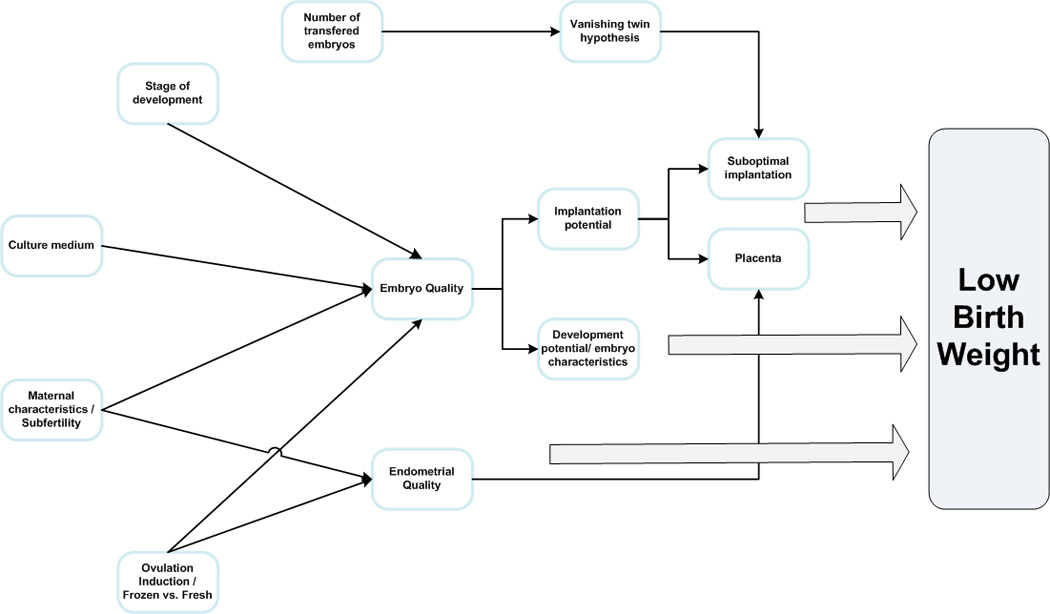
Since 1978, we have witnessed a successful evolution of assisted reproductive technology (ART), with improvement of the pregnancy rates and a growing demand. However, in recent years, there has been increasing concern regarding its safety due to the potential health impact on its infants. The raise of the developmental origins of adult disease has positioned low birth weight (LBW) as a significant health issue. Although multiple studies have associated ART with LBW, the etiology of this association remains largely unknown. We review the potential association between different components of ART and infertility with LBW, while acknowledging the limitations of interpretation of the existing literature.
Copyright © 2013 American Society for Reproductive Medicine. Published by Elsevier Inc. All rights reserved.
Conflict of interest statement
None declared.
Figures
References
-
- Nygren KGSE, Zegers-Hochschild F, Mansour R, Ishihara O, Adamson GD, de Mouzon J. International Committee for Monitoring Assisted Reproductive Technology (ICMART) world report: assisted reproductive technology 2003. Fertility and Sterility. 2011;95:2209–2222. - PubMed
-
- Fernando D, Halliday JL, Breheny S, Healy DL. Outcomes of singleton births after blastocyst versus nonblastocyst transfer in assisted reproductive technology. Fertil Steril. 2012;97:579–584. - PubMed
-
- Hayashi M, Nakai A, Satoh S, Matsuda Y. Adverse obstetric and perinatal outcomes of singleton pregnancies may be related to maternal factors associated with infertility rather than the type of assisted reproductive technology procedure used. Fertil Steril. 2012;98:922–928. - PubMed
-
- D'Angelo DV, Whitehead N, Helms K, Barfield W, Ahluwalia IB. Birth outcomes of intended pregnancies among women who used assisted reproductive technology, ovulation stimulation, or no treatment. Fertil Steril. 2011;96:314–320. e2. - PubMed
-
- Shih W, Rushford DD, Bourne H, Garrett C, McBain JC, Healy DL, et al. Factors affecting low birthweight after assisted reproduction technology: difference between transfer of fresh and cryopreserved embryos suggests an adverse effect of oocyte collection. Hum Reprod. 2008;23:1644–1653. - PubMed
Publication types
MeSH terms
Grants and funding
LinkOut - more resources
Full Text Sources
Other Literature Sources
Medical
