Review
. 2013 May;23(5):242-50.
doi: 10.1016/j.tcb.2013.01.004. Epub 2013 Feb 1.

Quality control mechanisms during ribosome maturation

Affiliations
Review

Quality control mechanisms during ribosome maturation

Katrin Karbstein. Trends Cell Biol. 2013 May.

Abstract

Protein synthesis on ribosomes is carefully quality-controlled to ensure the faithful transmission of genetic information from mRNA to protein. Many of these mechanisms rely on communication between distant sites on the ribosomes, and thus on the integrity of the ribosome structure. Furthermore, haploinsufficiency of ribosomal proteins, which increases the chances of forming incompletely assembled ribosomes, can predispose to cancer. Finally, release of inactive ribosomes into the translating pool will lead to their degradation together with the degradation of the bound mRNA. Together, these findings suggest that quality control mechanisms must be in place to survey nascent ribosomes and ensure their functionality. This review gives an account of these mechanisms as currently known.


Figures

Figure 1
Figure 1
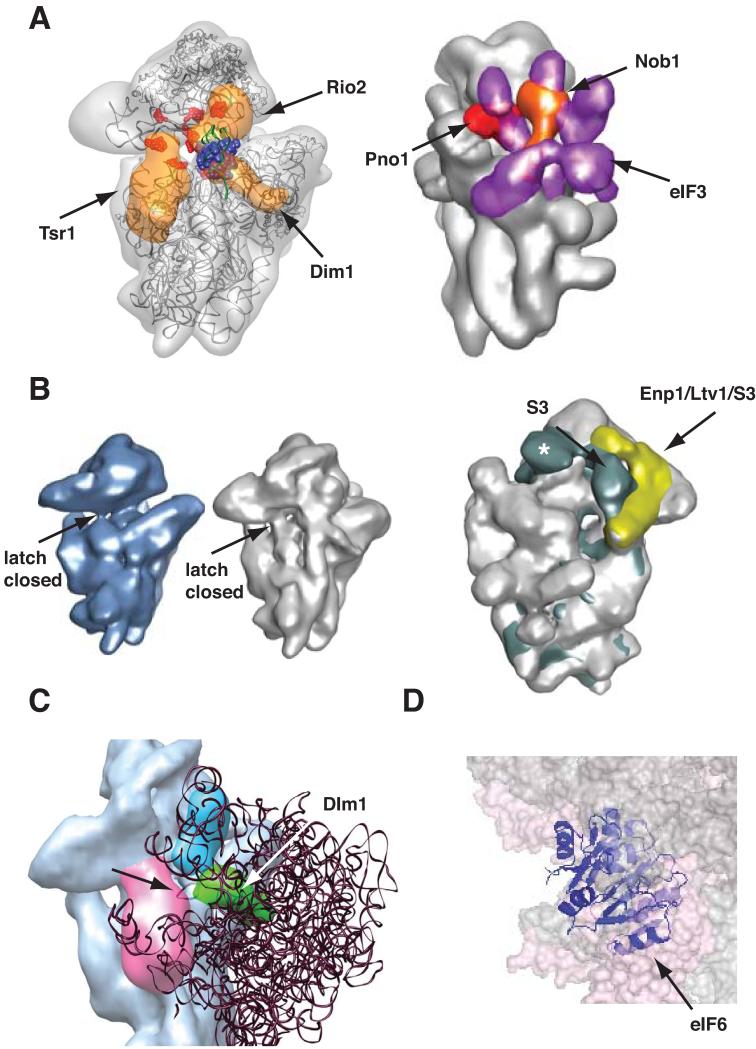
Assembly Factors Block Premature Translation Initiation. Adapted from [21]. (A) Left: Tsr1, Rio2 and Dim1 on the subunit interface block binding of eIF1 (in blue spacefill, [100]), eIF1A (binding site highlighted in red, [101]), and P-site tRNA (in green, [102]). Right: Nob1 (orange) and Pno1 (red) block binding of eIF3 (purple, [103]). (B) Opening of the mRNA binding channel is destabilized. The entry latch on the mRNA binding channel (indicated with the arrow) is closed in mature 40S subunits (left, [28]) and pre-40S subunits (middle, [21]). Channel opening in mature subunits (right panel) is stabilized by an interaction between S3 and H16 (shown in dark green, [28]) on the solvent side. The AFs Enp1 and Ltv1 form a complex with S3 (in yellow, [21]), which does not allow for this interaction of S3. Asc1, present only in mature 40S subunits, is indicated with a white asterisk. (C) In 80S ribosomes the A-site finger from the 60S subunit (indicated with the arrow), overlaps with H44 and Dim1 (in green), but not Tsr1 (in magenta). (D) In 80S ribosomes eIF6 (in purple, [37]) overlaps with the 40S subunit (shown in spacefill, [104]). For simplicity the 60S subunits is not shown.
Figure 2
Figure 2
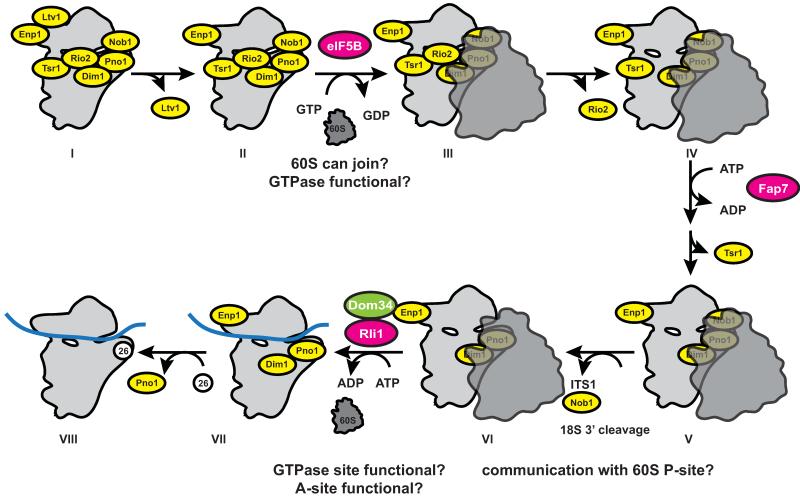
A translation-like cycle during 40S ribosome maturation. Adapted from [29]. The cycle starts with the dissociation of Ltv1 from the intermediate visualized by cryo-EM (I). The translation factor eIF5B, a GTPase, then promotes joining of 60S subunits, analogous to its function during translation, to give an 80S-like complex, lacking both mRNA and tRNA (III). Rio2 dissociates with or soon after 60S joining to give a stable 80S-like complex (IV), which accumulates in the absence of the ATPase Fap7. Dissociation of Tsr1 (V) allows for Nob1-dependent rRNA maturation (VI) and access of Dom34 and Rli1 to separate 80S-like ribosomes (VII). Exchange of S26 for Pno1 appears to be the final step in maturation. The small and large ribosomal subunits are shown in light and dark grey, respectively. Stably bound assembly factors are shown in yellow. ATP or GTP-hydrolyzing transiently bound factors are shown in magenta, other transiently bound factors are shown in green and mRNA is shown as a blue band.
Figure 3
Figure 3
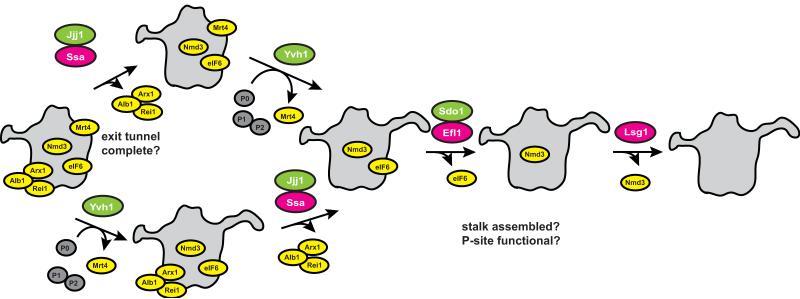
Pathway for Cytoplasmic 60S maturation. Adapted from [83]. Release of the Arx1/Alb1 complex from the exit tunnel requires the Hsp70 ATPase Ssa and its co-chaperone Jjj1, and has the ability to check the binding site for Ssa on the exit tunnel. Exchange of Mtr4 with P0 and subsequent stalk assembly requires Yvh1. Both events can occur independently of each other but are both required for the Efl1/Sdo1-dependent release of eIF6/Tif6. Efl1 function tests the P-site [86] as well as the stalk [83]. The final step in 60S maturation is the Lsg1-dependent release of Nmd3.

References

    1. Warner JR. The economics of ribosome biosynthesis in yeast. Trends Biochem Sci. 1999;24:437–440. - PubMed
    1. Burwick N, et al. Non-Diamond Blackfan anemia disorders of ribosome function: Shwachman Diamond syndrome and 5q-syndrome. Semin Hematol. 2011;48:136–143. - PMC - PubMed
    1. Ellis SR, Lipton JM. Diamond Blackfan anemia: a disorder of red blood cell development. Curr Top Dev Biol. 2008;82:217–241. - PubMed
    1. Stumpf CR, Ruggero D. The cancerous translation apparatus. Curr Opin Genet Dev. 2011;21:474–483. - PMC - PubMed
    1. Vlachos A, et al. Incidence of neoplasia in Diamond Blackfan anemia: a report from the Diamond Blackfan Anemia Registry. Blood. 2012;119:3815–3819. - PMC - PubMed

Publication types

MeSH terms

Supplementary concepts

LinkOut - more resources