


Proarrhythmic effect of blocking the small conductance calcium activated potassium channel in isolated canine left atrium
- PMID: 23376397
- PMCID: PMC3663880
- DOI: 10.1016/j.hrthm.2013.01.033
Proarrhythmic effect of blocking the small conductance calcium activated potassium channel in isolated canine left atrium
Abstract
Background: Small conductance calcium activated potassium (SKCa) channels are voltage insensitive and are activated by intracellular calcium. Genome-wide association studies revealed that a variant of SKCa is associated with lone atrial fibrillation in humans. Roles of SKCa in atrial arrhythmias remain unclear.
Objective: To determine roles of SKCa in atrial arrhythmias.
Methods: Optical mapping using the isolated canine left atrium was performed. The optical action potential duration (APD) and induction of arrhythmia were evaluated before and after the addition of specific SKCa blockers-apamin or UCL-1684.
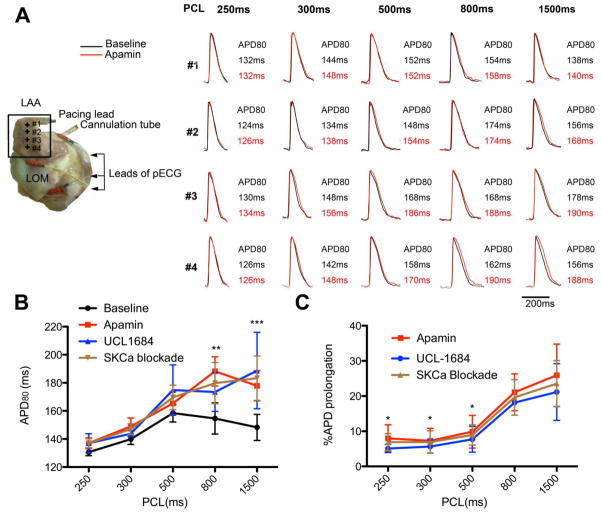
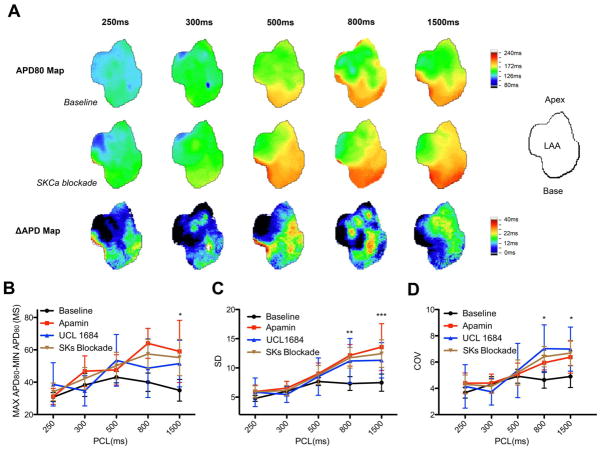
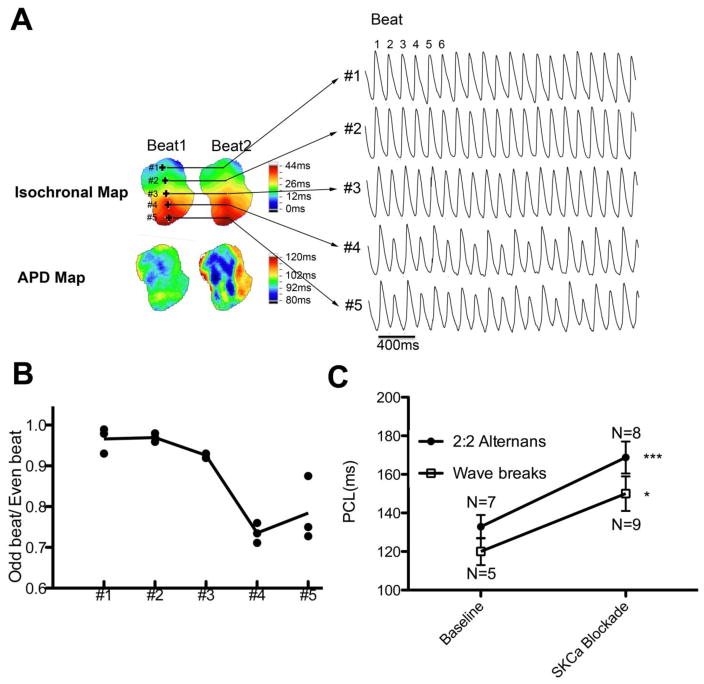
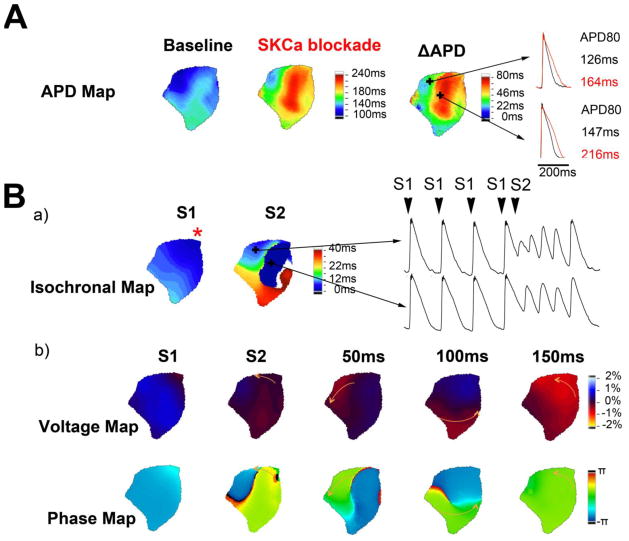
Results: SKCa blockade significantly increased APD₈₀ (188 ± 19 ms vs 147 ± 11 ms; P<.001). The pacing cycle length thresholds to induce 2:2 alternans, and wave breaks were prolonged by SKCa blockade. Increased APD heterogeneity was observed after the SKCa blockade, as measured by the difference between the maximum and the minimum APD (39 ± 4 ms vs 26 ± 5 ms; P<.05), by standard deviation (12.43 ± 2.36 ms vs 7.49 ± 1.47 ms; P<.001), or by coefficient of variation (6.68% ± 0.97% vs 4.90% ± 0.84%; P<.05). No arrhythmia was induced at baseline by an S1-S2 protocol. After SKCa blockade, 4 of 6 atria developed arrhythmia.
Conclusions: SKCa blockade promotes arrhythmia and prolongs the pacing cycle length threshold of 2:2 alternans and wave breaks in the canine left atrium. The proarrhythmic effect could be attributed to increased APD heterogeneity in the canine left atrium. This study provides supportive evidence of genome-wide association studies showing association of KCNN3 and lone atrial fibrillation.
Copyright © 2013 Heart Rhythm Society. Published by Elsevier Inc. All rights reserved.
Figures
Comment in
-
Small conductance Ca-activated K channel: small but powerful proarrhythmogenic?Heart Rhythm. 2013 Jun;10(6):899-900. doi: 10.1016/j.hrthm.2013.02.002. Epub 2013 Feb 7. Heart Rhythm. 2013. PMID: 23395736 No abstract available.
-
Reply to the Editor-Differential effects of SKCa blockade on arrhythmogenesis in normal and remodeled hearts.Heart Rhythm. 2015 Jan;12(1):e2. doi: 10.1016/j.hrthm.2014.10.011. Epub 2014 Oct 7. Heart Rhythm. 2015. PMID: 25304683 No abstract available.
-
Initiation and sustenance of reentry are promoted by two different mechanisms.Heart Rhythm. 2015 Jan;12(1):e2. doi: 10.1016/j.hrthm.2014.10.012. Epub 2014 Oct 8. Heart Rhythm. 2015. PMID: 25305480 Free PMC article. No abstract available.
References
-
- Lloyd-Jones DM, Wang TJ, Leip EP, et al. Lifetime risk for development of atrial fibrillation: the Framingham Heart Study. Circulation. 2004 Aug 31;110:1042–1046. - PubMed
-
- Chen LY, Shen WK. Epidemiology of atrial fibrillation: a current perspective. Heart Rhythm. 2007 Mar;4:S1–6. - PubMed
-
- Xia XM, Fakler B, Rivard A, et al. Mechanism of calcium gating in small-conductance calcium-activated potassium channels. Nature. 1998 Oct 1;395:503–507. - PubMed
-
- Kohler M, Hirschberg B, Bond CT, et al. Small-conductance, calcium-activated potassium channels from mammalian brain. Science. 1996 Sep 20;273:1709–1714. - PubMed
Publication types
MeSH terms
Substances
Grants and funding
LinkOut - more resources
Full Text Sources
Other Literature Sources
Medical
