


Disconnect between emergency contacts and surrogate decision-makers in the absence of advance directives
- PMID: 23376786
- PMCID: PMC5450815
- DOI: 10.1177/0269216312474486
Disconnect between emergency contacts and surrogate decision-makers in the absence of advance directives
Abstract
Background: The role played by emergency contacts can be extensive particularly for chronically seriously ill patients. If the patient's condition suddenly deteriorates, the emergency contact may be asked to make decisions that should instead fall to a designated surrogate decision-maker.
Aims: To describe a process used to help chronically seriously ill patients identify a surrogate during study enrollment and to describe whether these surrogates were the same as the documented emergency contacts.
Design: A descriptive cross-sectional study using eligibility assessment and baseline data from an efficacy trial. The parent trial tests the effects of an end-of-life communication intervention on patient and surrogate decision-maker outcomes, and thus, it was important to identify the surrogate. The study recruiter used a short battery of investigator-developed questions to help patients identify a surrogate.
Setting/participants: Patients were 94 self-identified African Americans or Caucasians recruited from 18 outpatient dialysis centers, receiving dialysis for ≥6 months, with Charlson Comorbidity Index of ≥6 or 5 and hospitalized in the last 6 months.
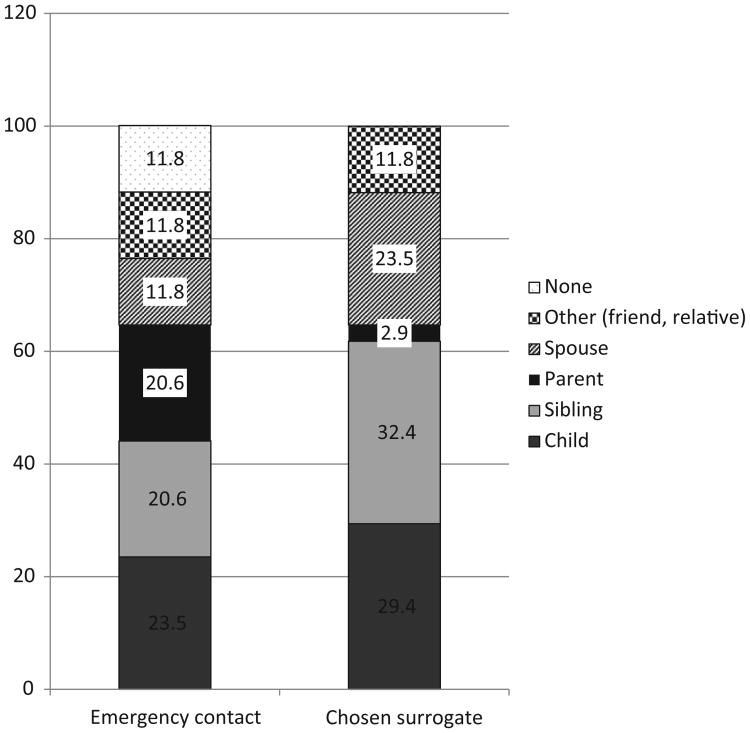
Results: When first approached, only three patients had a designated and documented surrogate. The remaining 91 selected a surrogate during the surrogate identification process. Of the 94 surrogates who were named, only 60 (63.8%) were also listed in the medical record as the emergency contact.
Conclusions: In roughly one-third of instances, the selected surrogate was not the same person listed in official medical records as the emergency contact, which may pose potential problems in medical decision-making in the absence of advance directives.
Keywords: Surrogate decision-maker; emergency contact; end-of-life.
Conflict of interest statement
Figures
References
-
- Davison SN, Torgunrud C. The creation of an advance care planning process for patients with ESRD. Am J Kidney Dis. 2007;49:27–36. - PubMed
-
- Holley JL. Advance care planning in CKD/ESRD: an evolving process. Clin J Am Soc Nephrol. 2012;7:1033–1038. - PubMed
-
- Fried L, Bernardini J, Piraino B. Charlson Comorbidity Index as a predictor of outcomes in incident peritoneal dialysis patients. Am J Kidney Dis. 2001;37:337–342. - PubMed
Publication types
MeSH terms
Grants and funding
LinkOut - more resources
Full Text Sources
Other Literature Sources
Medical
