


Linear mixed-effects modeling approach to FMRI group analysis
- PMID: 23376789
- PMCID: PMC3638840
- DOI: 10.1016/j.neuroimage.2013.01.047
Linear mixed-effects modeling approach to FMRI group analysis
Abstract
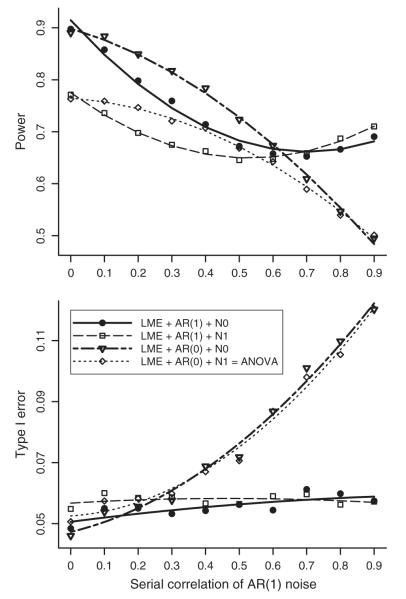
Conventional group analysis is usually performed with Student-type t-test, regression, or standard AN(C)OVA in which the variance-covariance matrix is presumed to have a simple structure. Some correction approaches are adopted when assumptions about the covariance structure is violated. However, as experiments are designed with different degrees of sophistication, these traditional methods can become cumbersome, or even be unable to handle the situation at hand. For example, most current FMRI software packages have difficulty analyzing the following scenarios at group level: (1) taking within-subject variability into account when there are effect estimates from multiple runs or sessions; (2) continuous explanatory variables (covariates) modeling in the presence of a within-subject (repeated measures) factor, multiple subject-grouping (between-subjects) factors, or the mixture of both; (3) subject-specific adjustments in covariate modeling; (4) group analysis with estimation of hemodynamic response (HDR) function by multiple basis functions; (5) various cases of missing data in longitudinal studies; and (6) group studies involving family members or twins. Here we present a linear mixed-effects modeling (LME) methodology that extends the conventional group analysis approach to analyze many complicated cases, including the six prototypes delineated above, whose analyses would be otherwise either difficult or unfeasible under traditional frameworks such as AN(C)OVA and general linear model (GLM). In addition, the strength of the LME framework lies in its flexibility to model and estimate the variance-covariance structures for both random effects and residuals. The intraclass correlation (ICC) values can be easily obtained with an LME model with crossed random effects, even at the presence of confounding fixed effects. The simulations of one prototypical scenario indicate that the LME modeling keeps a balance between the control for false positives and the sensitivity for activation detection. The importance of hypothesis formulation is also illustrated in the simulations. Comparisons with alternative group analysis approaches and the limitations of LME are discussed in details.
Published by Elsevier Inc.
Figures
References
-
- Aguirre GK, Zarahn E, D’Esposito M. The variability of human, BOLD hemodynamic responses. Neuroimage. 1998;8(4):360–369. - PubMed
-
- Allison PD. Missing Data. Sage Publications; Thousand Oaks, CA: 2001.
-
- Baayen RH. languageR: data sets and functions with “Analyzing Linguistic Data: A practical introduction to statistics”. 2011 http://CRAN.R-project.org/package=languageR.
-
- Bates D, Maechler M, Bolker B. lme4: Linear mixed-effects models using S4 classes. 2011 http://CRAN.R-project.org/package=lme4.
Publication types
MeSH terms
Grants and funding
LinkOut - more resources
Full Text Sources
Other Literature Sources
Medical
