


Early replication fragile sites: where replication-transcription collisions cause genetic instability
- PMID: 23376922
- PMCID: PMC3579142
- DOI: 10.1038/emboj.2013.20
Early replication fragile sites: where replication-transcription collisions cause genetic instability
Abstract
Cell (2013) 152: 620–632 doi:; DOI: 10.1016/j.cell.2013.01.006; published online January 31 2013
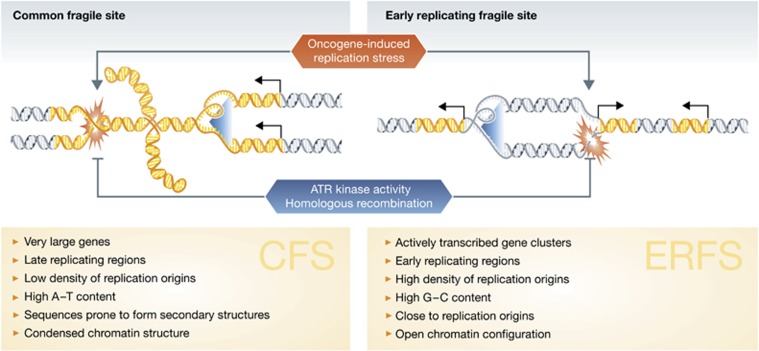
Although it is known that replication stress causes genetic instability, the underlying mechanisms are not yet fully understood. A new study by Barlow et al (2013) used an elegant genome-wide chromatin immunoprecipitation approach to reveal that DNA lesions induced by replication stress occur predominantly in early replicating and actively transcribed gene clusters. These ‘early replication fragile sites’ (ERFS) can be the source for rearrangements commonly found in cancer, and represent a new type of fragile site, distinct from common fragile sites (CFS).
Conflict of interest statement
The authors declare that they have no conflict of interest.
Figures
References
-
- Barlow J, Faryabi RB, Callen E, Wong N, Malhowski A, Tang Chen H, Gutierez-Cruz G, Sun H-W, McKinnon P, Wright G, Casellas R, Robbiani DF, Staudt L, Fernandez-Capetillo O, Nussenzweig A (2013) Identification of early replicating fragile sites that contribute to genome instability. Cell 152: 620–632 - PMC - PubMed
-
- Bartkova J, Rezaei N, Liontos M, Karakaidos P, Kletsas D, Issaeva N, Vassiliou LV, Kolettas E, Niforou K, Zoumpourlis VC, Takaoka M, Nakagawa H, Tort F, Fugger K, Johansson F, Sehested M, Andersen CL, Dyrskjot L, Orntoft T, Lukas J et al. (2006) Oncogene-induced senescence is part of the tumorigenesis barrier imposed by DNA damage checkpoints. Nature 444: 633–637 - PubMed
-
- Di Micco R, Fumagalli M, Cicalese A, Piccinin S, Gasparini P, Luise C, Schurra C, Garre M, Nuciforo PG, Bensimon A, Maestro R, Pelicci PG, d’Adda di Fagagna F (2006) Oncogene-induced senescence is a DNA damage response triggered by DNA hyper-replication. Nature 444: 638–642 - PubMed
Publication types
MeSH terms
LinkOut - more resources
Full Text Sources
Other Literature Sources
