. 2013 Apr;12(4):529-44.
doi: 10.1128/EC.00324-12. Epub 2013 Feb 2.

Identification, localization, and functional implications of the microdomain-forming stomatin family in the ciliated protozoan Paramecium tetraurelia

Affiliations

Identification, localization, and functional implications of the microdomain-forming stomatin family in the ciliated protozoan Paramecium tetraurelia

Alexander T Reuter et al. Eukaryot Cell. 2013 Apr.

Abstract

The SPFH protein superfamily is assumed to occur universally in eukaryotes, but information from protozoa is scarce. In the Paramecium genome, we found only Stomatins, 20 paralogs grouped in 8 families, STO1 to STO8. According to cDNA analysis, all are expressed, and molecular modeling shows the typical SPFH domain structure for all subgroups. For further analysis we used family-specific sequences for fluorescence and immunogold labeling, gene silencing, and functional tests. With all family members tested, we found a patchy localization at/near the cell surface and on vesicles. The Sto1p and Sto4p families are also associated with the contractile vacuole complex. Sto4p also makes puncta on some food vacuoles and is abundant on vesicles recycling from the release site of spent food vacuoles to the site of nascent food vacuole formation. Silencing of the STO1 family reduces mechanosensitivity (ciliary reversal upon touching an obstacle), thus suggesting relevance for positioning of mechanosensitive channels in the plasmalemma. Silencing of STO4 members increases pulsation frequency of the contractile vacuole complex and reduces phagocytotic activity of Paramecium cells. In summary, Sto1p and Sto4p members seem to be involved in positioning specific superficial and intracellular microdomain-based membrane components whose functions may depend on mechanosensation (extracellular stimuli and internal osmotic pressure).


Figures
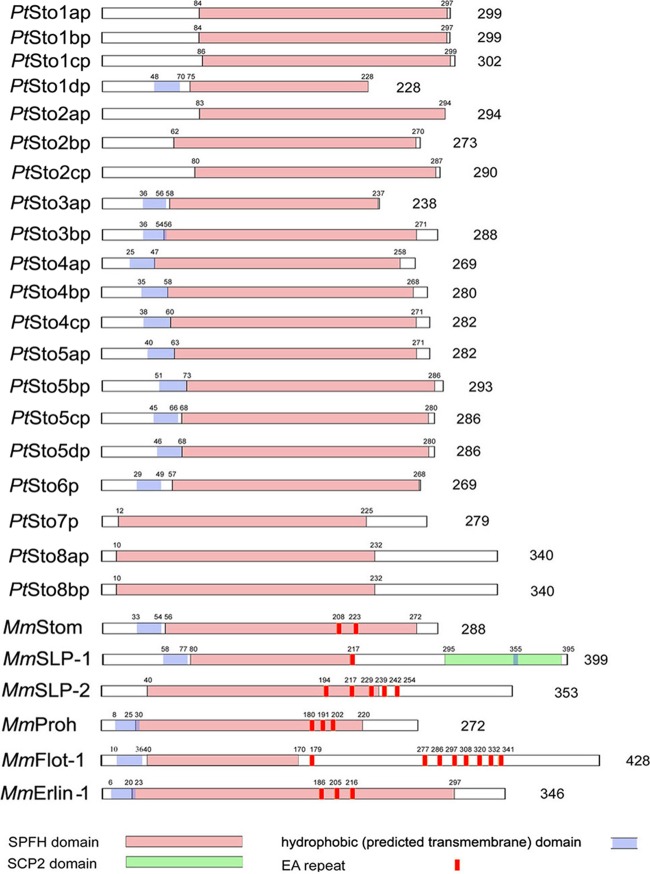
Fig 1
Fig 1
Domain structure of P. tetraurelia Stomatins. Schematic presentation of P. tetraurelia Stomatin domain architecture and those of various mammalian SPFH proteins. SPFH and SCP-2 domains, hydrophobic domains (called a transmembrane domain by some), and EA repeats (absent from P. tetraurelia Sto [PtSto]) are indicated. Sequences used are the following: GSPATP00013742001 (PtSto1ap), GSPATP00018485001 (PtSto1bp), GSPATP00027276001 (PtSto1cp), GSPATP00034033001 (PtSto1dp), GSPATP00024614001 (PtSto2ap), GSPAT00010097001 (PtSto2bp), GSPATP00004121001 (PtSto2cp), GSPATP00018907001 (PtSto3ap), GSPATP00024437001 (PtSto3bp), GSPATP00030747001 (PtSto4ap), GSPATP00021746001 (PtSto4bp), GSPATP00026272001 (PtSto4cp), GSPATP00033325001 (PtSto5ap), GSPATP00022578001 (PtSto5bp), GSPATP00012426001 (PtSto5cp), GSPATP00016343001 (PtSto5dp), GSPATP00015155001 (PtSto6p), GSPATP00020490001 (PtSto7p), GSPATP00020414001 (PtSto8ap), GSPATP00023643001 (PtSto8bp), AAH10703.1 (Homo sapiens Stom [HsStom]), AAH37074.1 (Mus musculus SLP-1 [MmSLP-1]), NP_075720.1 (MmSLP-2), NP_002625.1 (HsProh), AAD40192.1 (HsFlot-1), and NP_663477 (MmErlin1). All Paramecium sequence accession numbers are from ParameciumDB (http://paramecium.cgm.cnrs-gif.fr/page/index).
Fig 2
Fig 2
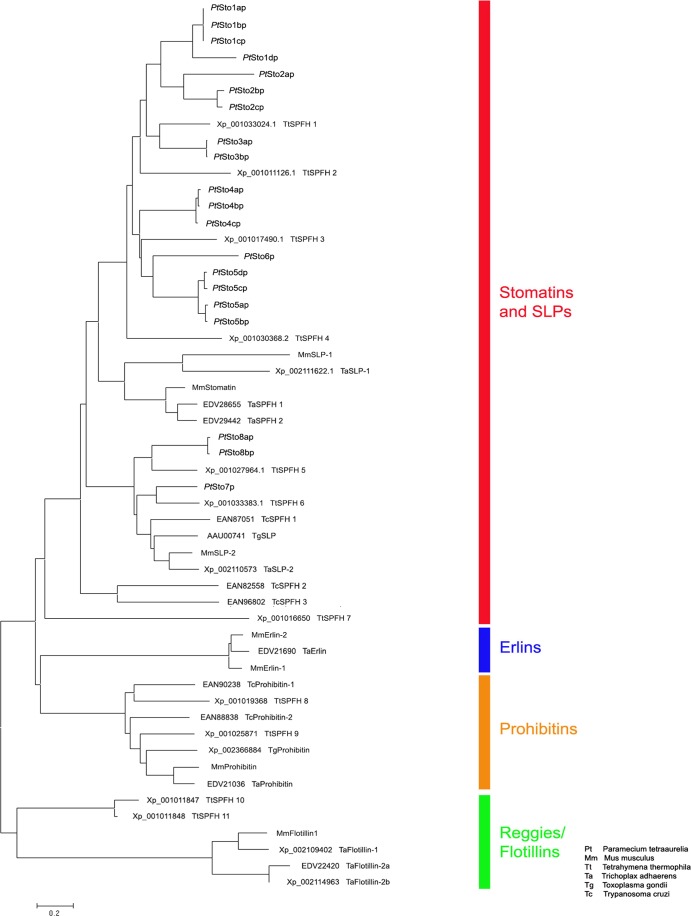
Phylogenetic tree of Stomatins. Protein sequences were aligned by the ClustalW method, and the tree was constructed using the Gonnet matrix and the neighbor-joining algorithm. Note that all Paramecium sequences belong to the Stomatin family.
Fig 3
Fig 3
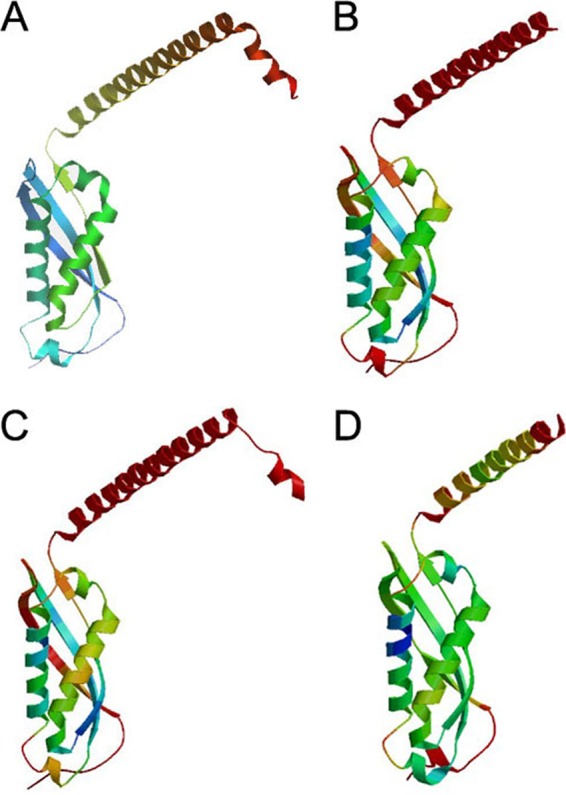
Molecular modeling of P. tetraurelia Stomatin. The SPFH domain of the only H. sapiens Stomatin (A) and representative members of each Stomatin family cluster of P. tetraurelia (B to D) were modeled with the SPFH domain of P. horikoshii (54) as a template. Although all family cluster members (PtSto1ap, z score = −3.46 [B]; PtSto4ap, z score = −2.72 [C]; PtSto8bp, z score = −2.07 [D]) could be modeled with a z score comparable to that of human Stomatin (z score = −2.26 [A]), subgroup 3 differed insofar as the homology region was slightly smaller, resulting in a smaller model region.
Fig 4
Fig 4
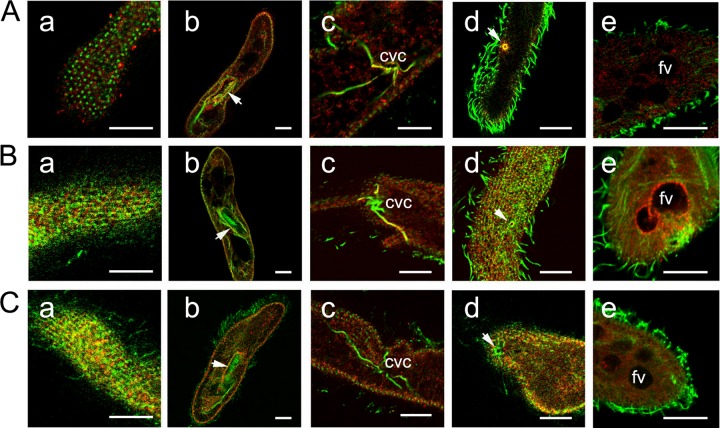
Immunofluorescence staining using Abs against peptides derived from Sto1p, Sto4p, and Sto8p. Cells were fixed and permeabilized to achieve optimal conditions for the immunoreaction as indicated in Materials and Methods. Cells then were labeled by affinity-purified Abs against peptides specific for the different Stomatin families, recognizing Sto1a,b,cp (A), Sto4a,b,c (B), and Sto8a,bp (C, red), respectively, as explained in the text. Counterstaining was performed with a mouse monoclonal anti-α-tubulin Ab (clone DM1A; green; Sigma) and with the secondary Abs specified in Materials and Methods. Note the patchy arrangement of Stomatin at the cell surface outside cilia (column a) with stronger staining in the region of the oral cavity (column b), as well as the occurrence of some Stomatin in granular form inside cells (column c). The contractile vacuole complex (column c) as well as the porus (column d) are stained only by Abs against Sto1a,b,cp and Sto4a,b,cp, whereas anti-Sto4a,b,cp stains some only phagocytic vacuoles (column e). fv, food vacuole. Scale bars, 10 μm.
Fig 5
Fig 5
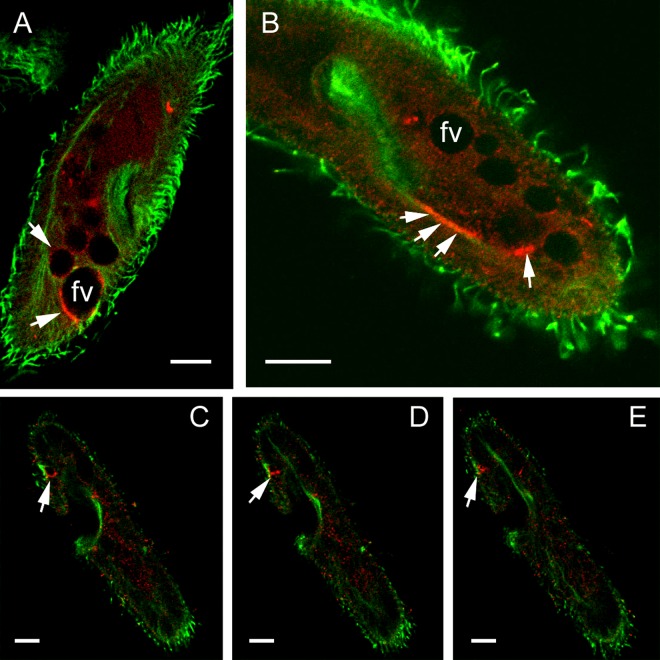
Immunofluorescence staining of vesicles along postoral fibers and at cytoproct. Fixed and permeabilized cells were labeled by affinity-purified Abs against peptides specific for Sto4a,b,cp (red) and counterstained with a mouse monoclonal anti-tubulin Ab (clone DM1A; green; Sigma). (A) Note the patchy staining at or close to some phagocytic vacuoles. Occasionally, vesicles at or close to the postoral fibers were stained by Abs against subfamily 4 (B), as were vesicles at the cytoproct (C, D, and E; 3 consecutive confocal sections are shown). For further details, see the text. Scale bars, 10 μm.
Fig 6
Fig 6
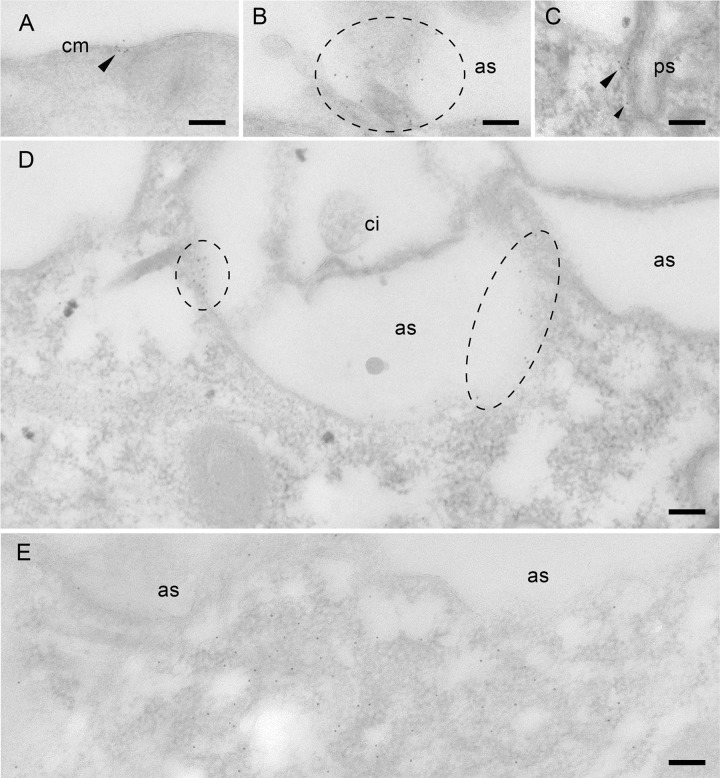
Immunogold EM analysis using Abs against Sto1a,b,cp. Label occurs as a small patch (microdomain) on a cross-sectioned cell membrane (cm, arrowhead) (A) and is more extended on a tangential section (encircled) close to underlying alveolar sacs (as) (B). (C) Outlines of a clathrin-coated parasomal sac (ps) are labeled. (D) Gold label on the membranes of two subcortical Ca2+ stores (as) but not on a cilia (ci). (E) Label is diffusely associated with a population of small vesicles which, as seen from the neighboring of alveolar sacs, are located below the cell surface. For further details, see Materials and Methods. Scale bars, 0.1 μm.
Fig 7
Fig 7
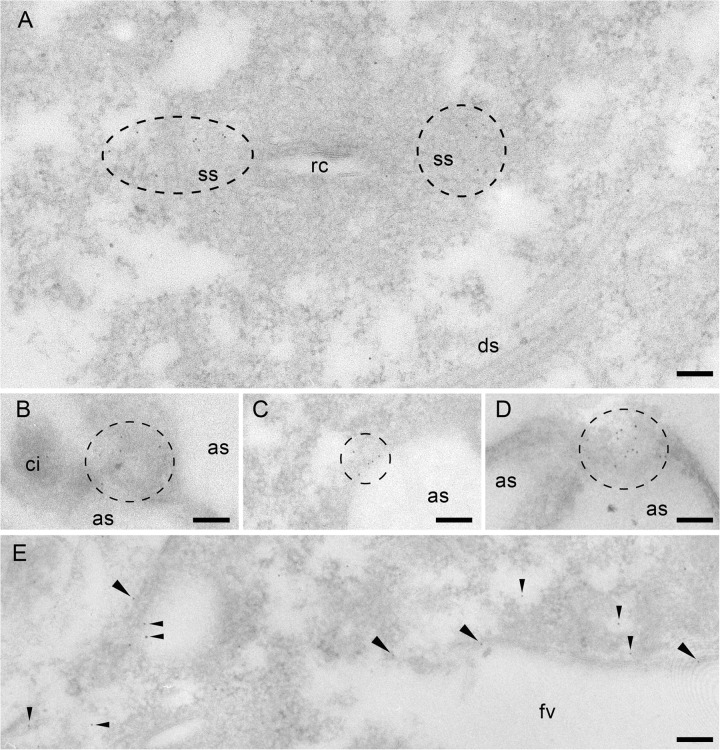
Immunogold EM analysis using anti-Sto4p (A to C and E) and anti-Sto8p (D) Abs. (A) Gold label is scattered in the CVC between the membrane labyrinth of the smooth spongiome (ss) close to the radial canals (rc) but not in the decorated spongiome (ds). With both Abs, labeling in microdomains occurs close to the cell membrane. (B to D) Label close to or at alveolar sacs (as) is particularly evident where cells are cut tangentially. Note the absence of label on a cilium (ci). (E) Label is enriched on a population of small vesicles close to the food vacuole and on the vacuole membrane itself. For further details, see Materials and Methods. Scale bars, 0.1 μm.
Fig 8
Fig 8
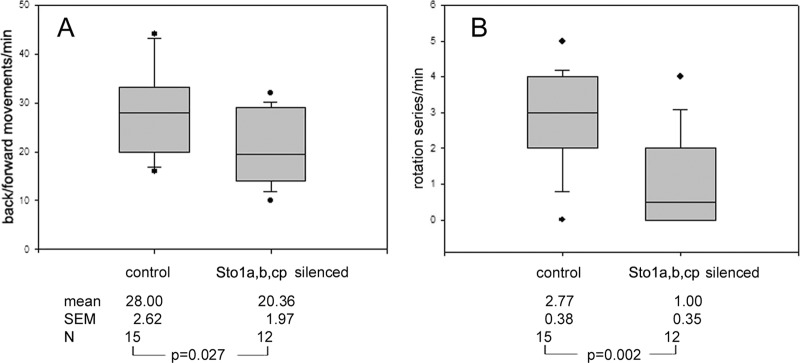
Ciliary reversal upon meeting an obstacle is impaired in cells silenced for STO1a. The entire cDNA sequence was used for silencing by feeding, as outlined in Materials and Methods. Due to high similarity of the gene sequences of STO1a to those of STO1b (88%) and STO1c (86%), all of these ohnologs can be assumed to be silenced (see the text). Silenced cells and aliquots mock silenced with the empty vector were observed when swimming through a narrow channel only partly filled with medium. Backward-forward movements per min, when hitting the meniscus, were counted (28.0 ± 2.6 for silenced cells and 20.4 ± 1.97 for mock-silenced cells; P = 0.027) (A), as were cell rotations (2.77 ± 0.38 for silenced cells and 1.00 ± 0.35 for mock-silenced cells; P = 0.002) (B). Both values are reduced significantly in silenced cells. Values are from Student's t test, and deviations are given as means ± SEM. N indicates the number of cells analyzed.
Fig 9
Fig 9
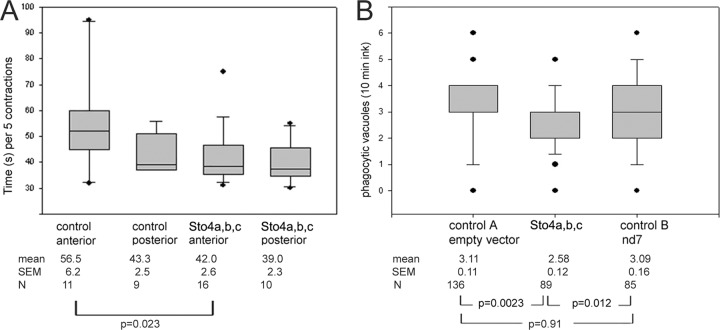
Increase in pumping frequency and of phagocytosis in cells silenced for STO4a. The entire cDNA sequence was used for silencing by feeding, as outlined in Materials and Methods. Due to the high similarity of the gene sequence of STO4a to that of STO4c (89%), this ohnolog may also be silenced, whereas the probability is lower for STO4b (82%). Silenced cells and aliquots mock silenced with the empty vector were analyzed. (A) The pumping frequency of the anterior and posterior contractile vacuoles was analyzed. A significant increase in pumping velocity of the anterior, but not of the posterior, contractile vacuole in cells silenced for Sto4a,b,cp was observed; the control value is ∼75% higher than that after silencing. (B) Silenced and mock-silenced cells were exposed to Indian ink for 10 min and fixed immediately thereafter. Silenced cells contained a significantly lower number of food vacuoles (phago[lyso]somes) than controls. The statistical evaluation is depicted in Fig. 8.

References

    1. Hinderhofer M, Walker CA, Friemel A, Stuermer CAO, Möller HM, Reuter A. 2009. Evolution of prokaryotic SPFH proteins. BMC Evol. Biol. 9:10 doi:10.1186/1471-2148-9-10 - DOI - PMC - PubMed
    1. Huang M, Gu G, Ferguson EL, Chalfie M. 1995. A stomatin-like protein necessary for mechanosensation in C. elegans. Nature 378:292–295 - PubMed
    1. Mannsfeldt AG, Carroll P, Stucky CL, Lewin GR. 1999. Stomatin, a MEC-2 like protein, is expressed by mammalian sensory neurons. Mol. Cell Neurosci. 13:391–404 - PubMed
    1. Hiebl-Dirschmied CM, Adolf GR, Prohaska R. 1991. Isolation and partial characterization of the human erythrocyte band 7 integral membrane protein. Biochim. Biophys. Acta 1065:195–202 - PubMed
    1. Kuwahara Y, Unzai S, Nagata T, Hiroaki Y, Yokoyama H, Matsui I, Ikegami T, Fujiyoshi Y, Hiroaki H. 2009. Unusual thermal disassembly of the SPFH domain oligomer from Pyrococcus horikoshii. Biophys. J. 97:2034–2043 - PMC - PubMed

Publication types

MeSH terms

Substances

LinkOut - more resources