Comment
doi: 10.1242/jcs.122929.
Keratin intermediate filament proteins - novel regulators of inflammation and immunity in skin
Affiliations
- PMID: 23377656
- PMCID: PMC3561851
- DOI: 10.1242/jcs.122929
Item in Clipboard
Comment
Keratin intermediate filament proteins - novel regulators of inflammation and immunity in skin
J Cell Sci.
.
No abstract available
Figures
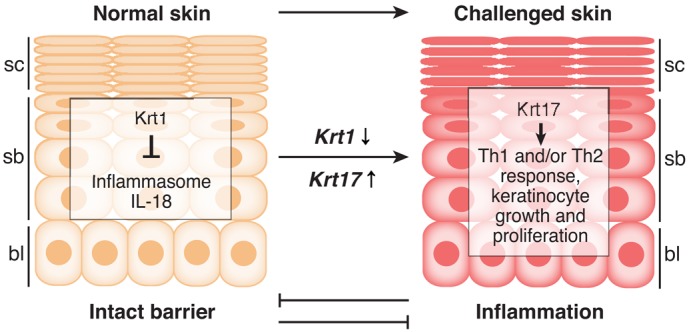
Krt1 and Krt17 regulate epidermal immunity in a distinct and context-dependent manner. Normal epidermis expresses Krt1 in the differentiating suprabasal layers, where it contributes to skin barrier homeostasis, in part by preventing the activation of the inflammasome and the processing of IL-18 (Roth et al., 2012). Upon an acute or chronic challenge to the epidermal barrier (e.g. injury, environmental irritants or cancer), several genes, including Krt17, are robustly induced in basal and suprabasal keratinocytes at the expense of Krt1 (and other differentiation-specific genes). Krt17 actively modulates intracellular signaling pathways to stimulate protein synthesis (Kim et al., 2006) and to also polarize the inflammatory response towards Th1 and/or Th17 (DePianto et al., 2010), thereby promoting keratinocyte growth and proliferation. Inflammation and normal barrier function thus can antagonize one another. bl, basal layer; sb, suprabasal layers; sc, stratum corneum (barrier proper).
Comment on
-
Keratin 1 maintains skin integrity and participates in an inflammatory network in skin through interleukin-18.J Cell Sci. 2012 Nov 15;125(Pt 22):5269-79. doi: 10.1242/jcs.116574. Epub 2012 Nov 6. J Cell Sci. 2012. PMID: 23132931
References
Publication types
MeSH terms
Substances
Grants and funding
LinkOut - more resources
Full Text Sources
Other Literature Sources