


doi: 10.1159/000343803.
Epub 2012 Nov 24.
Obesity and the Cardiorenal Metabolic Syndrome: Therapeutic Modalities and Their Efficacy in Improving Cardiovascular and Renal Risk Factors
Affiliations
- PMID: 23380694
- PMCID: PMC3551409
- DOI: 10.1159/000343803
Item in Clipboard
Obesity and the Cardiorenal Metabolic Syndrome: Therapeutic Modalities and Their Efficacy in Improving Cardiovascular and Renal Risk Factors
Cardiorenal Med.
2012 Dec.
Abstract
The prevalence of obesity has increased rapidly in the United States. Obesity affects about one third of the adult population and, even though it is attributed to excess calorie intake and inadequate physical activity, its etiopathogenesis is much more complex and is an area of active study. Lifestyle modifications (with a focus on increased activity and decreased calorie intake) have modest efficacy in the treatment of obesity. There is a dearth of safe and effective therapeutic modalities to treat obesity. In this review, we discuss the role of different treatment options in the management of obesity and its comorbidities, with a focus on recently approved drugs and the emerging role of bariatric surgery.
Figures
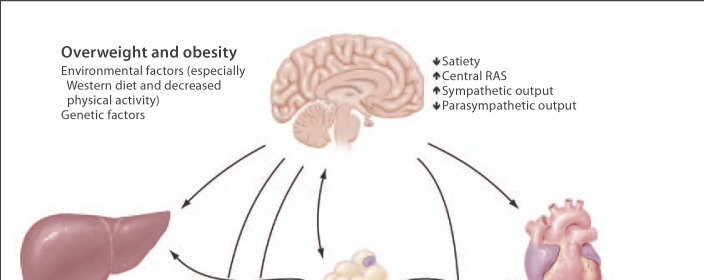
Mechanisms by which obesity promotes the cardiorenal metabolic syndrome. The scheme shows the complex environmental, behavioral, hormonal, and genetic interactions which help modify an individual's body weight, and further shows the effects of the resultant dysfunctional adipose tissue and low-grade inflammation on the structure and function of different organ systems.
References
-
- WHO Consultation on Obesity Obesity: preventing and managing the global epidemic: report of a WHO consultation. WHO technical report series 894. Geneva, WHO, 1999 - PubMed
-
- Ogden CL, Carroll MD, Kit BK, Flegal KM. Prevalence of obesity in the United States, 2009–2010. NCHS Data Brief. 2012;82:1–8. - PubMed
-
- Flegal KM, Carroll MD, Kit BK, Ogden CL. Prevalence of obesity and trends in the distribution of body mass index among US adults, 1999–2010. JAMA. 2012;307:491–497. - PubMed
-
- U.S. Department of Health and Human Services The Surgeon General's Vision for a Healthy and Fit Nation. Rockville, U.S. Department of Health and Human Services, Office of the Surgeon General, January 2010 - PubMed
-
- Finkelstein EA, Trogdon JG, Cohen JW, Dietz W. Annual medical spending attributable to obesity: payer- and service-specific estimates. Health Aff (Millwood) 2009;28:w822–w831. - PubMed
Grants and funding
LinkOut - more resources
Full Text Sources