


A clinical risk stratification tool for predicting treatment resistance in major depressive disorder
- PMID: 23380715
- PMCID: PMC3690142
- DOI: 10.1016/j.biopsych.2012.12.007
A clinical risk stratification tool for predicting treatment resistance in major depressive disorder
Abstract
Background: Early identification of depressed individuals at high risk for treatment resistance could be helpful in selecting optimal setting and intensity of care. At present, validated tools to facilitate this risk stratification are rarely used in psychiatric practice.
Methods: Data were drawn from the first two treatment levels of a multicenter antidepressant effectiveness study in major depressive disorder, the STAR*D (Sequenced Treatment Alternatives to Relieve Depression) cohort. This cohort was divided into training, testing, and validation subsets. Only clinical or sociodemographic variables available by or readily amenable to self-report were considered. Multivariate models were developed to discriminate individuals reaching remission with a first or second pharmacological treatment trial from those not reaching remission despite two trials.
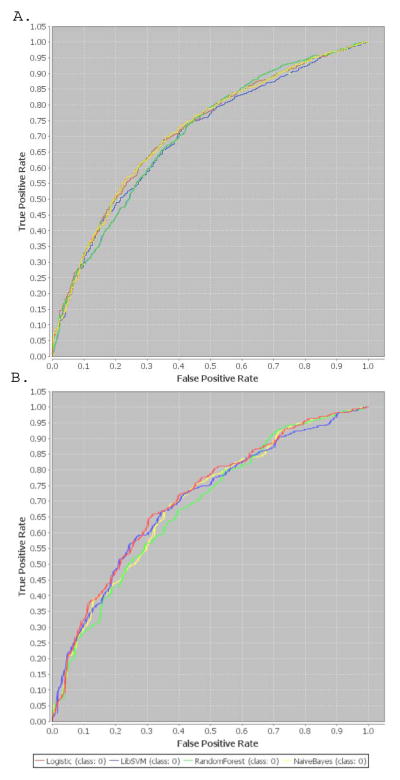
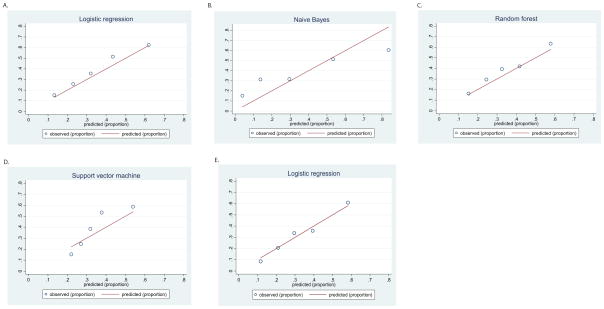
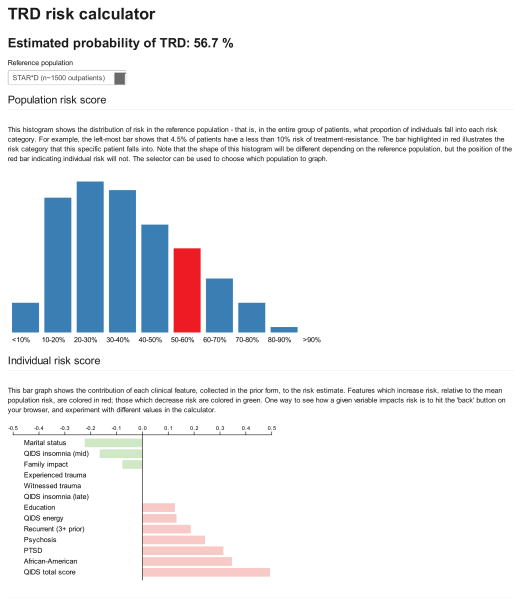
Results: A logistic regression model achieved an area under the receiver operating characteristic curve exceeding .71 in training, testing, and validation cohorts and maintained good calibration across cohorts. Performance of three alternative models with machine learning approaches--a naïve Bayes classifier and a support vector machine, and a random forest model--was less consistent. Similar performance was observed between more and less severe depression, men and women, and primary versus specialty care sites. A web-based calculator was developed that implements this tool and provides graphical estimates of risk.
Conclusion: Risk for treatment resistance among outpatients with major depressive disorder can be estimated with a simple model incorporating baseline sociodemographic and clinical features. Future studies should examine the performance of this model in other clinical populations and its utility in treatment selection or clinical trial design.
Trial registration: ClinicalTrials.gov NCT00021528.
Copyright © 2013 Society of Biological Psychiatry. Published by Elsevier Inc. All rights reserved.
Figures
Comment in
-
Modeling predictors, moderators and mediators of treatment outcome and resistance in depression.Biol Psychiatry. 2013 Jul 1;74(1):2-4. doi: 10.1016/j.biopsych.2013.05.009. Biol Psychiatry. 2013. PMID: 23787333 No abstract available.
References
-
- Petersen T, Papakostas GI, Mahal Y, Guyker WM, Beaumont EC, Alpert JE, et al. Psychosocial functioning in patients with treatment resistant depression. European psychiatry : the journal of the Association of European Psychiatrists. 2004;19:196–201. - PubMed
-
- Gibson TB, Jing Y, Smith Carls G, Kim E, Bagalman JE, Burton WN, et al. Cost burden of treatment resistance in patients with depression. The American journal of managed care. 2010;16:370–377. - PubMed
-
- Thase ME. Treatment-resistant depression: prevalence, risk factors, and treatment strategies. J Clin Psychiatry. 2011;72:e18. - PubMed
-
- Lee TH, Marcantonio ER, Mangione CM, Thomas EJ, Polanczyk CA, Cook EF, et al. Derivation and prospective validation of a simple index for prediction of cardiac risk of major noncardiac surgery. Circulation. 1999;100:1043–1049. - PubMed
-
- Lee TH, Juarez G, Cook EF, Weisberg MC, Rouan GW, Brand DA, et al. Ruling out acute myocardial infarction. A prospective multicenter validation of a 12-hour strategy for patients at low risk. N Engl J Med. 1991;324:1239–1246. - PubMed
Publication types
MeSH terms
Associated data
Grants and funding
LinkOut - more resources
Full Text Sources
Other Literature Sources
Medical
