Review
. 2011;52(3):329-41.
doi: 10.1093/ilar.52.3.329.

Changing mechanisms of opiate tolerance and withdrawal during early development: animal models of the human experience

Review

Changing mechanisms of opiate tolerance and withdrawal during early development: animal models of the human experience

Gordon A Barr et al. ILAR J. 2011.

Abstract

Human infants may be exposed to opiates through placental transfer from an opiate-using mother or through the direct administration of such drugs to relieve pain (e.g., due to illness or neonatal surgery). Infants of many species show physical dependence and tolerance to opiates. The magnitude of tolerance and the nature of withdrawal differ from those of the adult. Moreover, the mechanisms that contribute to the chronic effects of opiates are not well understood in the infant but include biological processes that are both common to and distinct from those of the adult. We review the animal research literature on the effects of chronic and acute opiate exposure in infants and identify mechanisms of withdrawal and tolerance that are similar to and different from those understood in adults. These mechanisms include opioid pharmacology, underlying neural substrates, and the involvement of other neurotransmitter systems. It appears that brain circuitry and opioid receptor types are similar but that NMDA receptor function is immature in the infant. Intracellular signaling cascades may differ but data are complicated by differences between the effects of chronic versus acute morphine treatment. Given the limited treatment options for the dependent infant patient, further study of the biological functions that are altered by chronic opiate treatment is necessary to guide evidenced-based treatment modalities.


Figures
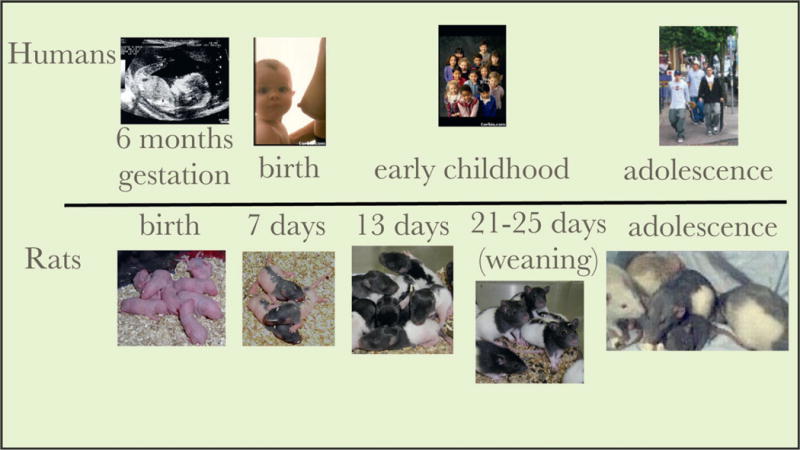
Figure 1
Figure 1
Illustration of rough equivalent ages for a rat and human based on rate of protein synthesis in the brain (Dobbing 1981). Other schemes, based on other criteria, show slightly different age equivalencies (Clancy et al. 2007) and individual brain regions and physiological functions develop at individual rates. Despite slight differences the rat is altricial and is developmentally similar at birth to the human fetus at 6 months.
Figure 2
Figure 2
Schematic demonstrating tolerance. When a drug that can induce tolerance is given repeatedly, the dose response curve shifts to the right. (Sensitization, not shown, would be a shift to the left.) The dose that affects 50% of the subjects (ED50) is then increased.
Figure 3
Figure 3
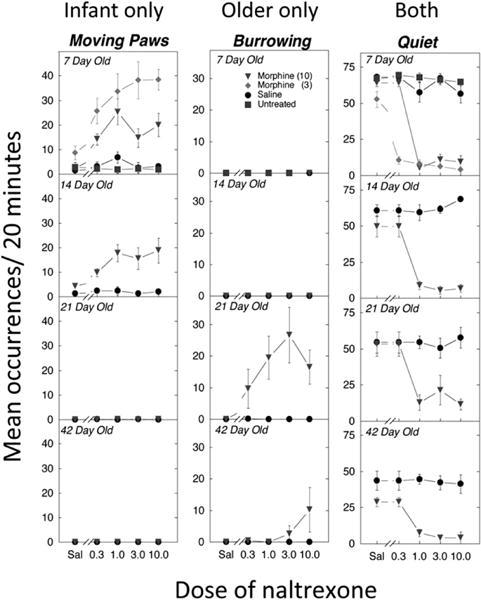
Examples of behaviors that are unique to infant rats (7 days old), occur only in older rats (21+ days old), or occur throughout the lifespan (adapted from Jones and Barr 1995). See Table 1 for definitions of the behaviors. Numbers after morphine are the chronic doses (3 or 10 mg/kg 2×/day) begun 7 days before testing. Sal, saline
Figure 4
Figure 4
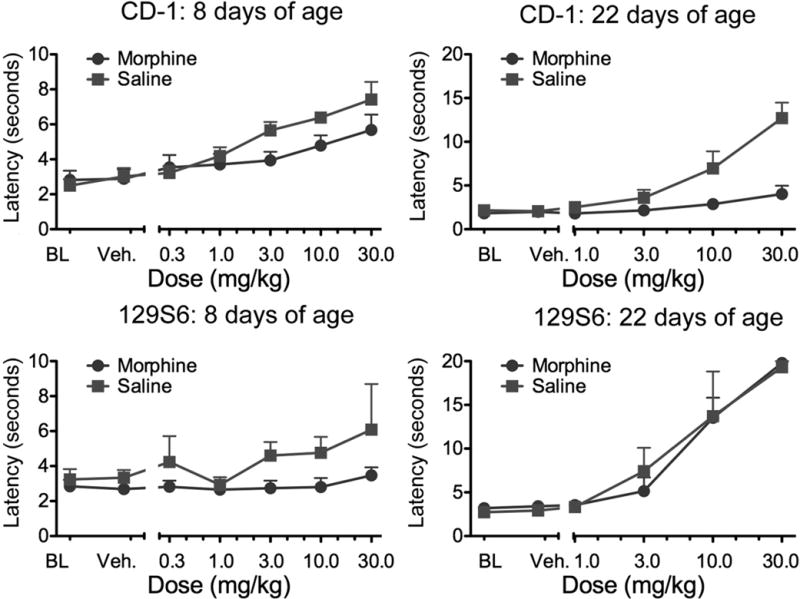
The development of tolerance in CD-1 and 129S6 mice. Pups were injected twice daily for 6½ days starting at either 1 or 15 days of age (N = 3–9 per condition). At 8 or 22 days of age, respectively, they were tested for analgesia in a cumulative dose response paradigm with morphine using the tail immersion test. At 8 days of age, both strains showed tolerance, but at 22 days only the CD-1 mice were tolerant. Thus the deficit in the 129S6 mouse—whether a lack of functional NMDA receptors or deficiencies in GM1 ganglioside–regulated excitatory opioid receptor function—has no influence on tolerance in the infant. In the older pup, the deficit has functional consequences (Perez and Barr, unpublished data). BL, baseline; NMDA, N-methyl-d-aspartate; veh, vehicle
Figure 5
Figure 5
Schematic diagram of protein kinase (PK) A and PKC intracellular signaling pathways by which G protein–coupled receptors (GPCRs) activate cAMP and other signaling molecules and thus affect gene expression. Adapted from SABiosciences/Protein Lounge.
Figure 6
Figure 6
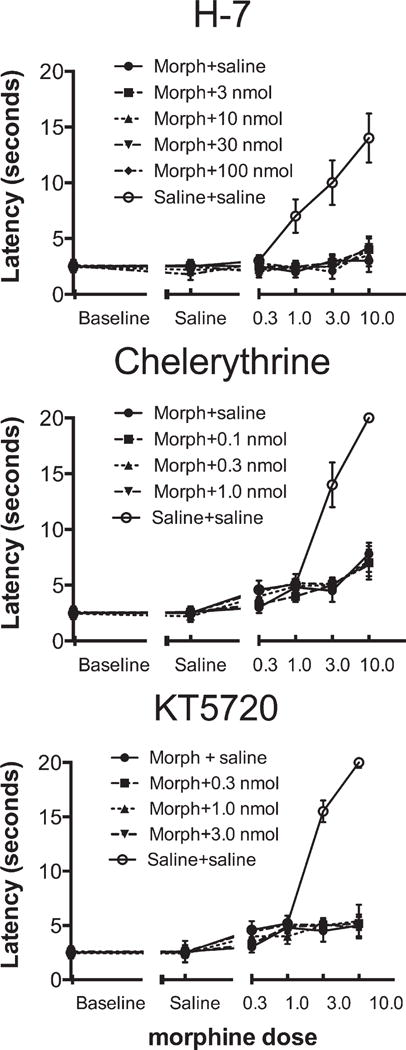
Rat pups were made tolerant to morphine by 13 twice-daily injections (10 mg/kg) from postnatal day (PND) 1 to PND 7, after which we used a cumulative dose-response paradigm to test for tolerance to the drug’s analgesic effect. We injected H-7, chelerythrine, and KT5720—broadly acting protein kinase (PK), PKC, and PKA antagonists, respectively—before the tolerance test (a thermal tail immersion test of nociception). None of these drugs reduced tolerance at any dose (McPhie-Lalmansingh and Barr, unpublished data). Morph, morphine; nmol, nanomole
Figure 7
Figure 7
pAkt, pCREB, and pERK in the periaqueductal gray. Rat pups were treated as described in Figure 6. At postnatal day (PND) 7 and 21, pAkt and pERK were enhanced by chronic morphine but not further increased in withdrawal (Riley and Barr, unpublished data). There were no changes in pCREB at either age for any treatment. pCREB, phosphorylated cyclic adenosine monophosphate (cAMP) response element binding [protein]; pERK, phosphorylated extracellular-signal-regulated kinase

References

    1. Anand KJ, Willson DF, Berger J, Harrison R, Meert KL, Zimmerman J, Carcillo J, Newth CJ, Prodhan P, Dean JM, Nicholson C. Tolerance and withdrawal from prolonged opioid use in critically ill children. Pediatrics. 2010;125:e1208–e1225. - PMC - PubMed
    1. Bannister K, Dickenson AH. Opioid hyperalgesia. Curr Opin Support Palliat Care. 2009;4:1–5. - PubMed
    1. Bardo MT, Hughes RA. Single-dose tolerance to morphine-induced analgesic and hypoactive effects in infant rats. Dev Psycho biol. 1981;14:415–423. - PubMed
    1. Barr GA, Goodwin GA. Precipitated morphine withdrawal induces a conditioned aversion in the preweaning rat. Pharmacol Biochem Behav. 1997;57:779–783. - PubMed
    1. Barr GA, Wang S. Tolerance and withdrawal to chronic morphine treatment in the week-old rat pup. Eur J Pharmacol. 1992;215:35–42. - PubMed

Publication types

Substances