. 2013 Feb 26;110(9):3615-20.
doi: 10.1073/pnas.1212466110. Epub 2013 Feb 4.

Insects groom their antennae to enhance olfactory acuity

Affiliations

Insects groom their antennae to enhance olfactory acuity

Katalin Böröczky et al. Proc Natl Acad Sci U S A. .

Abstract

Grooming, a common behavior in animals, serves the important function of removing foreign materials from body surfaces. When antennal grooming was prevented in the American cockroach, Periplaneta americana, field emission gun scanning electron microscopy images revealed that an unstructured substance accumulated on nongroomed antennae, covering sensillar pores, but not on groomed antennae of the same individuals. Gas chromatography analysis of antennal extracts showed that over a 24-h period nongroomed antennae accumulated three to four times more cuticular hydrocarbons than groomed antennae. Moreover, nongroomed antennae accumulated significantly more environmental contaminants from surfaces (stearic acid) and from air (geranyl acetate) than groomed antennae. We hypothesized that the accumulation of excess native cuticular hydrocarbons on the antennae would impair olfactory reception. Electroantennogram experiments and single-sensillum recordings supported this hypothesis: antennae that were prevented from being groomed were significantly less responsive than groomed antennae to the sex pheromone component periplanone-B, as well as to the general odorants geranyl acetate and hexanol. We therefore conclude that antennal grooming removes excess native cuticular lipids and foreign chemicals that physically and/or chemically interfere with olfaction, and thus maintains the olfactory acuity of the antennae. Similar experimental manipulations of the German cockroach (Blattella germanica), carpenter ant (Camponotus pennsylvanicus), and the housefly (Musca domestica), which use different modes of antennal grooming, support the hypothesis that antennal grooming serves a similar function in a wide range of insect taxa.


Conflict of interest statement

The authors declare no conflict of interest.

Figures
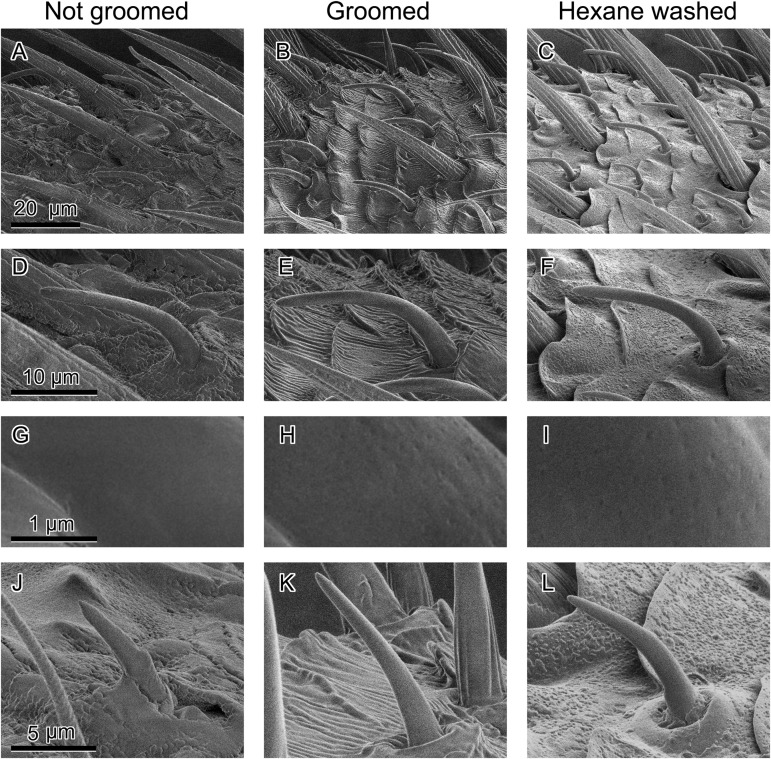
Fig. 1.
Fig. 1.
Accumulation of material on nongroomed antennae, covering olfactory pores. Field emission gun scanning electron microscope images of nongroomed, groomed, and hexane-washed antennae of male P. americana. Large amounts of unstructured material completely cover the surface of nongroomed antennae, including the bases of all sensilla (A), groomed antennae have grooved material on their surface (B), whereas this material is completely removed from the surface of hexane-washed antennae (C). Images in the second row (D–F) show pheromone-sensitive sensilla, morphological type swB (20), whereas the third row shows high-magnification images of the same sensilla around the middle of their shaft. Sensillar pores are completely covered and not visible on the nongroomed antenna (G), but they are clearly visible on sensilla of the groomed antenna (H) of the same insect, as well as on hexane-washed antennae (I). The last row of images shows hexanol-sensitive single-walled type A (swA) olfactory sensilla on the nongroomed (J), groomed (K), and hexane-washed (L) antennae.
Fig. 2.
Fig. 2.
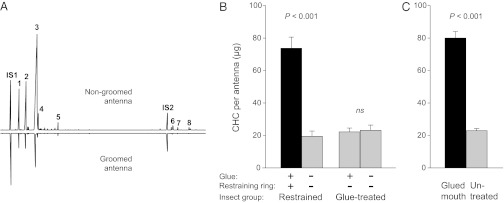
Cuticular hydrocarbons (CHCs) accumulate on nongroomed antennae of male P. americana. Gas chromatographic CHC profiles of restrained (nongroomed) and control (groomed) antennae of a male P. americana (A). Peaks are as reported by Jackson (21) and Saïd et al. (22): n-pentacosane (A, 1), 3-methylpentacosane (A, 2), (Z,Z)-6,9-heptacosadiene (A, 3), n-heptacosane (A, 4), n-nonacosane (A, 5), (Z)-15-hentetracontene (A, 6), 13-methylhentetracontane (A, 7), and tritetracontadiene (A, 8). Internal standards n-tetracosane (IS1) and n-tetracontane (IS2) were used to quantify CHCs on the antennae. Amounts of CHCs (mean ± SEM) on nongroomed and groomed antennae (B and C). In glue-control insects (n = 7) one antenna was treated with glue that did not interfere with grooming; in the “restrained” group grooming of one antenna was prevented while the other antenna could be groomed (n = 7) (B). Another set of cockroaches was either untreated (n = 7) or their mouthparts were glued to completely prevent antennal grooming (n = 7) (C). Significant differences are indicated between nongroomed and groomed antennae of the same individuals (Student’s paired t test) and between mouthparts-glued and untreated cockroaches (Student’s unpaired t test); ns, not significant.
Fig. 3.
Fig. 3.
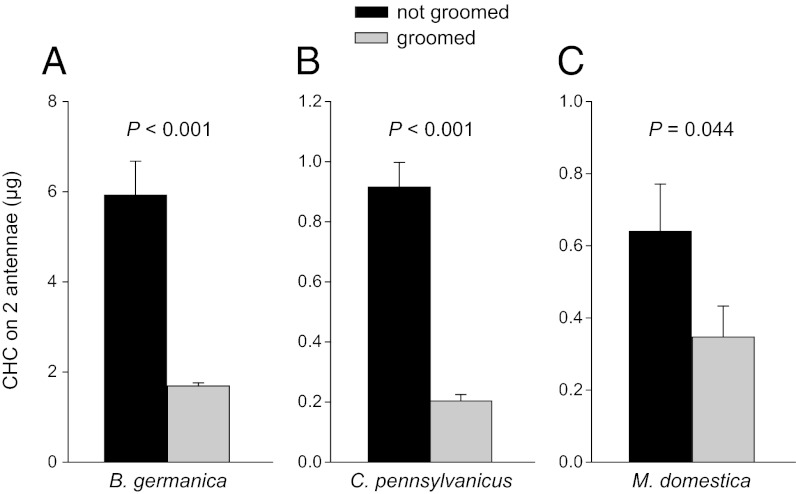
Species representing three insect orders accumulate excess CHCs on the antennae when grooming is prevented. Accumulation of CHCs on nongroomed and groomed antennae of B. germanica adult male cockroaches (n = 10) (A), C. pennsylvanicus worker ants (n = 10) (B), and M. domestica adult male flies (n = 7–9) (C). Mean ± SEM are shown, and significant differences between respective treatments are indicated (Student’s unpaired t test).
Fig. 4.
Fig. 4.
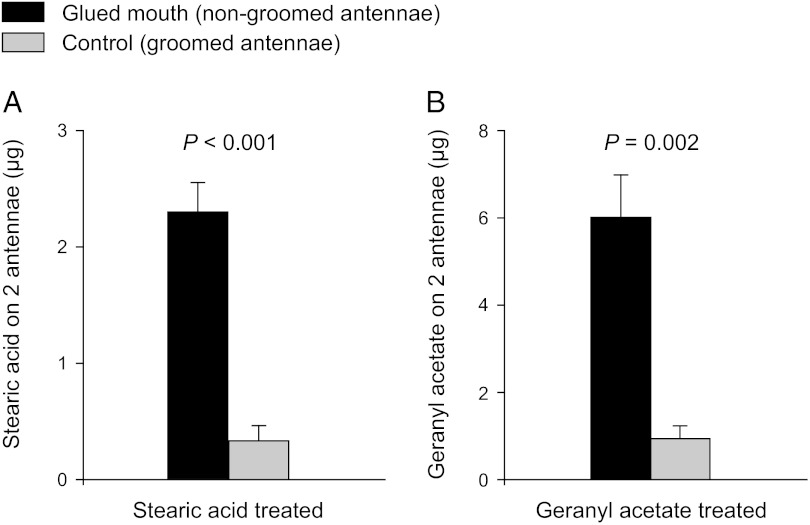
Environmental chemicals accumulate on nongroomed antennae of male P. americana. Amounts of stearic acid (A) and geranyl acetate (B) (mean ± SEM) are presented. Mouthparts-glued (n = 8) and control (n = 7) cockroaches were kept in stearic acid-coated canning jars for 24 h (A) or in jars with geranyl acetate in the headspace (B) (n = 7). Significant differences are indicated between nongroomed and groomed antennae of mouthparts-glued and control cockroaches, respectively (Student’s unpaired t test).
Fig. 5.
Fig. 5.
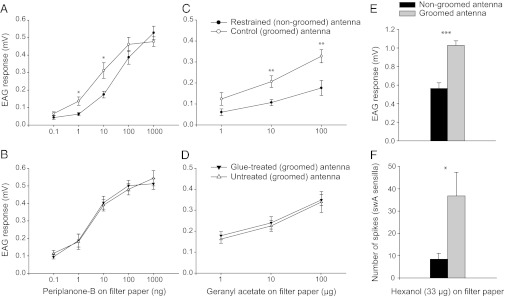
Antennal grooming enhances the sensitivity of the olfactory system. Electroantennogram (EAG) dose–response results of male P. americana antennae stimulated with periplanone-B (n = 8) (A and B) and geranyl acetate (n = 6) (C and D). In the experimental group one antenna of each cockroach was prevented from being groomed (A and C). In the control group both antennae were allowed to be groomed, with one antenna being sham glue treated (B and D). Results of EAG recordings (E) and single sensillum recordings (SSRs) with hexanol-sensitive swA sensilla (F) on groomed (n = 12 EAG, 9 SSR) and nongroomed antennae (n = 11 EAG, 10 SSR) of male P. americana. The absolute EAG responses are presented in AD, whereas in E and F the responses to the mineral oil control (vehicle) were subtracted from the respective sensillum responses to hexanol. Mean ± SEM are shown. Differences in the responses of pairs of antennae from the same individuals (AD) are indicated for each dose (Student’s paired t test), and differences in the responses between treatment groups (E and F) are also indicated (Student’s unpaired t test): *P < 0.05, **P < 0.01, ***P < 0.001.

References

    1. Jander U. Phylogenetic analysis of grooming behaviors in Tracheata. (Translated from German) Z Tierpsychol. 1966;23(7):799–844. - PubMed
    1. Szebenyi AL. Cleaning behaviour in Drosophila melanogaster. Anim Behav. 1969;17(4):641–651.
    1. Elawami IO, Dent DR. The interaction of surface and dust particle-size on the pick-up and grooming behavior of the German cockroach Blattella germanica. Entomol Exp Appl. 1995;77(1):81–87.
    1. Vincent CM, Bertram SM. Crickets groom to avoid lethal parasitoids. Anim Behav. 2010;79(1):51–56.
    1. Reber A, Purcell J, Buechel SD, Buri P, Chapuisat M. The expression and impact of antifungal grooming in ants. J Evol Biol. 2011;24(5):954–964. - PubMed

Publication types