. 2013 Feb 19;110(8):E707-15.
doi: 10.1073/pnas.1215278110. Epub 2013 Feb 4.

Computational modeling and experimental validation of the Legionella and Coxiella virulence-related type-IVB secretion signal

Affiliations

Computational modeling and experimental validation of the Legionella and Coxiella virulence-related type-IVB secretion signal

Ziv Lifshitz et al. Proc Natl Acad Sci U S A. .

Abstract

Legionella and Coxiella are intracellular pathogens that use the virulence-related Icm/Dot type-IVB secretion system to translocate effector proteins into host cells during infection. These effectors were previously shown to contain a C-terminal secretion signal required for their translocation. In this research, we implemented a hidden semi-Markov model to characterize the amino acid composition of the signal, thus providing a comprehensive computational model for the secretion signal. This model accounts for dependencies among sites and captures spatial variation in amino acid composition along the secretion signal. To validate our model, we predicted and synthetically constructed an optimal secretion signal whose sequence is different from that of any known effector. We show that this signal efficiently translocates into host cells in an Icm/Dot-dependent manner. Additionally, we predicted in silico and experimentally examined the effects of mutations in the secretion signal, which provided innovative insights into its characteristics. Some effectors were found to lack a strong secretion signal according to our model. We demonstrated that these effectors were highly dependent on the IcmS-IcmW chaperons for their translocation, unlike effectors that harbor a strong secretion signal. Furthermore, our model is innovative because it enables searching ORFs for secretion signals on a genomic scale, which led to the identification and experimental validation of 20 effectors from Legionella pneumophila, Legionella longbeachae, and Coxiella burnetii. Our combined computational and experimental methodology is general and can be applied to the identification of a wide spectrum of protein features that lack sequence conservation but have similar amino acid characteristics.


Conflict of interest statement

The authors declare no conflict of interest.

Figures
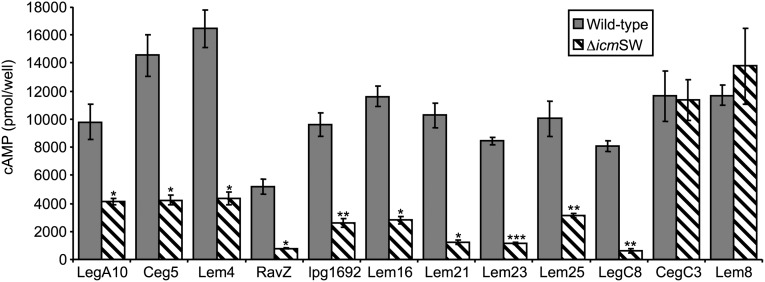
Fig. 1.
Fig. 1.
The IcmS–IcmW chaperon complex affects the translocation of effectors that received a low score by the HSMM. The WT strain JR32 (gray bars) and the icmS-icmW double-deletion mutant ED400 (diagonal striped bars) harboring the CyaA fusion proteins indicated below each bar were used to infect HL-60–derived human macrophages, and the cAMP levels of the infected cells were determined as described in Materials and Methods. The bar heights represent the means of the amount of cAMP per well obtained in at least three independent experiments; error bars indicate SDs. The cAMP levels of each fusion were found to be significantly different (*P < 0.05; **P < 0.01; ***P < 0.001, paired Student t test), comparing the WT strain and the icmS-icmW double-deletion mutant.
Fig. 2.
Fig. 2.
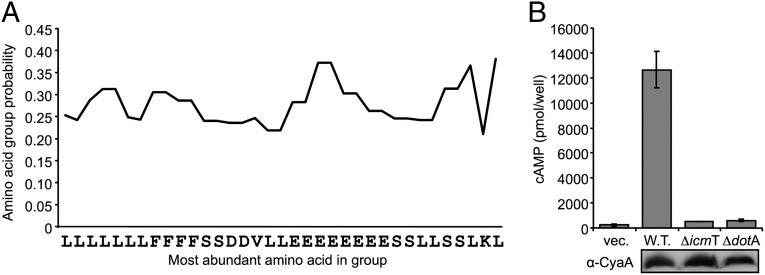
The synthetic signal predicted by the HSMM translocates a protein into host cells in an Icm/Dot- dependent manner. (A) Amino acids of the synthetic signal were divided into five groups (ILVF, DE, RK, ST, and QN) according to their physicochemical properties. Each group of amino acids is represented by the amino acid in the group that received the highest probability of occurrence in each position, and the probability of occurrence of each amino acid group is presented. (B) CyaA protein fused to the synthetic signal was examined for translocation into HL-60–derived human macrophages from the WT strain JR32, the icmT deletion mutant GS3011, and the dotA insertion mutant LELA3118. vec., vector control. The bar heights represent the means of cAMP levels per well obtained from at least three independent experiments; error bars represent SDs. Protein levels were assessed by Western blot using α-CyaA antibody and are shown below each bar.
Fig. 3.
Fig. 3.
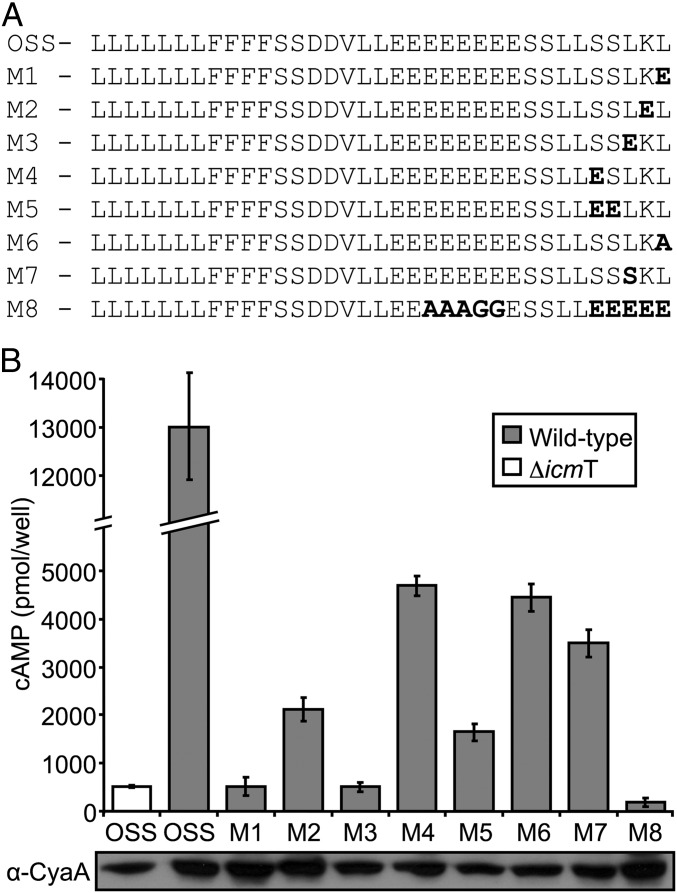
Mutation analysis of the OSS. (A) Amino acid sequences of the OSS and the mutations constructed are shown. The mutated residues are marked in bold. (B) CyaA fusions of the OSS and the eight mutated OSSs were examined for translocation from the WT strain JR32 into HL-60–derived human macrophages. The translocation level of the OSS from the icmT deletion mutant is also presented. The bar heights represent the means of cAMP levels per well obtained from at least three independent experiments; error bars represent SDs. The cAMP levels were found to be significantly different (P < 10−6, paired Student t test) when comparing the OSS and each of the mutants. Protein levels were assessed by Western blot using α-CyaA antibody and are shown below each bar.
Fig. 4.
Fig. 4.
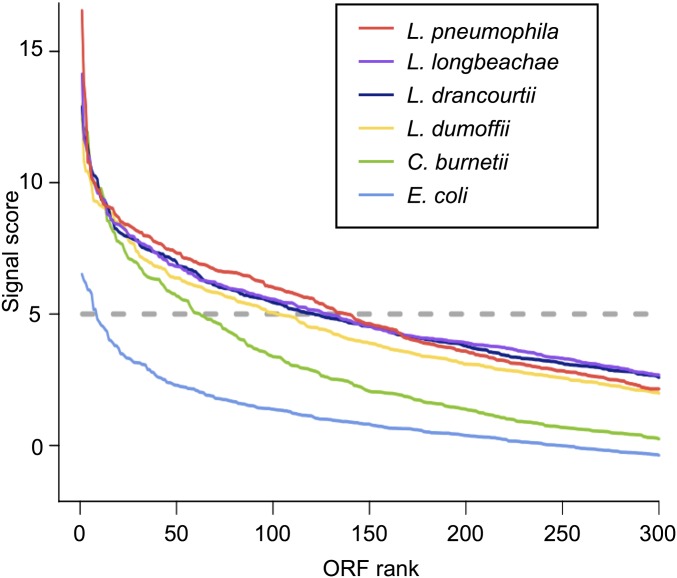
Top-scoring ORFs from four Legionella species and C. burnetii according to the HSMM. The HSMM signal score reflects the agreement between the C terminus of each ORF and the effector model, while accounting for the background model trained separately for each bacterial species. The 300 top-scoring ORFs for the indicated Legionella species and C. burnetii are shown. The scoring of E. coli ORFs was used as a negative control for a bacterial species that does not contain an Icm/Dot secretion system. The horizontal gray dashed line represents the cutoff score of 5, which was used for the experimental validation of L. pneumophila and L. longbeachae ORFs.
Fig. 5.
Fig. 5.
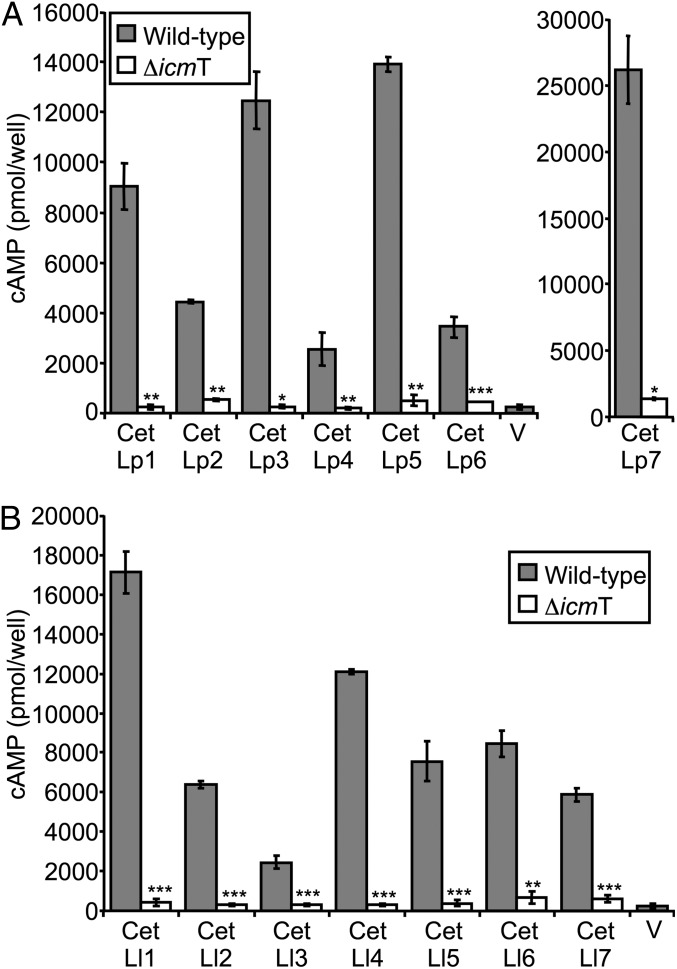
Icm/Dot-dependent translocation of Legionella effector proteins predicted by the HSMM. CyaA fusions of predicted L. pneumophila (A) and L. longbeachae (B) effectors were examined for translocation into HL-60–derived human macrophages from the WT strain JR32 (gray bars) and the icmT deletion mutant GS3011 (white bars); the effectors examined are indicated below each bar. V, vector control. The cAMP levels of the infected cells were determined as described in Materials and Methods. The bar heights represent the means of the amount of cAMP per well obtained in at least three independent experiments; error bars indicate SDs. The cAMP levels of each fusion were found to be significantly different (*P < 0.05; **P < 0.01; ***P < 0.001, paired Student t test) between the WT strain and the icmT deletion mutant.
Fig. 6.
Fig. 6.
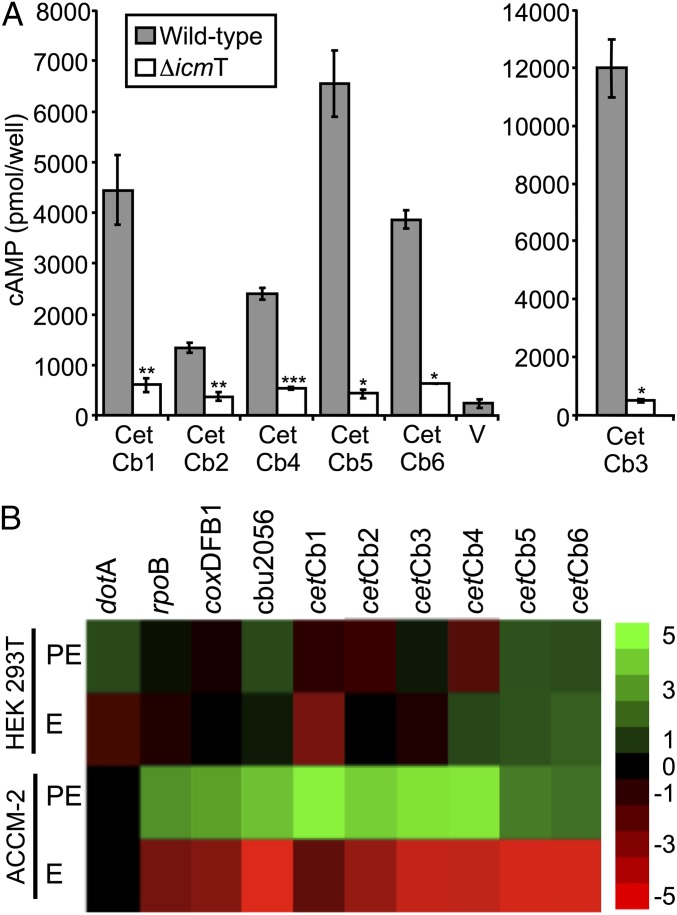
Icm/Dot-dependent translocation of C. burnetii effectors identified by the HSMM and their expression during infection. (A) WT strain JR32 (gray bars) and the icmT deletion mutant GS3011 (white bars) harboring the CyaA fusion proteins (indicated below each bar) were used to infect HL-60–derived human macrophages, and the cAMP levels of the infected cells were determined as described in Materials and Methods. V, vector control. The bar heights represent the means of the amount of cAMP per well obtained in at least three independent experiments; error bars indicate SDs. The cAMP levels of each fusion were found to be significantly different (*P < 0.05; **P < 0.01; ***P < 0.001, paired Student t test) between the WT strain and the icmT deletion mutant. (B) Gene expression levels of C. burnetii effector genes during growth in ACCM-2 axenic medium and in HEK 293T cells. The heat map shows the logarithm of expression values of specific genes during growth in ACCM-2 media or in HEK 293T cells. Four genes were used as controls: dotA and rpoB, as well as coxDFB1 and cbu2056, two previously identified effectors. The values are the RNA levels normalized to 16S RNA during exponential (E) and postexponential (PE) phases. The RNA levels were measured by RT-qPCR and normalized to the levels of 16S RNA as described in Materials and Methods.
Fig. 7.
Fig. 7.
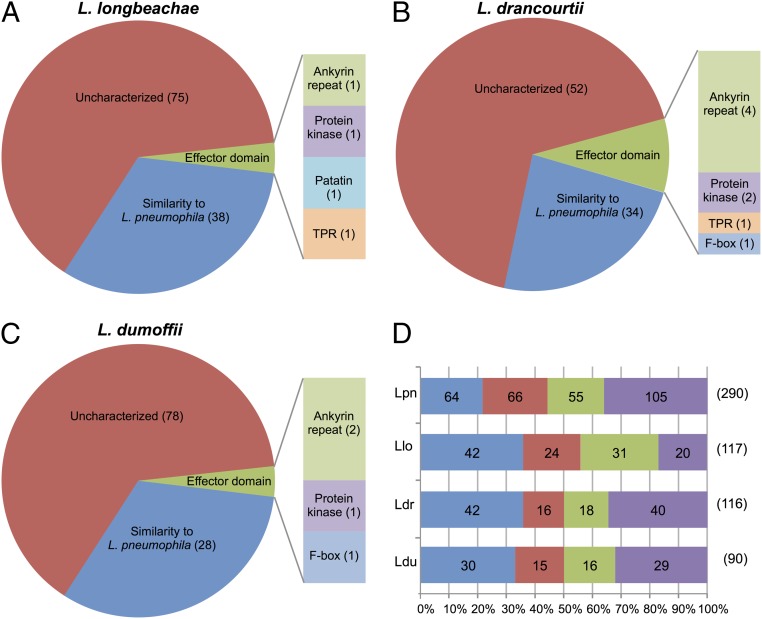
Analysis of putative effectors in L. longbeachae, L. drancourtii, and L. dumoffii. The ORFs of L. longbeachae (A), L. drancourtii (B), and L. dumoffii (C) that received a signal score above 5 (excluding ORFs that are unlikely to encode for effectors; Dataset S4) were divided into three groups: (i) “Effector domain”: putative effectors containing one of the domains known to characterize L. pneumophila effectors (the bars next to the “effector domain” specify which domains are present in the putative effectors), (ii) “Similarity to L. pneumophila”: putative effectors that do not harbor such a domain but show local similarity to known L. pneumophila effectors, and (iii) “Uncharacterized”: putative effectors containing neither a known effector domain nor similarity to known L. pneumophila effectors. The number of effectors in each category is indicated in parentheses. (D) Representation of the percentage of putative effectors that are unique (blue), as well as those that have homology in one (red), two (green), or all three (purple) other Legionella species. The top bar presents the same analysis for all 290 effectors of L. pneumophila. Ldr, L. drancourtii; Ldu, L. dumoffii; Llo, L. longbeachae; Lpn, L. pneumophila. The total number of predicted or validated (for L. pneumophila) effectors in each species is indicated in parentheses to the right. The number of effectors in each category is indicated inside the bars.
Fig. P1.
Fig. P1.
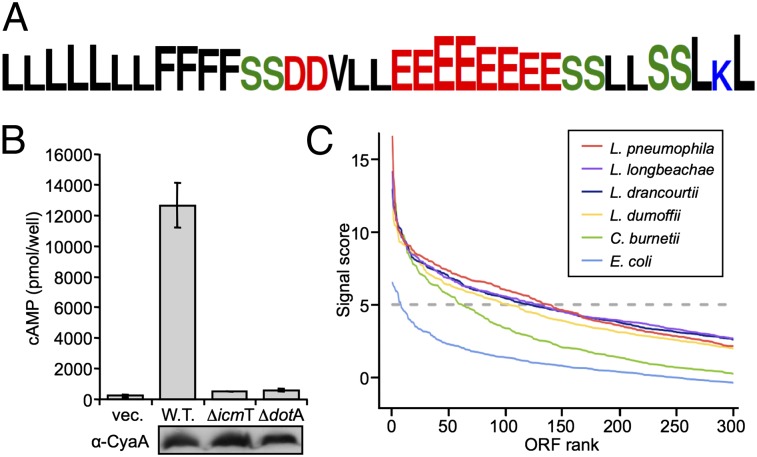
Computational modeling of the type-IVB secretion signal using the hidden semi-Markov model (HSMM) and its use in constructing a functional optimal synthetic signal and identifying previously unknown effectors. (A) Probability of amino acid occurrence in the optimal secretion signal according to the HSMM. (B) Synthetic signal predicted by the HSMM translocates the CyaA protein into host cells in a type-IVB–dependent manner. Translocation was examined from the WT strain (W.T.), the icmT deletion mutant (ΔicmT), and the dotA insertion mutant (ΔdotA). vec, vector control. (C) Three hundred top-scoring ORFs from four Legionella species and C. burnetii according to the HSMM. Escherichia coli ORFs were used as a negative control.

References

    1. Ghigo E, et al. Intracellular life of Coxiella burnetii in macrophages. Ann N Y Acad Sci. 2009;1166:55–66. - PubMed
    1. Diederen BM. Legionella spp. and Legionnaires’ disease. J Infect. 2008;56(1):1–12. - PubMed
    1. Cutler SJ, Bouzid M, Cutler RR. Q fever. J Infect. 2007;54(4):313–318. - PubMed
    1. Fields BS. The molecular ecology of legionellae. Trends Microbiol. 1996;4(7):286–290. - PubMed
    1. Newton HJ, Roy CR. The Coxiella burnetii Dot/Icm system creates a comfortable home through lysosomal renovation. MBio. 2011;2(5):e00226–e00211. - PMC - PubMed

Publication types

LinkOut - more resources