. 2013 Apr 15;207(8):1281-5.
doi: 10.1093/infdis/jit034. Epub 2013 Feb 4.

Heterogeneity in viral shedding among individuals with medically attended influenza A virus infection

Affiliations

Heterogeneity in viral shedding among individuals with medically attended influenza A virus infection

Lincoln L H Lau et al. J Infect Dis. .

Abstract

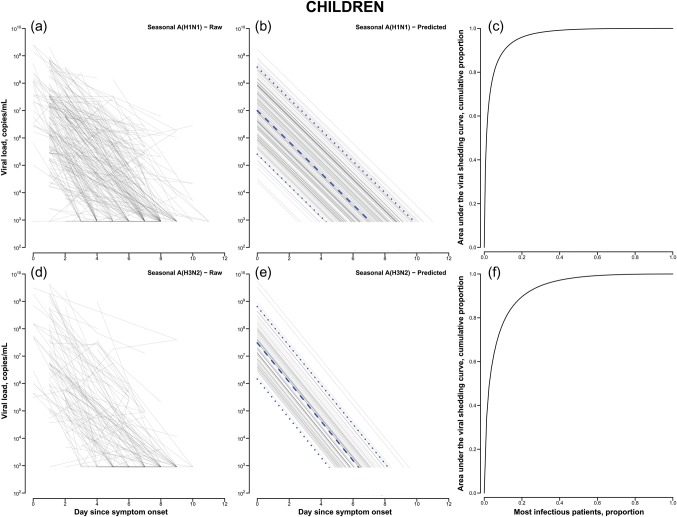
Compared with the average transmissibility of human influenza A virus, much less attention has been paid to the potential variability in its transmissibility. We considered viral shedding as a proxy for infectiousness and explored the heterogeneity of infectiousness among patients with medically attended seasonal influenza A virus infection. The analysis revealed that viral shedding is more heterogeneous in children than in adults. The top 20% most infectious children and adults were estimated to be responsible for 89%-96% and 78%-82%, respectively, of the total infectiousness in each age group. Further investigation is required to correlate the substantial variations in viral shedding with heterogeneity in actual transmissibility.


Figures
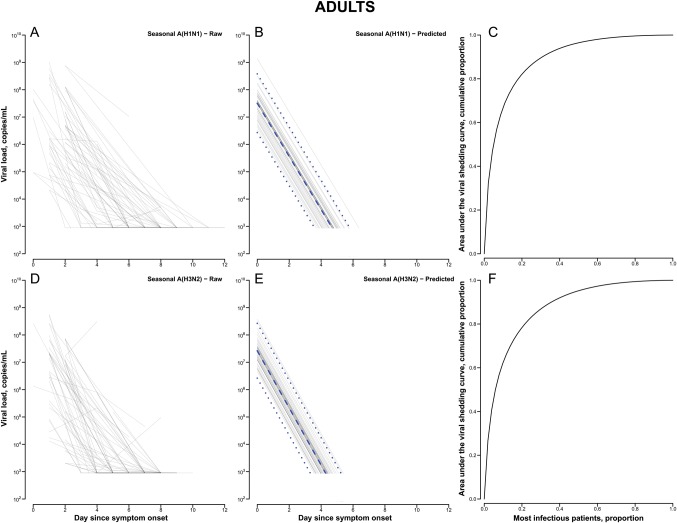
Figure 1.
Figure 1.
Observed and modeled seasonal influenza A virus subtypes H1N1 (A[H1N1]) and H3N2 (A[H3N2]) shedding patterns, determined by quantitative reverse transcription polymerase chain reaction analysis, and cumulative area under the viral shedding curve in adults and children. A–C, Actual (A) and predicted (B) seasonal A(H1N1) shedding patterns and cumulative viral shedding (C) in adults, by time since onset of acute respiratory illness (ARI). D–F, Actual (D) and predicted (E) seasonal A(H3N2) shedding patterns and cumulative viral shedding (F) in adults, by time since ARI onset. a–c, Actual (a) and predicted (b) seasonal A(H1N1) shedding patterns and cumulative viral shedding (c) in children, by time since ARI onset. d–f, Actual (d) and predicted (e) seasonal A(H3N2) shedding patterns and cumulative viral shedding (f) in children, by time since ARI onset. Dashed lines denote the median predicted trajectory of viral shedding, and dotted lines denote the 20th and 80th percentiles.
Figure 1.
Figure 1.
Observed and modeled seasonal influenza A virus subtypes H1N1 (A[H1N1]) and H3N2 (A[H3N2]) shedding patterns, determined by quantitative reverse transcription polymerase chain reaction analysis, and cumulative area under the viral shedding curve in adults and children. A–C, Actual (A) and predicted (B) seasonal A(H1N1) shedding patterns and cumulative viral shedding (C) in adults, by time since onset of acute respiratory illness (ARI). D–F, Actual (D) and predicted (E) seasonal A(H3N2) shedding patterns and cumulative viral shedding (F) in adults, by time since ARI onset. a–c, Actual (a) and predicted (b) seasonal A(H1N1) shedding patterns and cumulative viral shedding (c) in children, by time since ARI onset. d–f, Actual (d) and predicted (e) seasonal A(H3N2) shedding patterns and cumulative viral shedding (f) in children, by time since ARI onset. Dashed lines denote the median predicted trajectory of viral shedding, and dotted lines denote the 20th and 80th percentiles.

References

    1. Stein RA. Super-spreaders in infectious diseases. Int J Infect Dis. 2011;15:e510–3. - PMC - PubMed
    1. Cori A, Boelle PY, Thomas G, Leung GM, Valleron AJ. Temporal variability and social heterogeneity in disease transmission: the case of SARS in Hong Kong. PLoS Comput Biol. 2009;5:e1000471. - PMC - PubMed
    1. Moser MR, Bender TR, Margolis HS, Noble GR, Kendal AP, Ritter DG. An outbreak of influenza aboard a commercial airliner. Am J Epidemiol. 1979;110:1–6. - PubMed
    1. Pestre V, Morel B, Encrenaz N, et al. Transmission by super-spreading event of pandemic A/H1N1 2009 influenza during road and train travel. Scand J Infect Dis. 2012;44:225–7. - PubMed
    1. Lloyd-Smith JO, Schreiber SJ, Kopp PE, Getz WM. Superspreading and the effect of individual variation on disease emergence. Nature. 2005;438:355–9. - PMC - PubMed

Publication types

MeSH terms