. 2013 Feb 4:7:8.
doi: 10.3389/fnins.2013.00008. eCollection 2013.

Neural mechanisms of attentional control in mindfulness meditation

Affiliations

Neural mechanisms of attentional control in mindfulness meditation

Peter Malinowski. Front Neurosci. .

Abstract

The scientific interest in meditation and mindfulness practice has recently seen an unprecedented surge. After an initial phase of presenting beneficial effects of mindfulness practice in various domains, research is now seeking to unravel the underlying psychological and neurophysiological mechanisms. Advances in understanding these processes are required for improving and fine-tuning mindfulness-based interventions that target specific conditions such as eating disorders or attention deficit hyperactivity disorders. This review presents a theoretical framework that emphasizes the central role of attentional control mechanisms in the development of mindfulness skills. It discusses the phenomenological level of experience during meditation, the different attentional functions that are involved, and relates these to the brain networks that subserve these functions. On the basis of currently available empirical evidence specific processes as to how attention exerts its positive influence are considered and it is concluded that meditation practice appears to positively impact attentional functions by improving resource allocation processes. As a result, attentional resources are allocated more fully during early processing phases which subsequently enhance further processing. Neural changes resulting from a pure form of mindfulness practice that is central to most mindfulness programs are considered from the perspective that they constitute a useful reference point for future research. Furthermore, possible interrelations between the improvement of attentional control and emotion regulation skills are discussed.

Keywords: Stroop; attention; attentional control; meditation; mindfulness.


Figures
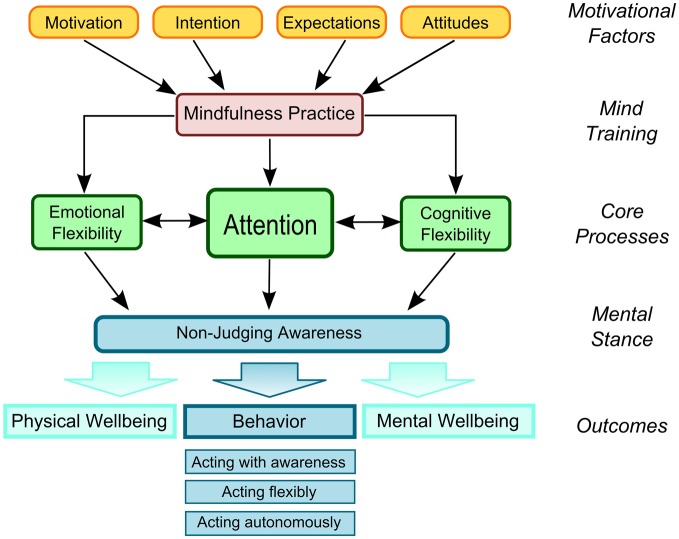
Figure 1
Figure 1
The Liverpool Mindfulness Model.
Figure 2
Figure 2
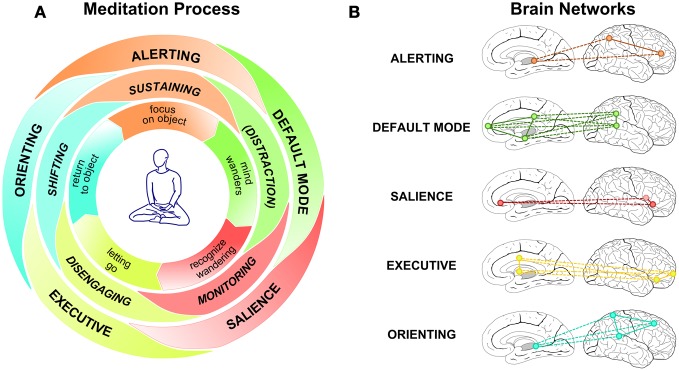
Effortful attention regulation during meditation. Panel (A) provides a schematic representation of the meditation process. The inner circle outlines the phenomenological layer, presenting the typical sequence (clockwise) a meditator will go through. The middle circle relates the attentional processes that lie underneath, while the outer circle represents the different brain networks that are involved in carrying out these functions. The different attentional processes and the brain networks are represented as partially overlapping to indicate that in many instances more than one process/network is involved. Panel (B) outlines the main brain areas involved in each of the five networks. Anatomical details are discussed in the main text.
Figure 3
Figure 3
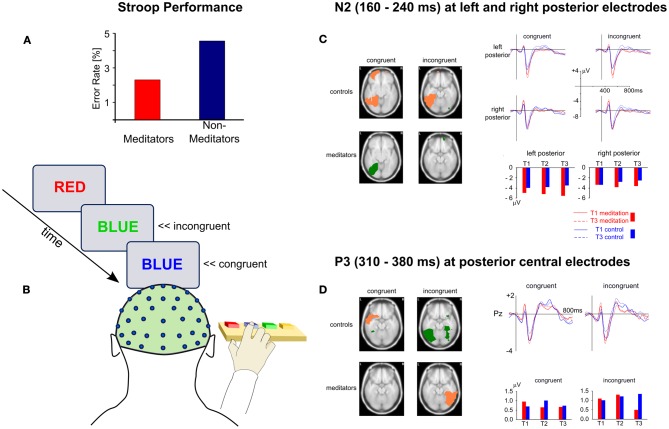
Behavioral and ERP results from the Stroop task as a function of meditation practice. (A) Performance differences between meditators and non-meditators in a cross-sectional comparison (Moore and Malinowski, 2009). (B) Outline of the Stroop task. (C) and (D) Results from a longitudinal study (Moore et al., 2012) showing effects of meditation training on ERPs during the Stroop task for the N2 (C) and P3 (D) ERP components. The glass brain slices show activation differences between T1 and T3 for each group and congruency. Salmon-colored areas indicate a decrease in activation and green areas indicate activation increase. On the right hand side ERPs (line graphs) and ERP-component amplitudes (bar graphs) are depicted for left and right posterior sites (C) and for posterior central sites (D).

References

    1. Aarts E., Roelofs A., Van Turennout M. (2008). Anticipatory activity in anterior cingulate cortex can be independent of conflict and error likelihood. J. Neurosci. 28, 4671–4678 10.1523/JNEUROSCI.4400-07.2008 - DOI - PMC - PubMed
    1. Adorni R., Proverbio A. M. (2009). New insights into name category-related effects: is the age of acquisition a possible factor? Behav. Brain Funct. 5:33 10.1186/1744-9081-5-33 - DOI - PMC - PubMed
    1. Allen M., Dietz M., Blair K. S., Van Beek M., Rees G., Vestergaard-Poulsen P., et al. (2012). Cognitive-affective neural plasticity following active-controlled mindfulness intervention. J. Neurosci. 32, 15601–15610 10.1523/JNEUROSCI.2957-12.2012 - DOI - PMC - PubMed
    1. Anderson N. D., Lau M. A., Segal Z. V., Bishop S. R. (2007). Mindfulness-based stress reduction and attentional control. Clin. Psychol. Psychother. 14, 449–463
    1. Baron Short E., Kose S., Mu Q., Borckardt J., Newberg A., George M. S., et al. (2010). Regional brain activation during meditation shows time and practice effects: an exploratory FMRI study. Evid. Based Complement. Alternat. Med. 7, 121–127 10.1093/ecam/nem163 - DOI - PMC - PubMed