Review
. 2012;2(12):1117-26.
doi: 10.7150/thno.4381. Epub 2012 Dec 10.

Lipid- and polymer-based nanostructures for cancer theranostics

Affiliations
Review

Lipid- and polymer-based nanostructures for cancer theranostics

Brian T Luk et al. Theranostics. 2012.

Abstract

The relatively new field of nanotheranostics combines the advantages of in vivo diagnosis with the ability to administer treatment through a single nano-sized carrier, offering new opportunities for cancer diagnosis and therapy. Nanotheranostics has facilitated the development of nanomedicine through direct visualization of drug blood circulation and biodistribution. From a clinical perspective, nanotheranostics allows therapies to be administered and monitored in real time, thus decreasing the potential of under- or over-dosing and allowing for more personalized treatment regimens. Herein, we review recent development of nanotheranostics using lipid- and polymer-based formulations, with a particular focus on their applications in cancer research. Recent advances in nanotechnology aimed to combine therapeutic molecules with imaging agents for magnetic resonance imaging, radionuclide imaging, or fluorescence imaging are discussed.

Keywords: fluorescence imaging; liposomes; magnetic resonance imaging; nanotheranostics; polymeric nanoparticles; radionuclide imaging.


Conflict of interest statement

Competing Interests: The authors have declared that no competing interest exists.

Figures
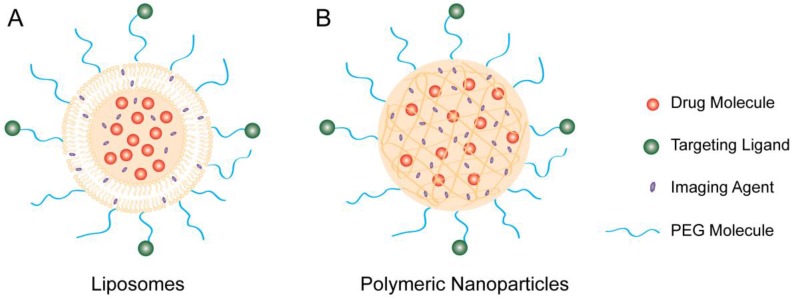
Figure 1
Figure 1
Therapeutic molecules and imaging agents can be co-encapsulated into (A) liposomes or (B) polymeric nanoparticles to form nanotheranostic platforms. Depending on the amphiphilicity of the imaging agents, they can be encapsulated either inside of the liposome or in the lipid bilayers. In addition, the particle surface can be conjugated with targeting ligands for targeted delivery.
Figure 2
Figure 2
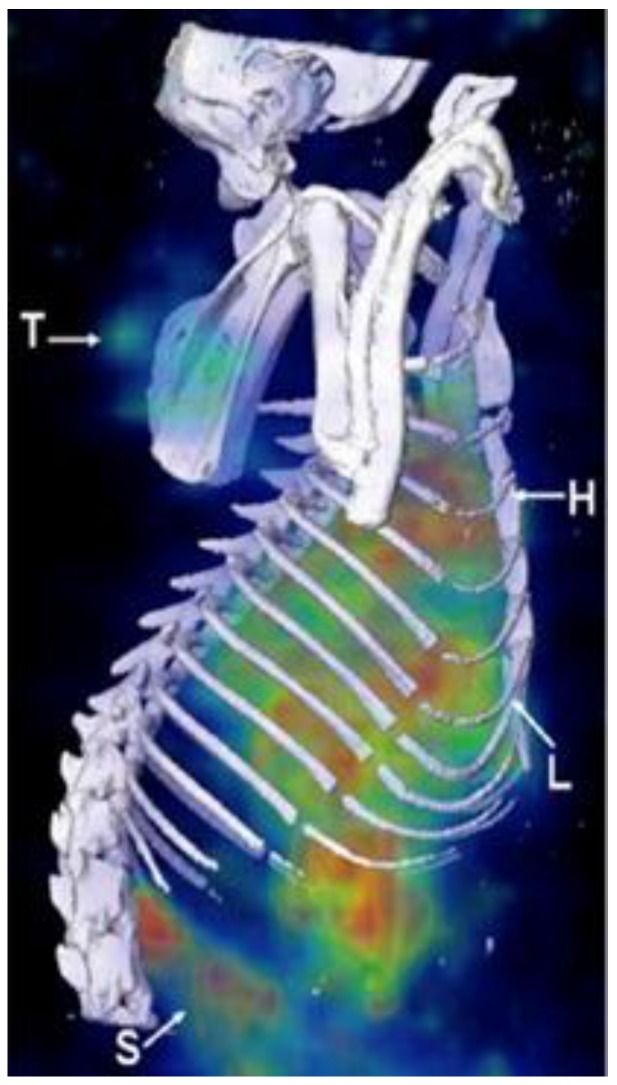
MicroSPECT/CT images acquired at 20 hours post administration of 186Re-Doxil using a multi-pinhole collimator. Three dimensional (3D) volume rendered SPECT image of 186Re-Doxil overlaid with CT isosurface displayed in bone window shows the accumulation in Tumor (T), liver (L), spleen (S) and circulation through heart (H). (Adapted from reference 36).
Figure 3
Figure 3
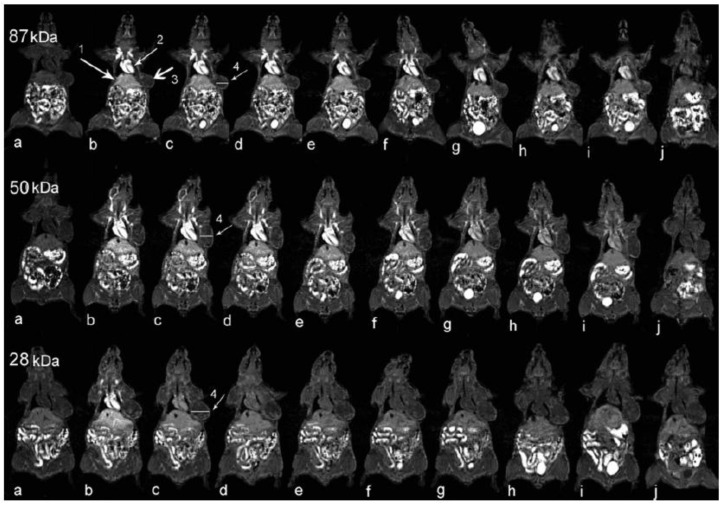
Coronal MR images of tumor bearing mice (a) before and at (b) 1, (c) 11, (d) 20, (e) 30, (f) 60, (g) 120, (h) 180, and (i) 240 minutes and (j) 24 hours after injection of PGA-1,6-hexanediamine-(Gd-DO3A) conjugates of different molecular weights. Arrows point to the (1) liver, (2) heart, and (3) tumor tissue, and (4) the cross section is for subsequent quantitative analysis.
Figure 4
Figure 4
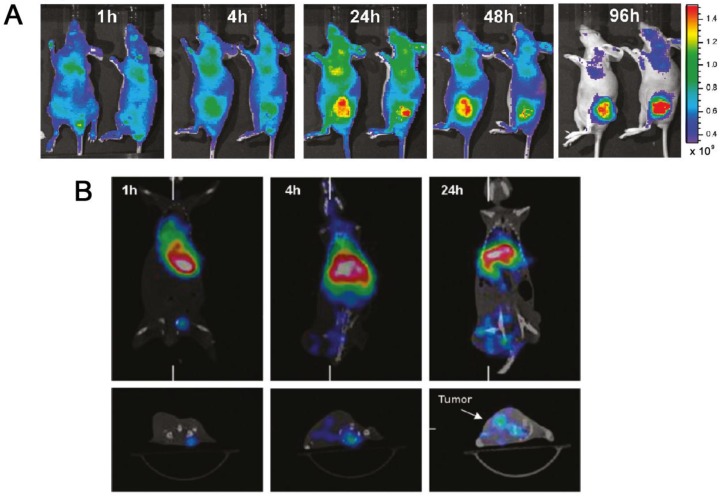
Multifunctional polymeric nanoparticles composed of PEG-PCL di-block co-polymer were loaded with IR-780, a NIR florescent dye, for both NIR imaging and photodynamic therapy (PDT). The NPs were also labeled with 188Re for microSPECT-guided tumor imaging. (A) Time-lapse near-IR fluorescence images of mice bearing HCT-116 tumors after intravenous injections of PEG-PCL polymeric NPs containing IR-780. (B) MicroSPECT/CT images were obtained by first injecting 188Re-labeled IR-780 particles and then imaging at 1, 4, and 24 hours later, respectively.
Figure 5
Figure 5
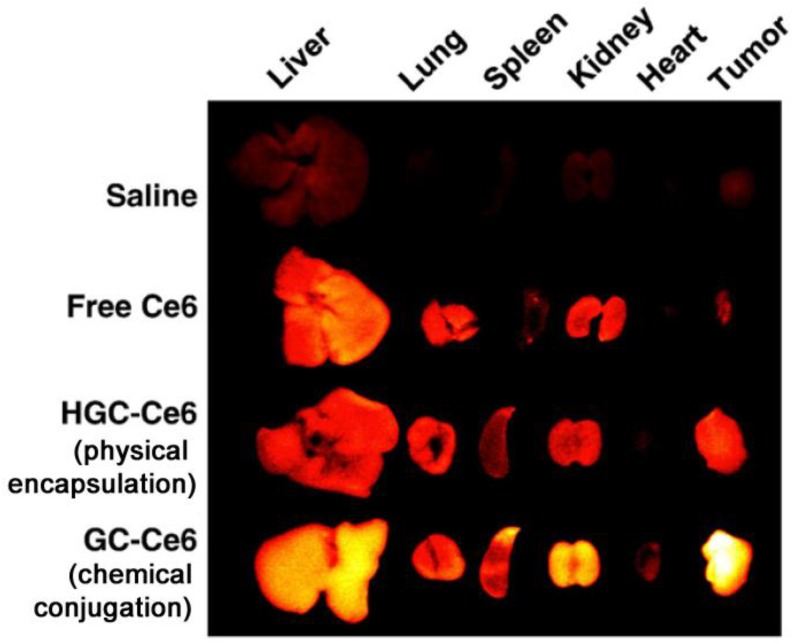
Athymic nude mice bearing HT-29 tumors after intravenous injection of saline, free Ce6, HGC-Ce6 (a formulation where Ce6 was physically encapsulated), or GC-Ce6 (a formulation where Ce6 was chemically conjugated). Ce6 dosage is 2.5 mg/kg. Here the figure shows ex vivo images of normal organs (liver, lung, spleen, kidney, and heart) and tumors excised at 2 days post-injection of saline, free Ce6, HGC-Ce6, or GC-Ce6.

References

    1. Morgan B. Opportunities and pitfalls of cancer imaging in clinical trials. Nat Rev Clin Oncol. 2011;8:517–27. - PubMed
    1. Sumer B, Gao JM. Theranostic nanomedicine for cancer. Nanomedicine. 2008;3:137–40. - PubMed
    1. Kievit FM, Zhang M. Cancer nanotheranostics: Improving imaging and therapy by targeted delivery across biological barriers. Adv Mater. 2011;23:H217–H47. - PMC - PubMed
    1. Sun D. Nanotheranostics: Integration of imaging and targeted drug delivery. Mol Pharm. 2010;7:1879. - PubMed
    1. Davis ME, Chen Z, Shin DM. Nanoparticle therapeutics: an emerging treatment modality for cancer. Nat Rev Drug Discov. 2008;7:771–82. - PubMed

Publication types