


Review
doi: 10.1111/bjh.12235.
Epub 2013 Feb 6.
Neonatal alloimmune thrombocytopenia: pathogenesis, diagnosis and management
Affiliations
- PMID: 23384054
- PMCID: PMC3895911
- DOI: 10.1111/bjh.12235
Item in Clipboard
Review
Neonatal alloimmune thrombocytopenia: pathogenesis, diagnosis and management
Br J Haematol.
2013 Apr.
Abstract
Neonatal alloimmune thrombocytopenia, (NAIT) is caused by maternal antibodies raised against alloantigens carried on fetal platelets. Although many cases are mild, NAIT is a significant cause of morbidity and mortality in newborns and is the most common cause of intracranial haemorrhage in full-term infants. In this report, we review the pathogenesis, clinical presentation, laboratory diagnosis and prenatal and post-natal management of NAIT and highlight areas of controversy that deserve the attention of clinical and laboratory investigators.
© 2013 Blackwell Publishing Ltd.
Figures
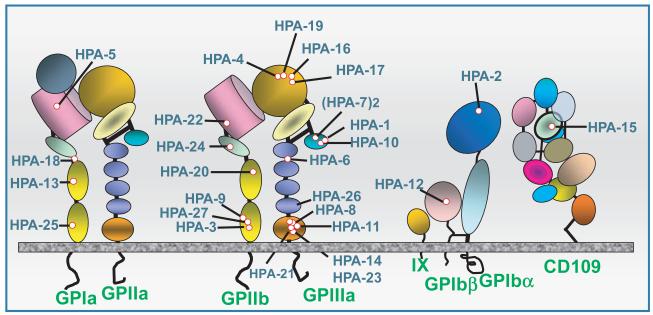
Antigens known to trigger maternal sensitization leading to neonatal alloimmune thrombocytopenia are carried on four different platelet membrane glycoproteins (GP) and glycoprotein complexes. Structural domains identified by crystallographic studies are shown schematically. Adapted from (Peterson et al, 2012a).
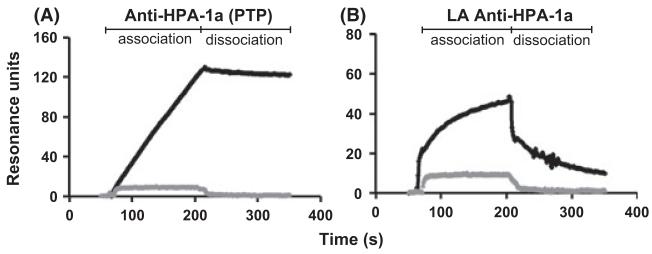
Detection of HPA-1a antibodies by surface plasmon resonance analysis (SPR). Equal quantities of GPIIb/IIIa purified from HPA-1a-positive and HPA-1a-negative platelets were fixed to CM5 Biacore chips using standard linkage chemistry and were perfused with IgG containing HPA-1a antibodies from a patient with post-transfusion purpura (PTP) (A) and from an HPA-1a-negative woman who delivered an infant with apparent neonatal alloimmune thrombocytopenia (NAIT) but had no HPA-1a antibody detectable by conventional serological methods (B). The progressive increase in SPR signal during the first 200 s of perfusion reflects binding of IgG to HPA-1a-positive GPIIb/IIIa (dark line). IgG from a healthy individual is depicted by the grey line. During subsequent perfusion with buffer, the HPA-1a antibody from the PTP case remained associated with its target but the low avidity (LA) antibody from the NAIT case dissociated almost completely. HPA-1a antibodies from NAIT cases that could be detected by standard serology produce intermediate tracings (not shown). Adapted from (Peterson et al, 2012c).
References
-
- Arinsburg SA, Shaz BH, Westhoff C, Cushing MM. Determination of human platelet antigen typing by molecular methods: importance in diagnosis and early treatment of neonatal alloimmune thrombocytopenia. American Journal of Hematology. 2012;87:525–528. - PubMed
-
- Arnold DM, Smith JW, Kelton JG. Diagnosis and management of neonatal alloimmune thrombocytopenia. Transfusion Medicine Reviews. 2008;22:255–267. - PubMed
-
- Aster RH, Newman PJ. HPA-1a/b (PlA1/A2, Zwa/b): the odyssey of an alloantigen system. Immunohematology. 2007;23:2–8. - PubMed
-
- Bakchoul T, Kubiak S, Krautwurst A, Roderfeld M, Siebert HC, Bein G, Sachs UJ, Santoso S. Low-avidity anti-HPA-1a alloantibodies are capable of antigen-positive platelet destruction in the NOD/SCID mouse model of alloimmune thrombocytopenia. Transfusion. 2011;51:2455–2461. - PubMed
Publication types
MeSH terms
Substances
Grants and funding
LinkOut - more resources
Full Text Sources
Other Literature Sources
